What this brand uses
The brand first. According to the homepage of ON LIVE Unlimited's own website, it is a content commerce platform connecting users, creators and brands, covering content publishing, brand tasks and product sales on one platform. The site describes three audiences: general users, who watch content and can take part in revenue sharing; creators, who make content and turn influence into income; and brands, who find creators to drive exposure and sales.
In other words, three kinds of people write in. That matters below.
This table is the only "case fact" in the article.
| Channel | Product | Since | Type of work handled |
|---|---|---|---|
| LINE Official Account (general door) | FRIDAI Chat | Mid-2026 | DM auto-reply, knowledge-base answers, human handoff |
| LINE Official Account 「ONLIVE 品牌 | FRIDAI Chat | Mid-2026 | DM auto-reply, knowledge-base answers, human handoff |
| Facebook Page Messenger | FRIDAI Chat | Mid-2026 | DM auto-reply, knowledge-base answers, human handoff |
| Instagram DMs | FRIDAI Chat | Mid-2026 | DM auto-reply, knowledge-base answers, human handoff |
The last column describes what FRIDAI Chat as a product is built to do. It does not say which features ON LIVE has switched on or what rules it has written; that is the brand's own business and we do not cover it.
For how other brands combine channels, see the FRIDAI customer stories roundup.
Why a business like this would set it up this way
This section is FRIDAI's own view, reasoned from the business type (a platform with several audiences). It is not a reason ON LIVE gave us.
Consumers and brand partners do not ask the same kind of question
The hard part for a platform business is that one inbox mixes two crowds. General users and creators mostly ask "how do I use this, how do I join, how do I get paid". Brands ask "how do we work together, what is the process, who do I talk to". The first group is high-volume, repetitive and wants speed. The second is low-volume, and every message may be a partnership, so it needs accuracy and a named owner.
Mix them and partnership enquiries tend to sink under usage questions. Putting brand partners in a separately named LINE Official Account (LINE OA is the business side of the LINE messaging app, which is the default chat channel in Taiwan) tells them they are at the right door the moment they add the account, and lets you design tone, the information to collect and the handover separately.
LINE, Facebook and Instagram must give the same answer
The same person may see content on Instagram, message the Facebook Page and finally add LINE. Three channels, three different answers, and trust drops. A wrong answer delivered instantly is just a more efficient way to cause trouble.
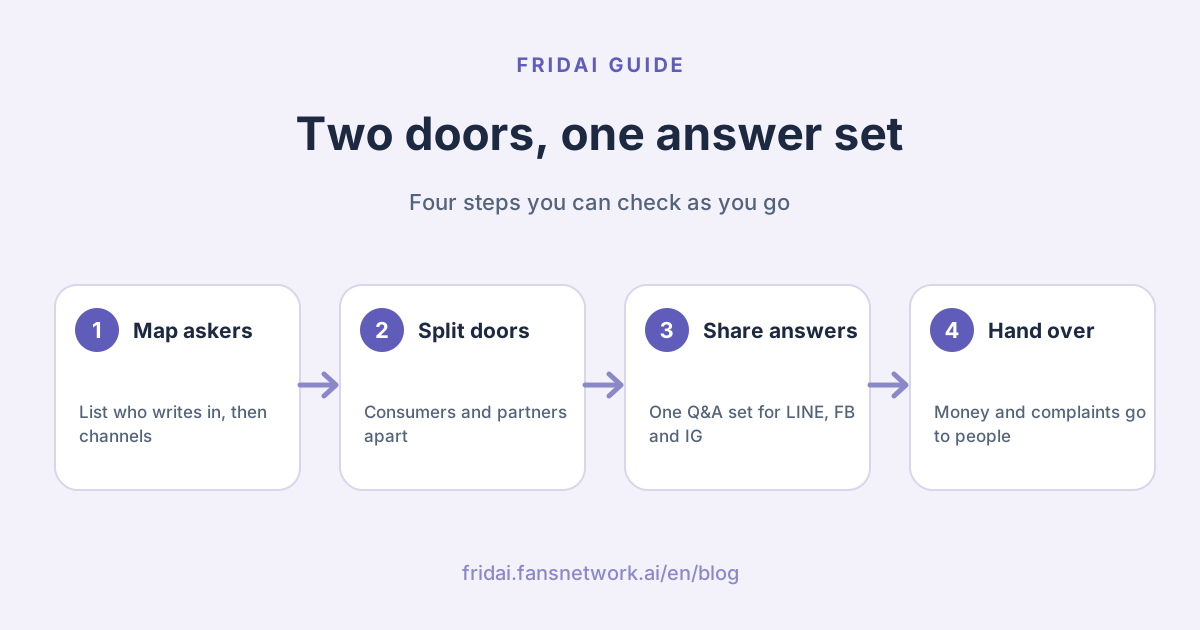
So the point of multichannel support is not "someone replies everywhere" but "every channel replies from the same content". In practice that means one body of knowledge and one set of rules, shared by all channels. The full four-stage approach is in What is omnichannel customer service.
Separate doors make handover clean
There is a practical bonus: when a person takes over, nobody has to guess who is on the other end. Conversations from the partner door go to whoever owns partnerships; conversations from the general door go to support or operations. One fewer judgement call means one fewer misrouted chat.
How a similar brand could set this up
The following is general advice for brands that serve both consumers and business partners. It is not ON LIVE's internal setup and does not represent any result.
| What to prepare | Why | Guide |
|---|---|---|
| A list of who writes in | The number of doors follows audiences, not channels | Omnichannel customer service guide |
| How many LINE Official Accounts to run | A second account has a running cost; open it only for a second audience | LINE Official Account complete guide |
| One Q&A set shared by all three channels | One copy to maintain, so channels do not contradict each other | How to write AI customer service rules |
| The reply window on Messenger and Instagram | Meta limits when a business may reply; follow-ups must fit the rules | Messenger 24-hour rule |
| Whether comments lead into DMs | With busy Page comments, split public replies and DMs first | Facebook comment and Messenger auto-reply |
| A named handover list | Each question type needs a person's name, not just "support" | How to write AI customer service rules |
Step 1: split by audience first, then by channel
Write down everyone who contacts you: buyers, partner companies, creators or resellers who want to join, the press. A separate door is worth it only when the questions differ a lot and a different person takes over. If only the channel differs and the questions are the same, share one answer set and do not split.
Step 2: the partner door does three things only
A partner door does not need to chat much. Let the AI outline how partnerships work, collect the essentials and say who will follow up. Quotes, schedules and contract terms stay with people.
Here is a requirement-collecting opener you can adapt to your own brand voice. The template is in Chinese because that is what your customers will read; it introduces the partnership desk and asks for company name, the kind of cooperation wanted, and timing plus contact details, then says a person will follow up.
您好,這裡是品牌合作窗口。為了讓負責的同事能直接回覆您,想先請教三件事:
1. 貴公司或品牌名稱
2. 想合作的形式或想解決的問題
3. 希望的時程與聯絡方式
收到後我們會轉給合作團隊,由專人與您聯繫。
Step 3: start the general door with high-frequency questions
For the general door, begin with the ten to twenty questions you hear most. For each, write the answer, the exceptions and who takes over when the AI cannot answer. The six-part rule format in How to write AI customer service rules works well; add rules one at a time.
Step 4: test all three channels with the same messages
Before launch, send the same five to ten test messages into LINE, Messenger and Instagram and check that the answers match and that the cases meant for a person are handed over. It costs nothing and is the step most often skipped.
What to leave to people
In our view, a platform business has four kinds of message the AI should not close on its own: disputes about money or revenue-share calculations, partnership terms and quotes, complaints and refunds, and anything about accounts or personal data. The AI can catch the message, collect details and explain what happens next, but a person decides. Every paid FRIDAI plan includes human handoff and human review, and can alert the team through FRIDAI's official LINE account when someone needs to step in.
This chart is a generally recommended division of work, not ON LIVE's actual flow. Take it and edit it: replace "money, complaint or personal data" with the three things you can least afford to get wrong.
What this article does not cover
There are no reply rates, hours saved, sales or revenue figures here, and no customer quotes. The reason is simple: those are the brand's own operating information, and message volume, question types and rule quality differ so much between brands that someone else's number would not hold for you. We would rather leave it out than hand you a good-looking figure you cannot verify.
Also not covered: ON LIVE's plan tier, fees, rule content or conversations.
So how do you judge whether this fits you? Test with your own messages. FRIDAI offers a trial for a US$1 verification fee (NT$30 with PAYUNi or JKO Pay, two Taiwan payment methods): 30 days with 100 AI replies. It converts to the plan you chose when the 30 days end or the trial allowance runs out, and it is limited to one trial per service per email address. We suggest doing one thing in those 30 days: pick one channel, load ten to twenty high-frequency questions, and record three numbers: how many the AI answered correctly, how many times it handed over, and how many times you edited a rule. Those three numbers are your case study.
Two more cases in this series cover different industries: the gogoout car rental platform case and the 4K Baking case.
FAQ
Which channels does ON LIVE Unlimited use FRIDAI on?
Since mid-2026 it has used FRIDAI Chat on two LINE Official Accounts, Facebook Page Messenger and Instagram DMs. One of the LINE accounts is the brand-partner centre named 「ONLIVE 品牌
Why are there no results figures in this article?
Results are the brand's own operating information and FRIDAI has not published them. Message volume and question types also differ by business, so another brand's numbers do not transfer. The most reliable check is a 30-day trial with your own messages.
Do I have to run two LINE Official Accounts like this?
No. It is worth splitting only when you really have two audiences with very different questions and different people taking over. Each extra account adds management and cost; a small brand is usually fine with one account and clear routing rules.
Do I need three sets of rules for LINE, Facebook and Instagram?
Keep one copy of the content and adjust tone and format per channel. What does need separate handling is platform rules: Meta's reply-time limits on Messenger and Instagram differ from how LINE bills messages, so check both before designing follow-ups.
Will the AI quote partnership prices on its own?
You can set it up so it does not. The safer approach is a rule that sends quotes, schedules and contract terms to a person, while the AI explains the process and collects needs. AI replies can be incomplete or wrong, so anything that commits you should be confirmed by a person.
How FRIDAI can help
If you also serve both consumers and business partners, start with one channel: turn your high-frequency questions into rules, route the things you cannot afford to get wrong to a person, then decide whether to extend to other channels. FRIDAI Chat handles DMs and FRIDAI Social handles comments; you can evaluate them separately.
- Product: FRIDAI Chat
- FRIDAI Social: FRIDAI Social
- Customer stories: FRIDAI customer stories from Taiwan brands
- Multichannel planning: Omnichannel customer service guide
- Instagram: FRIDAI on Instagram
- Threads: FRIDAI on Threads
- Facebook: FRIDAI on Facebook
Official sources
- ON LIVE Unlimited homepage: onliveunlimited.com
- FRIDAI website (customer logo wall): fridai.fansnetwork.ai/
- FRIDAI Chat: fridai.fansnetwork.ai/
fridai-chat - FRIDAI Social: fridai.fansnetwork.ai/
fridai-social - FRIDAI product and pricing summary: fridai.fansnetwork.ai/
llms.txt