What is omnichannel, and how is it different from multichannel customer service?
In marketing, omnichannel is about online and offline buying experiences joining up. In customer service, it is about one thing: when the customer switches channels, the conversation does not start over.
Multichannel customer service is something else. You have accounts on LINE, Instagram and Facebook, and customers can find you on all of them, but each account answers on its own. A customer who asked about sizes on Instagram moves to LINE to order, the person who picks it up has no idea what was said before, and has to ask them to repeat it.
| Aspect | Multichannel | Omnichannel |
|---|---|---|
| Number of channels | Two or more | Two or more |
| Where conversations live | A separate copy in each platform's back end | Collected in one place |
| Customer record | Each channel keeps its own | One per customer |
| Basis for answers | Whoever is on shift, whichever back end | One set of rules and knowledge |
| When the channel changes | The customer repeats everything | Whoever takes over can read what came before |
| How results are read | Platform by platform | With one set of metrics |
So omnichannel does not mean "more channels". You can run omnichannel with only two channels, and you can open eight accounts and still be multichannel.
What "one customer, one history" really requires
It sounds simple. In practice four things have to hold at once, and if one is missing you fall back to multichannel.
Identities have to match up
This is the hardest of the four. Platforms do not recognize people for you. Take LINE, the default messaging app in Taiwan: its developer documentation states that the user ID provided by the Messaging API is different from the LINE ID a customer sets for themselves, and that the same customer gets a different user ID under a different provider. Instagram and Facebook each have their own way of identifying people too.
In other words, no system automatically knows that "this person on Instagram" and "that person on LINE" are the same. To match them you usually need a shared clue the customer gives you, such as a mobile number, an order number or a member number, and you need to tell them why you are asking. That step involves personal data; see the notice and consent section of What is Social CRM.
Conversations have to come in
Messages from every channel need to land in one place, whether that is a shared inbox, a customer service system or a sheet everyone looks at. A channel you cannot bring in gets handled as an exception. Do not pretend it is integrated.
One copy of rules and knowledge
If LINE says "yes, you can return it" and Instagram says "no, you cannot", a customer only has to compare two screenshots. Prices, returns, opening hours and "when to hand over to a person" belong in one document that every channel and every person answers from.
Handover shows what came before
From AI to a person, from the morning shift to the evening shift, from Instagram to LINE: whoever takes over needs to see what was said and where it got stuck. A handover without context just spends the customer's patience a second time.
What each channel really allows
Omnichannel is often drawn as a diagram with every icon connected. In reality each channel has different rules, and the depth of integration you can reach differs too. What follows is only what we read on official pages.
LINE Official Account and the Messaging API
- According to LINE's developer documentation, the Messaging API works like this: when a customer sends a message, the LINE Platform sends a webhook event to your server, and the server replies through the LINE Platform.
- Messages are either reply messages or proactive pushes. The official pricing documentation states that reply messages do not count toward a plan's monthly message quota; push, multicast, broadcast and narrowcast messages do.
- The documentation also states that if a customer has not consented to sharing profile information, the webhook contains no user ID.
- The LINE Official Account manager has its own tools for organizing one-on-one chats. An official column describes tags, notes, and marking a conversation as pending or resolved. Another official article explains that the Chat Advanced plan raises the tag limit to 30 per chat room and 300 in total, and extends chat history retention to five years. Check the official page for its fee.
The point for a small shop: on LINE, replying to a customer does not use up quota, while reaching out to a customer does. Before steering customers from every other channel into LINE, think through whether the follow-up will run on pushes or on conversations. For cost details, see LINE Official Account pricing 2026.
Facebook Messenger
- Meta's Messenger Platform policy states that a customer sending a message, clicking a button that starts a conversation, arriving from a click-to-Messenger ad, or reacting to a message all open a 24-hour standard messaging window. Inside the window you can reply, and replies may include promotional content.
- To message outside the window, the routes the policy lists include message tags for approved use cases, the Human Agent tag that lets a business reply manually within 7 days, and paid sponsored messages.
- Where the law requires it, an automated chat must disclose that the customer is interacting with an automated service; where it does not, Meta still recommends telling them.
Instagram direct messages
- Instagram's official developer documentation states that your app can message a customer only after they have messaged your professional account, and that you have 24 hours to respond.
- The documentation mentions that a tag can allow a reply outside the 24-hour window, but that page does not state how many days. Go by Meta's policy page.
- Group messaging is not supported; one conversation is with one customer.
- The documentation states that new conversations from non-followers first appear in the Requests folder, and that messages in that folder with no activity for 30 days are not returned in API calls. Put plainly, message requests left unhandled for too long may be invisible to your integration tool.
Threads direct messages
The Threads API documentation home page we read lists posting, reply moderation, mentions, insights, webhooks and keyword search. We did not see a section on direct messages. So integrating Threads DMs is not the same kind of thing as the official messaging APIs for Messenger and Instagram.
If a vendor says it can connect Threads DMs, ask directly how it connects and how your account has to be authorized. FRIDAI, for example, states publicly that because Threads has no official DM API, Threads DMs are handled through a cloud browser signed in to the customer's account, and that it is billed differently from other channels.
Website chat, phone and email
These three channels are your own. No platform sets a reply window, but each has its own problem with recognizing people.
- Website chat: until a visitor leaves contact details, they are usually anonymous. Linking them to the same customer on LINE again depends on a clue they give you.
- Phone: a call does not turn into a text record by itself. The practical move for a small shop is adding one line to that customer's notes after hanging up.
- Email: the exchange keeps a full record, but the pace is slow. It suits formal documents and after-sales, not real-time questions.
We did not find a single rule that applies to all website chat or phone systems. Products differ a lot, so go by the documentation of the tool you use.
Channel limits at a glance
| Channel | Who speaks first | Reply limit | Watch for |
|---|---|---|---|
| LINE | A customer message triggers the reply | Replies are not counted; pushes are billed | User ID differs by provider |
| Messenger | A customer action opens the window | Standard window of 24 hours | Tags or sponsored messages outside it |
| The customer must message first | Reply within 24 hours | Old message requests may not be returned | |
| Threads | Depends on how the tool works | No official messaging API to follow | Ask the vendor how it connects |
| Website chat | The visitor | You decide | Visitors are mostly anonymous |
| Phone and email | Either side | You decide | Records must be added by hand |
Readiness check: which stage should you be at?
No questionnaire needed. See whether these signals show up in your shop.
| Signal you see | What it means | Next step |
|---|---|---|
| A customer says "I just asked on Instagram" | Conversations are not collected together | Stage 1: one inbox |
| The same question gets different answers | Rules and knowledge are not unified | Stage 2: write one copy |
| Unanswered messages turn up the next day | Nobody owns it, nobody is notified | Assign an owner per channel first |
| Handover takes a long dig to understand | No notes, no status | Stage 3: a handover format |
| You cannot say which channel brings most business | No shared metrics | Stage 4: measurement |
| Ninety percent of messages come from one channel | You do not need omnichannel yet | Do that one channel well first |
| An account is open but hardly anyone messages | Too many channels | Close it or leave only a pointer |
A four-stage path
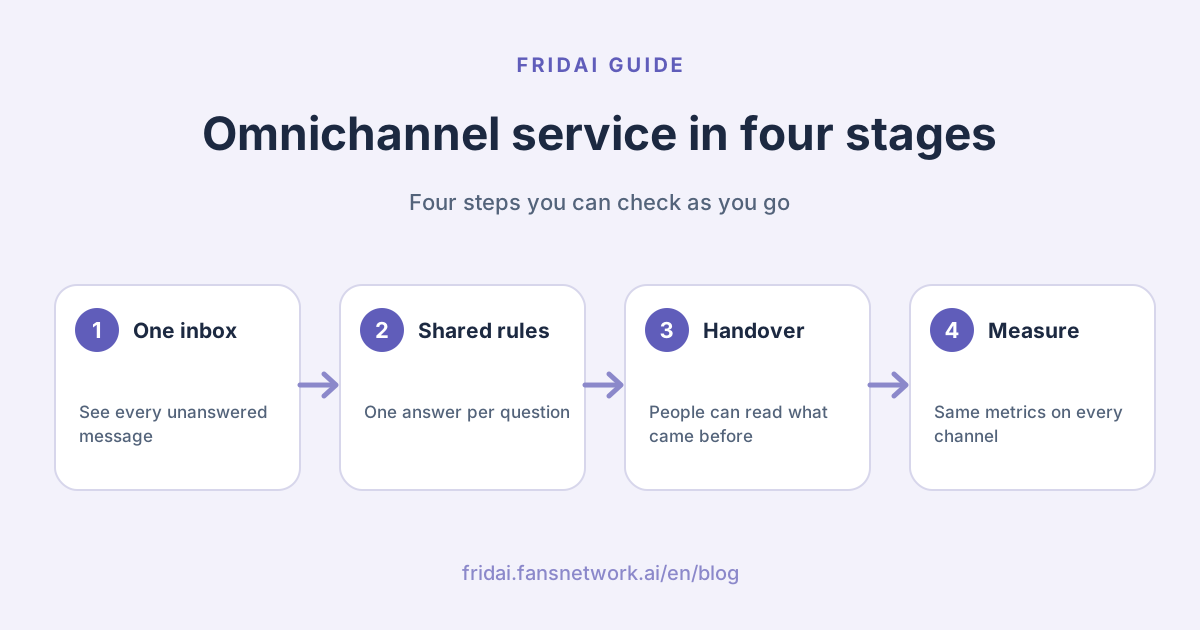
The order we suggest is inbox, rules, handover, measurement. Do not rush into the next stage before the previous one stands.
Stage 1: one inbox
There is a single goal: open one place each day and see the unanswered messages from every channel.
- List the channels where customers message you now, and roughly how many messages each gets per week.
- Decide on the inbox. For a low-volume shop, a shared sheet plus notifications from each platform's app is enough; evaluate a shared inbox or customer service tool once volume grows.
- Name an owner and a backup for every channel.
- For a channel you cannot bring in, write down "checked once a day at such a time".
Stage 2: shared rules and knowledge
- Collect the ten to twenty most-asked questions and keep one standard answer for each.
- Write prices, returns, shipping and opening hours into one document shared by all channels.
- Write down what staff "must not decide alone", such as discounts and refunds outside the rules.
- If you plan to use AI replies, this document is what it answers from. Document first, AI second; the other way round only gets you wrong answers faster.
Stage 3: human handover
- Define what must always go to a person: complaints, refund disputes, medical or legal judgment, and a customer who says they want a human.
- Confirm that notifications really reach someone, with an arrangement for off-hours too.
- Standardize how handover notes are written; a template follows.
- Mind each platform's time limits. Once the 24-hour window on Messenger and Instagram has passed, your options shrink, so handover cannot drag.
Stage 4: measurement
- Pick three to five metrics every channel can produce, such as first-reply time, unanswered messages, handover rate, and the number of sales or bookings that followed an enquiry.
- Review weekly, and look at four weeks at least before concluding anything.
- Use your own past as the baseline rather than someone else's "industry average".
- Let the results decide which channel gets more effort and which gets closed.
Two templates you can use as they are
When matching a customer across channels, the message asking for a clue can read like this. The point is to state the purpose and to let them decline. It asks for the mobile number or order number used when ordering, says it is only for checking the order and after-sales service, and says it is fine not to provide it.
為了幫您查詢之前的訂單與對話紀錄,方便提供訂購時留的手機號碼或訂單編號嗎?
這項資訊只用來核對您的訂單與售後服務。
如果不方便提供也沒關係,請直接告訴我想詢問的內容,我一樣為您處理。
Use a fixed format for handover notes, so the next person is up to speed within ten seconds.
Handover note
Customer: (name plus an identifying clue, such as the last four digits of the order)
From: LINE / IG / FB / Threads / website / phone
What they want solved:
What has been answered or promised:
Where it is stuck:
Next step, by whom and by when:
Reply deadline reminder: (for example, when the Instagram 24-hour window ends)What a small shop can skip for now
Articles on omnichannel tend to list every feature as a must-have. We think a shop of three to five people can leave these for later.
- An account on every platform. Where your customers are not, you do not need to be.
- Automatic identity merging. At low volume, a hand-written note saying "same person as so-and-so on LINE" is enough.
- Complex auto-assignment rules. With two or three people, "who owns which channel" solves it.
- A real-time dashboard. A table reviewed once a week beats a live screen nobody looks at.
- Integrations with e-commerce, POS and membership systems. Talk about those once the first three stages are stable.
Cost traps: where the budget usually breaks
- Pricing per channel or per account. Many tools charge again for every platform account you connect. FRIDAI works this way too: its product page states one plan per platform account, so handling DMs on both Instagram and LINE means two plans. Budget with "accounts times plan", not with a single plan's monthly fee.
- The platform's own message fees. Proactive pushes on LINE count toward the monthly quota. After steering customers from every channel into LINE, if follow-up runs on broadcasts, message fees grow with your friend count.
- Seat fees. Some tools charge per agent, and part-timers and shift workers each count as a seat.
- People time for rollout and upkeep. Somebody has to write the rules and knowledge and keep them current. This cost is not on the quote, and it is the one that most often stalls the project.
- Overlapping tools. Paying for an inbox, a chatbot and a broadcast tool whose features overlap is the waste we see most.
- Contract length. Annual plans are usually cheaper, but while your channel strategy is still settling, a round on monthly billing is safer.
For how each vendor charges, compare with AI customer service platforms compared for 2026.
You do not need omnichannel yet if…
This section is meant seriously. If any of these fits, keep your money and time for now.
- More than ninety percent of your messages come from one channel. Do that one well first, for example with just AI customer service on LINE.
- One person can answer a day's messages in half an hour. What you are missing is a fixed reply slot, not integration.
- Your common questions have no standard answers yet. Integrating channels now only gathers the mess onto one screen.
- Customers rarely cross channels. If "switch and repeat" happens only a few times a month, it is not worth buying a system for.
- Nobody has time to maintain the rules. Unmaintained omnichannel turns back into multichannel within three months, with an extra monthly fee.
To start by automating a single job, see What is social media automation.
FAQ
What is the difference between omnichannel and multichannel customer service?
Multichannel customer service means accounts on many platforms that each answer on their own. Omnichannel customer service brings conversations, customer records and answering rules together, so a customer who switches channels does not have to repeat everything. The difference is whether things are joined up, not how many channels there are.
Does a small shop need omnichannel customer service?
Not necessarily. If messages are concentrated in one channel and one person can answer them, doing that channel well is enough. The signals that you need it are customers asking across channels, the same question getting different answers, and handovers that keep dropping things.
How much does an omnichannel customer service system cost?
There is no single going rate. Common billing units are platform accounts, agent seats, and conversation or contact volume, plus platform fees such as LINE pushes. Take your own message volume and account count from the last three months and ask each vendor to run the numbers.
Why do customers still have to repeat themselves after we bought an omnichannel system?
Usually identities were never matched. Customer identifiers do not carry across platforms, so no system automatically knows the same person is on Instagram and on LINE. You need the customer to give a mobile or order number, and a proper note at handover.
Can LINE, Instagram and Facebook messages be answered with the same rules?
The answers can come from one shared set of rules and knowledge, but each platform's time limits differ. Messenger and Instagram have a 24-hour reply window, while on LINE proactive pushes count toward the quota. Check the flow platform by platform.
Can Threads DMs be brought into omnichannel customer service?
The official Threads API documentation currently lists posting, reply management, insights and similar features, and we did not see a section on direct messages. Some tools handle it another way; confirm the method, authorization and cost directly with the vendor.
What is the most common reason an omnichannel rollout fails?
Most often the order is wrong: buying a system before rules and knowledge are sorted out, or connecting every channel at once. We suggest the inbox first, then unified rules, then human handover, and measurement last.
How FRIDAI can help
FRIDAI Chat has DMs on LINE, Instagram, Facebook and Threads answered from the AI rules and knowledge notebook you write, and notifies a person to take over in the situations you define. It covers the "shared rules" and "human handover" stages of the four; if what you need is assignment for a large support team plus membership marketing, compare other tools as well.
- DM customer service: FRIDAI Chat
- Comment engagement: FRIDAI Social
- Customer records: What is Social CRM
- Tool comparison: AI customer service platforms compared for 2026
- Instagram: FRIDAI on Instagram
- Threads: FRIDAI on Threads
- Facebook: FRIDAI on Facebook
Official sources
- Meta: Messenger Platform Policy Overview: developers.facebook.com/
docs/ messenger-platform/ policy/ policy-overview/ - Meta: Instagram Messaging API: developers.facebook.com/
docs/ instagram-platform/ instagram-api-with-instagram-login/ messaging-api - Meta: Threads API documentation: developers.facebook.com/
docs/ threads/ - LINE Developers: Messaging API overview: developers.line.biz/
en/ docs/ messaging-api/ overview/ - LINE Developers: Messaging API pricing: developers.line.biz/
en/ docs/ messaging-api/ pricing/ - LINE Developers: Get user IDs: developers.line.biz/
en/ docs/ messaging-api/ getting-user-ids/ - LINE column (in Chinese): one-on-one chat features: tw.linebiz.com/
column/ 1to1/ - LINE column (in Chinese): Chat Advanced plan: tw.linebiz.com/
column/ 1on1-chat/