What is CRM, and what does Social CRM add?
CRM stands for Customer Relationship Management. It answers these questions: who is this customer, what have they bought, when did they last come, and what should you say to them next. Records in a traditional CRM mostly come from orders, member sign-ups, sales visits and phone calls.
The "Social" in Social CRM means the records come from somewhere else. A customer may never sign up as a member, but they added your LINE, messaged your Instagram, or commented under a post. SCRM connects those social interactions to the record of "who this customer is".
"LINE CRM", a term you hear a lot in Taiwan where LINE is the default messaging app, is SCRM played mainly on a LINE Official Account: segment friends by their interactions and tags, then decide who gets a broadcast. It is one kind of SCRM, not a separate thing.
As for membership management, that is the goal; CRM and SCRM are tools for it. You can look after members with no tool at all, it just stops fitting in your head once there are many.
Social CRM vs traditional CRM vs a chat inbox
These three terms get mixed up most easily, so we sort them by "what it mainly does for you".
- Chat inbox: collects messages from each channel, assigns them to people, and marks whether they have been answered. It manages "this message".
- Social CRM: builds conversations and interactions into a record and tags for "this customer", used to segment and to contact them again. It manages "this person".
- Traditional CRM: centered on transactions, contracts and sales processes, often tied to orders, invoices and sales reports. It manages "this deal".
Plenty of products now have two or three of these at once, and the names get borrowed back and forth. When you look at a product, ignore what it is called and look at whether its main screen is a message list, a customer list, or orders and opportunities.
CRM, SCRM and AI customer service tools compared
Add the AI customer service tools that have been so popular lately, and here is the comparison in one table. It compares categories, not specific brands.
| Aspect | Traditional CRM | Social CRM | AI customer service tool |
|---|---|---|---|
| Main purpose | Manage transactions and sales process | Run social lists and segments | Answer customers' questions well |
| Core records | Orders, contracts, contact details | Interactions, tags, conversations | Knowledge, rules, conversations |
| Main users | Sales and managers | Marketing and membership staff | Support staff and shop owners |
| Typical actions | Track opportunities, read sales figures | Tagging, segmented broadcasts, automated journeys | Auto-replies, human handover |
| Typical vendor category | Sales CRM, modules built into ERP | LINE marketing and social CRM platforms | DM AI customer service, chatbots |
| Weaker at | Real-time social conversations | Finishing a one-to-one answer | Large segmented broadcasts |
The three categories are not mutually exclusive. Many brands have an AI customer service tool do the "replying", an SCRM do the "pushing", and a traditional CRM do the "books". A small shop usually does not need to buy all three; start from whichever job hurts most.
What customer information can you keep from chats?
Before doing SCRM, be clear about what you may keep and how. This section only quotes articles of Taiwan's Personal Data Protection Act (個人
What counts as personal data
The definition in Article 2 is broad. Besides name, date of birth and national ID number, it includes contact information, financial conditions, social activities, and other data that can identify the person directly or indirectly. The mobile number and address a customer gives you in a DM, and conversation records that can be traced back to a specific person, should all be handled as personal data.
Three basic principles
- Purpose and scope: Article 5 provides that collecting, processing or using personal data must not exceed the necessary scope of the specific purpose and must be legitimately and reasonably connected to the purpose of collection. Asking for an address in order to ship is fine; also asking for birthday, occupation and income means you need to think about what the purpose is.
- A legal basis: Article 19 provides that a non-government entity collecting or processing personal data must have a specific purpose and meet one of the listed conditions, which include having a contractual or quasi-contractual relationship with the person with appropriate security measures in place, and having the person's consent.
- Notice: Article 8 lists what must be clearly told to the person at collection, including the collector's name, the purpose of collection, the categories of personal data, the period, region, recipients and manner of use, the rights the person may exercise, and how not providing the data affects them.
Article 7 adds that the collector bears the burden of proving that the person consented. In other words, whether the customer agreed is for you to prove. Saying it out loud is shaky; having it in the conversation record is safer.
Two extra points before you use it for marketing
Article 20 provides that personal data must be used within the necessary scope of the specific purpose of collection. The same article states two things that bear directly on broadcasts: when the person refuses marketing, you must immediately stop using their personal data for marketing; and at the first marketing contact, you must provide a way for the person to refuse.
Put plainly, a mobile number kept to handle an order is not a number you may send promotions to. To market, write marketing into the purpose when you give notice, and let the customer say no every time.
Delete it when you are done
Article 11 provides that when the specific purpose of collection no longer exists or the period expires, the data must be deleted, or its processing or use stopped, on your own initiative or at the person's request; the article also lists exceptions. People doing SCRM tend to think only about keeping and rarely schedule deleting. We suggest setting a retention period from the start.
Sensitive categories: ask a lawyer first
Articles 19 and 20 both exclude "data specified in Article 6, paragraph 1", which falls under separate, stricter rules. In the Article 2 definition you can see items such as medical records, medical treatment and health examinations. We did not quote the full text of Article 6 in our check, so we do not explain its requirements here. Clinics, aesthetic medicine, fitness, health supplements and other businesses where DMs touch on physical conditions should consult a lawyer before creating any customer record.
How a small shop can sort it
| Type of information | Example | Before keeping it |
|---|---|---|
| Public profile from the platform | Display name, profile picture | Use only to identify who you are talking to |
| Given by the customer for a transaction | Mobile, address, order contents | State the purpose; ask only what the deal needs |
| Tags you compile yourself | Source, product interest, stage | Record facts, not opinions |
| Consent to marketing contact | Willing to hear about new products | Give separate notice and keep the consent |
| Health and other sensitive content | Medical history, treatments, test results | Consult a lawyer before deciding |
The platform side has its own boundary. On LINE, for example, the developer documentation states that you can get the profile of a user who interacts with your LINE Official Account, namely display name, language, profile image and status message; another document states that when a user has not consented to sharing profile information, the webhook contains no user ID. What the platform does not give you, do not try to get by going around it.
Notice can go straight into the conversation. Below is a template to adapt; adjust it to your real purposes and have a lawyer look at it where needed. It thanks the customer, asks for recipient name, mobile and address for shipping and after-sales, names the shop as the user of the data, limits use to this order and its after-sales period, says the customer can ask to check, correct or delete it at any time, and asks them to reply "
謝謝您的訂購。為了出貨與售後服務,需要請您提供收件人姓名、手機與地址。
這些資訊由[店名]使用,只用在這筆訂單的出貨、通知與售後,保存到售後期間結束。
您可以隨時請我們查詢、更正或刪除。
另外,若您願意收到新品與優惠通知,請回覆「願意」;不回覆就不會收到,之後也可以隨時說不要。
A tagging and notes scheme for a three-person shop
You can start without buying an SCRM. The LINE Official Account manager already has tools for organizing one-on-one chats: an official column describes tags, notes, and setting a conversation to pending or resolved. Another official article explains that the Chat Advanced plan raises the tag limit to 30 per chat room and 300 in total, and the number of notes to 1,000. Whether the Instagram and Facebook back ends have matching features, go by the screen you see; if not, a shared spreadsheet works with the same rules.
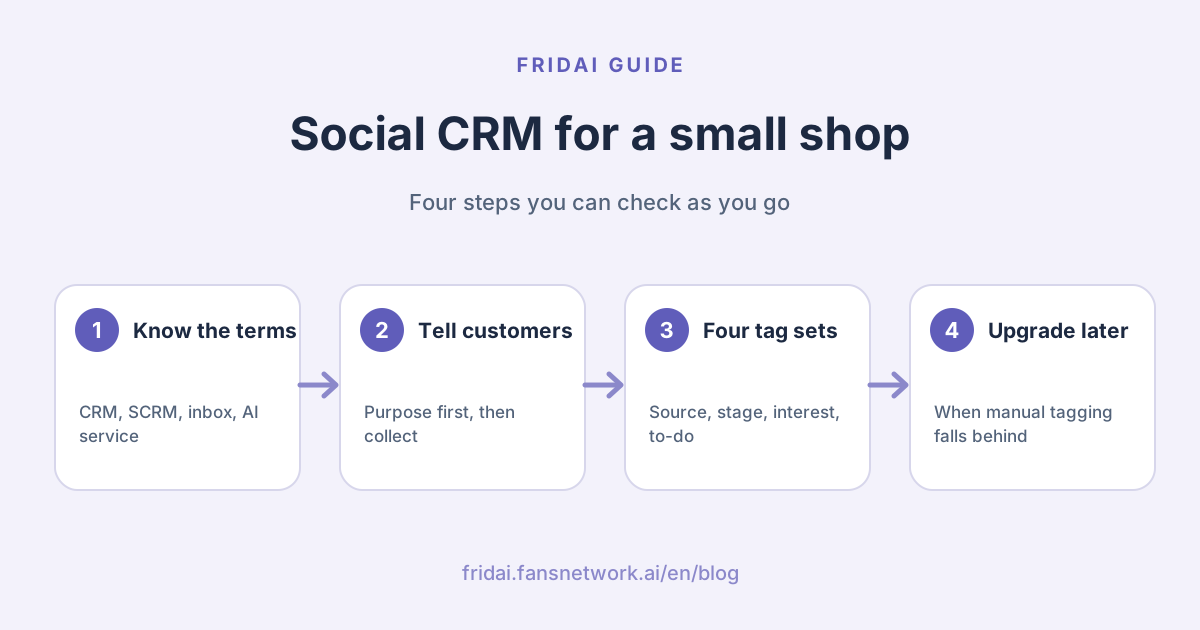
The tool is not the point, the rules are. The minimum version we suggest has just four tag groups.
Use only four groups of tags
- Source: where this customer came from, such as the store, Instagram or a referral.
- Stage: enquiring, purchased, repeat buyer, dormant.
- Interest: the broad product categories they asked about or bought, five to eight at most.
- To-do: needs a call back, waiting for a quote, waiting for a restock notice.
Keep the total under twenty. Put the group name in front of each tag so they sort together. The list below reads: Source (store, IG, referral), Stage (enquiring, purchased, repeat, dormant), Interest (your product categories), To-do (awaiting quote, restock notice).
標籤命名表

來源|門市
來源|IG
來源|介紹
階段|詢問中
階段|已購買
階段|回購
階段|沉睡
興趣|(你的品項大類一)
興趣|(你的品項大類二)
待辦|等報價
待辦|到貨通知
Notes hold facts only
Notes are for what tags cannot hold. With a fixed format, three people's notes come out looking the same.
Customer note
Name to use:
Last talked about: (date plus one sentence)
Bought: (item plus date)
Preferences and no-gos: (only what the customer said themselves, e.g. no phone calls)
Next step: (who, when, what)
Marketing notices: willing / not willing / not askedAgree on what not to write as well: subjective opinions of the customer, physical conditions, and private matters unrelated to the transaction. A customer may one day ask to see their notes, so write them as if they will.
When to tag, and who does it
- Whoever ends the conversation does the tagging. Do not leave it to a month-end catch-up.
- Spend fifteen minutes a week clearing "to-do" tags; remove each one when the job is done.
- Look over the tag list once a month and delete tags nobody uses.
- Once a quarter, check "dormant" customers and expired records, and delete what should go.
Tags are there to be used
A tag you never use is the same as no tag. There are three minimum uses: glance at tags and notes before replying; when stock arrives or a campaign starts, notify only people with the matching "interest" who also agreed to notices; and once a month count how many purchases each "source" brought, so you know where to put your effort.
Broadcasts on LINE count toward the monthly quota, so sending only to the right people also saves money. For how the fees work, see LINE Official Account pricing 2026.
The most common Social CRM pitfalls
- Too many tags. Past twenty, nobody remembers the differences and tagging becomes guesswork.
- Tagging without cleaning. A to-do tag hangs around for three months and everyone on the list is "waiting for a quote".
- Writing opinions into notes. "Difficult customer" does nothing for service, and causes trouble if it is seen.
- Asking too much for the sake of segmentation. The customer only wanted to know if it is in stock and you asked for birthday and occupation. The more you ask, the faster they leave, and the more you are responsible for.
- Broadcasting to contact details collected for transactions. This is the Article 20 point above, not a question of technique.
- Assuming that buying a system gives you records. A system only provides fields; someone still has to fill them in by the rules.
When should you graduate to a real SCRM?
The scheme above only stretches so far. When the signals below appear, it is worth seriously evaluating platforms in the "social CRM" or "LINE marketing automation" category.
| Signal you see | What it means | Next step |
|---|---|---|
| Friend count outgrows manual tagging | You need behavior-based auto-tagging | Evaluate an SCRM platform |
| Segmented broadcasts every month | You need segment conditions and reports | Evaluate an SCRM platform |
| You want an automated journey after someone adds you | You need marketing automation | Evaluate an SCRM platform |
| You need to match e-commerce or store members | You need system integrations | Find a vendor with that integration |
| The main problem is unanswered messages | You are short of people to reply | Look at AI customer service tools first |
| Small list, one or two broadcasts a month | Not needed yet | Stay with tags and notes |
In Taiwan, the names most often compared in this category are Crescendo Lab (漸強實驗室), Super 8 and Omnichat. Their investment in tags, segmented broadcasts, automated journeys and membership modules goes well beyond FRIDAI's. FRIDAI plans include contact tags and customer records, but the product's focus is AI replies to DMs and comments plus social posting, and it does not position itself as a LINE marketing CRM.
If your revenue mainly comes from segmented broadcasts driving repeat purchases, evaluate these vendors first. We have written up each one's positioning, features and pricing model from their official pages in three separate articles:
If you are also wondering whether to join all your channels together, continue with What is omnichannel customer service; to start automating from replies and posting, see What is social media automation. For AI customer service on LINE only, there is LINE AI customer service tools, and the cross-category tool comparison is in AI customer service platforms compared for 2026.
FAQ
What is the difference between Social CRM and a traditional CRM?
A traditional CRM is centered on orders, contracts and sales processes. Social CRM draws its records from conversations and interactions on LINE, Instagram and Facebook, and focuses on segmenting with tags and contacting people again. The two can be used together; neither replaces the other.
Does a small shop need to buy an SCRM system?
Not while the list is small and broadcasts are infrequent. Start with the tags and notes built into LINE Official Account, or a shared sheet, and run them by fixed rules for three months. Evaluate a system once manual tagging falls behind and you segment broadcasts every month.
How much does LINE CRM cost?
Billing units differ by vendor. Common ones are friend count, message volume, feature modules and seats, and on top of that come the LINE Official Account's own monthly fee and message fees. Ask vendors to run the numbers with your own friend count and monthly broadcast volume, not sample prices.
Can I use customers' chat records to send marketing messages?
We do not recommend it. Article 20 of the Personal Data Protection Act requires use to stay within the necessary scope of the specific purpose of collection, an immediate stop when the customer refuses marketing, and a way to refuse at the first marketing contact. To market, say so in your notice and obtain consent.
A customer asks me to delete their record. Do I have to?
Article 11 of the Personal Data Protection Act provides that when the specific purpose of collection no longer exists or the period expires, data must be deleted or its processing or use stopped, proactively or on request, with exceptions listed in the article. Confirm the person's identity first, then handle it by the rules; consult a lawyer if in doubt.
Why has revenue not changed after adding lots of tags?
The usual reason is that tags are not used in any decision: broadcasts still go to everyone, and nobody reads the notes before replying. Cut the tags to under twenty first, then fix three moments when they must be used.
Is FRIDAI a Social CRM?
No. FRIDAI has contact tags and customer records, but its focus is AI replies to DMs and comments and social posting. Brands that need segmented broadcasts, automated journeys and membership modules should evaluate an SCRM platform; the two can also be used side by side.
How FRIDAI can help
The quality of SCRM records depends on whether each conversation was properly handled. FRIDAI Chat has DMs on LINE, Instagram, Facebook and Threads answered from the AI rules and knowledge notebook you write, and notifies a person to take over when needed. It fills in the "replying" part; for list management and segmented broadcasts, evaluate it alongside the SCRM platforms mentioned above.
- DM customer service: FRIDAI Chat
- Comment engagement: FRIDAI Social
- Channel integration: What is omnichannel customer service
- Tool comparison: AI customer service platforms compared for 2026
- Instagram: FRIDAI on Instagram
- Threads: FRIDAI on Threads
- Facebook: FRIDAI on Facebook
Official sources
- Laws and Regulations Database of the Republic of China (Taiwan): Personal Data Protection Act (in Chinese): law.moj.gov.tw/
LawClass/ LawAll.aspx?pcode=I0050021 - LINE Developers: Messaging API overview: developers.line.biz/
en/ docs/ messaging-api/ overview/ - LINE Developers: Get user IDs: developers.line.biz/
en/ docs/ messaging-api/ getting-user-ids/ - LINE Developers: Messaging API pricing: developers.line.biz/
en/ docs/ messaging-api/ pricing/ - LINE column (in Chinese): one-on-one chat features: tw.linebiz.com/
column/ 1to1/ - LINE column (in Chinese): Chat Advanced plan: tw.linebiz.com/
column/ 1on1-chat/