
When AI customer service answers unpredictably, the cause is usually the same: the rules tell it what the shop has, but not what to do in each situation.
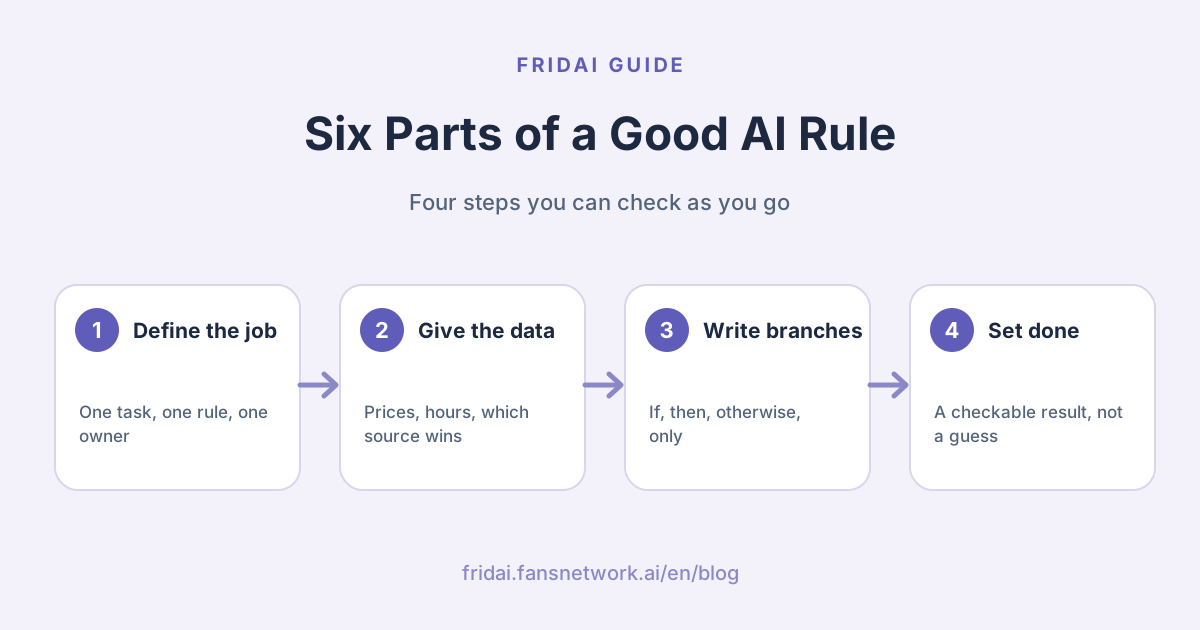
How do you write AI customer service rules? Cover six things first
Most people setting up AI customer service for the first time paste in a price list, opening hours and a few sample replies, then expect the AI to understand the whole business on its own. The data can all be true and the replies still wobble, because knowing "what the shop has" and knowing "when this happens, do this first, and never promise that" are two different things.
A good rule is not a pile of nice-sounding phrases. It is your own decision process written down. Think of it as onboarding a new colleague: first tell them who the brand is, then explain which data to check for which kind of question and in what order, and finally say clearly when to hand things to a human.
This article gives you a six-part framework first, then breaks it down with three real conversations from FRIDAI customers. When you finish, you should be able to take one common question from your own business and write your first complete rule. If you want to put those rules into a cross-platform support workflow, you can also look at how FRIDAI Chat works.
What six parts does a complete AI rule need?
You do not need to learn prompt engineering or write code. Pick one job and, in the tone you would use with a colleague, fill in the six parts below.
| What to write | The question it answers |
|---|---|
| 1. Role and task | Who does the AI represent? Which kind of enquiry is it mainly responsible for? |
| 2. Brand data it may use | For prices, service scope, opening hours and how to order, which document is the source of truth? |
| 3. Trigger situation | What does the customer say, or what situation comes up, before this rule kicks in? |
| 4. Order of handling | What to check first? What to ask when data is missing? What to do once the data is complete? |
| 5. Boundaries and fallback | What must it never promise on its own? When an exception comes up, what should it do instead? |
| 6. Completion standard | Which concrete result must it see before telling the customer the job is done? |
A sentence or two per part is enough; the point is that all six are there. Perfect prices with no completion standard, and the AI may turn "the customer wants to buy" into "order placed". Write only "don't make things up" with no fallback, and the AI still has no idea what to do next when an exception shows up.
The most useful sentence pattern: if, then, otherwise, only
A rule should read like a job description, not a wish list. Instead of "reply professionally and hand over to a human when appropriate", write down the "when" and the "how".
| Wording that makes the AI guess | Clearer wording |
|---|---|
| Ask the customer for details when appropriate. | If the next step still needs a phone number, explain why and ask for it; never re-ask for data already given. |
| Please help with rush orders. | If pickup is fewer than four days away, give the phone number of the assigned store and ask the customer to call during opening hours to confirm. |
| Hand over to a human when unsure. | If live availability cannot be checked, summarise the customer's date and needs, pass it to a human for confirmation, and say it is still pending. |
| Do not say the booking succeeded. | Only after a valid booking confirmation is received may you say the booking is complete; before that, explain the current status and the next step. |
Use this skeleton to write your first rule
When the customer ____, first confirm ____.
If the conversation already contains ____, reuse it and do not ask again; if ____ is still missing, ask only for the missing part.
If ____ applies, then ____; otherwise ____.
You may not ____ on your own. When ____ comes up, hand it to ____ instead.
Only after ____ is confirmed may you tell the customer this is complete.
"If" states the condition, "then" gives the action, "otherwise" adds the other path, and "only" guards the line that must not be crossed. Use the skeleton as a checklist and you will catch any missing decision.
Case 1 | The date came out right because the rule was specific enough
A bakery using FRIDAI received this question on LINE. The customer had already given a pickup date and just wanted to know the latest day to order.
Customer: If I want it on [pickup date], what's the latest date I need to order by?
AI support: If you'd like to pick up on [pickup date], you need to order through the official website on or before [latest order date] (4 days before pickup). Since the pickup date is 4 days or more from today, ordering on the website is the better deal and also earns member points.
Happy to help with any other questions~ (AI support)
*Excerpt from the bakery's LINE conversation. The pickup date and order date are hidden; the original four-day gap is preserved.*
What does the rule behind this reply need to spell out?
At least four things: how to get the exact pickup date, how many days of lead time, which ordering channel applies to which lead time, and what counts as a completed order. Drop any one of them and the AI may miscalculate the date, point to the wrong channel, or mistake a question for an order.
Latest order date = pickup date − the shop's required lead time
For example, if pickup is 20 October, the shop requires four calendar days' notice, and there is no other cut-off time or closing day in the way, the latest order date is 16 October. Relative dates like "next Saturday" must be converted to an exact date before you calculate.
| What usually gets left out | What the rule should add |
|---|---|
| "Cakes need four days' notice" | Whether four days means calendar or working days, and whether today counts as day zero. |
| "Send the customer to the website" | Which lead times go to the website; which channel to use when it is too late. |
| "Help the customer confirm the order" | What the AI can actually look up; without an order confirmation it may not say the order is done. |
Full rule example
When a customer asks about a new order, first confirm the exact pickup date. If the conversation already contains the date, reuse it; ask only when the date is unclear.
If the pickup date is four or more calendar days from today, calculate the latest order date and provide the official website; if it is fewer than four days, provide the assigned store's phone number and ask the customer to confirm during opening hours.
You may not create an order on the customer's behalf. Only after a valid order confirmation is found may you tell the customer the order is complete.
What this case teaches: the rule cannot hold only the answer "four days". It has to carry the calculation, the branches, the fallback channel and the completion standard together.
Case 2 | To stop repeat questions, the rule must say "check first"
A short-video consulting firm received a partnership enquiry from the owner of a beauty studio. A human handled the early questions about the business; after the customer added their service area and services, the AI took over collecting contact details.
Customer: [service area] I run a studio doing [beauty services]
AI support: Got it, you run a [beauty services] studio in [service area]. Could you leave your LINE ID and phone number so we can arrange for a specialist to discuss further with you?
Customer: [LINE ID hidden]
AI support: Thanks for the information. Could you leave your LINE ID or phone number again so we can arrange for a specialist to discuss further with you?
Customer: [phone number hidden]
*The acknowledgement and thank-you in between are omitted; the human colleague picks up below.*
Human colleague: I'll let you know once project manager [name hidden] has been added. Here's their LINE ID in the meantime: [phone number hidden]. The project manager will start with a call of about half an hour, so please keep an eye out for a new friend request and message.
Customer: 👌
*Excerpt from the short-video consulting firm's Instagram conversation. The actual repeat question is kept, along with the human handoff message that followed.*
The problem in this case sits at step two: the AI never marked the LINE ID the customer had provided as known, so it asked again.
Which rule went wrong?
After the customer gave their LINE ID, the AI asked again for "LINE ID or phone number". This is usually not a data problem. The rule said "collect LINE ID and phone number" but never said to check what was already known, and never said whether both are required or one is enough.
| What to decide | How it affects this case |
|---|---|
| Which data does the next step need? | If the next step is adding a LINE friend, the LINE ID is enough; a phone number is only needed for a phone consultation. |
| Which fields are required, and which are either/ | "LINE ID or phone" and "LINE ID plus phone" are two different flows. |
| What happens after the customer gives part of it? | Keep the known fields and ask only for the required data still missing. |
Full rule example
When a customer wants to discuss a partnership, first confirm what services they offer and what they want to discuss this time.
Arranging a LINE consultation requires the services and a LINE ID; arranging a phone consultation requires the services and a phone number. Before every question, check the data already provided in the conversation, reuse what is there, and ask only for the fields the current flow still lacks.
Once the required data is complete, summarise the needs and contact details and hand them to the responsible colleague. Until the human replies, you may only say the data has been received and is awaiting follow-up.
In the real conversation a human colleague picked up afterwards, so the handoff moved forward. Write the completion standard on the same principle: "handed over" is progress, and only a confirmed call or partnership counts as done.
What this case teaches: do not just list the fields to collect. The rule also needs the purpose, whether each field is required or either/
Case 3 | Tell the AI which stage it is in, so it does not promise too early
On-site services often have to follow the customer's timeline. This cleaning company's customer asked about pricing and then mentioned that construction had only just started. From that point, judging when a service can be scheduled became the main job.
Customer: We've only just started construction
*The AI reply below is from later in the same thread; there was an earlier discussion of area, floor space and pricing.*
AI support: Since construction has only just started, we recommend doing the detailed clean after the last crew leaves and before furniture arrives, so the result holds up better.
*This excerpt is the full paragraph relating to the construction stage.*
*Photos and a question about booking times came in between; the same thread continues below.*
Customer: Because we don't know the end date of the works yet
Customer: I'll book with you when the built-in cabinets are almost done
AI support: Understood. You're welcome to contact us to book when the built-in cabinets are almost finished. That way the cleaning happens at the best time and the result isn't affected by post-construction dust.
If you have any questions or need further help, just let me know! Looking forward to hearing from you!
*Excerpt from the cleaning company's Facebook conversation. This focuses on construction progress and booking timing; the pricing, photo and availability discussion is not shown in full.*
Define the "stages" in the rule first
When the customer says "we don't know the end date yet", the service date cannot be fixed. They later said they would get in touch when the cabinets were nearly done, so the sensible outcome of this conversation is a clear next step, not a completed booking.
| The customer's current situation | What to handle this time |
|---|---|
| Still under construction, end date unknown | Understand the progress and explain when this service works best. |
| Nearly done, with a rough timeframe | Confirm site conditions, service scope and preferred date. |
| Ready to schedule, with clear needs | Have the person or system that can confirm availability check the time and price. |
Full rule example
When a customer asks about post-renovation cleaning, first confirm the current construction stage and the expected completion time.
If the completion date is not yet set, explain which construction stage is right for scheduling the clean and ask the customer to get in touch when they are close to it; do not collect full booking data at this point, and do not say anything has been scheduled.
If completion is near, collect the remaining data needed for a quote and scheduling. Only after the responsible colleague or the scheduling system confirms availability and price may you say the booking is arranged.
The same approach works for renovation, photography or event services. Define the stages that affect scheduling first, then write one action and one hard boundary for each stage.
What this case teaches: the rule must recognise which stage the customer is in, and keep "waiting for the customer", "waiting for the business to confirm" and "scheduling complete" separate.
Now do it: write your first rule with the six-part template
Start with a small, everyday question, such as "can you make a pickup on this date". Do not try to cram the whole company's knowledge into one rule.
The six-part fill-in template
- Role and task: You are the customer service for ____, and this rule handles only ____.
- Brand data: Our ____ is ____; the source of truth is ____.
- Trigger situation: Use this rule when the customer ____.
- Order of handling: First confirm ____; if ____ is already known, reuse it; ask only when ____ is missing.
- Boundaries and fallback: You may not ____ on your own; when ____ comes up, hand it to ____.
- Completion standard: Only after seeing ____ may you tell the customer it is complete.
When you are done, merge any repeated or contradictory sentences in the same rule. Keep the terms consistent too: if you pick "customer", use "customer" all the way through rather than rotating between client, consumer and buyer in the same rule.
Check your rule with three questions
Check 1: Any vague words?
Circle words with no standard behind them: "when appropriate", "try to", "depending on the situation", "quickly", "don't make things up". Can each one be replaced with a clear condition and action?
Answer and how to judge: for example, turn "hand over to a human when appropriate" into "when the customer asks for a refund, or the knowledge base has no matching answer, summarise the current request and hand it to a human".
Check 2: Any prohibitions with no alternative?
Find every sentence with "may not", "do not", "never". When the AI cannot do that thing, what should it do next?
Answer and how to judge: for example, "you may not quote a price on your own; if the existing data cannot produce a figure, collect the floor space and site conditions and pass them to the estimating colleague to confirm".
Check 3: Is the completion standard visible?
Does the customer saying "OK" count as done? Or do you need to see an order, a payment, a booking or a human confirmation? Write down the verifiable result.
Answer and how to judge: for example, "only when a valid order number appears in the order system may you say the order is complete". The customer agreeing to a plan only shows intent.
Test five scenarios first, then go fully live
A rule is ready once every branch has actually been walked through. Take the same type of question and test it five times, changing only one condition each time.
| Test scenario | What you should see | Change the rule if you see this |
|---|---|---|
| Data complete | Proceeds directly, no further questions. | Still asks for data already provided. |
| One condition missing | Asks only for the missing item. | Re-asks for every field at once. |
| Data already mentioned | Reuses the earlier message and keeps the same context. | Ignores earlier messages or contradicts itself. |
| Condition not met | Goes to a clear fallback. | Only says it cannot help, with no next step. |
| Needs a human | Stops promising, summarises the data and actually hands over. | Says it is done before anything is confirmed. |
When testing, do not just check whether the tone reads well; check whether the decision went the right way. Wrong date, go back and add the calculation. Repeat question, add "check known data first". Declared done too early, add a verifiable completion standard.
Keep the first version short: explain one job completely, then use real conversations to find the gaps. When a rule goes from "please handle this smartly" to clear conditions, actions and boundaries, the AI finally starts learning how you do things.
Summary: explain one job completely first

A quick note from FRIDAI
Here's the heart of it: a good AI customer service rule is your decision process written as conditions, actions and boundaries. Pick one question you get every day, write it out with the six-part template, then use real conversations to fill the gaps.
As you write, keep this list close:
- Give every rule all six parts: role and task, brand data, trigger, order of handling, boundaries and fallback, completion standard.
- Turn vague requests into executable conditions with "if, then, otherwise, only".
- Before every follow-up question, check the whole conversation and ask only for what is still missing.
- Define the customer's current stage, and say done only after a verifiable result.
- Before going live, test five scenarios, changing one condition at a time.
Once the rule is written, the next step is having it answer customers consistently every day. Send me your first rule and we'll test those five scenarios together.
FAQ
How do I write AI customer service rules so the AI doesn't answer randomly?
Limit the rule to one job, then write out in order the role and task, the brand data it may use, the trigger situation, the order of handling, the boundaries and fallback, and the completion standard. Phrase conditions as "if, then, otherwise, only" wherever you can.
Do AI customer service rules need to be long?
No. Complete beats long. Fully write out the required data, decision branches, off-limits actions and completion standard for one common question first, then fill the gaps from real conversations.
How do I stop the AI from re-asking for details the customer already gave?
State in the rule that before every question it must check the whole conversation, mark the known fields and reuse them, and ask only for the required data the current flow still lacks.
When should a customer service conversation be handed to a human?
When the question goes beyond the data it can look up or its permission to act, when an exception condition comes up, or when a human must confirm availability, price, refunds or commitments. Summarise what is known, hand it over, and say it is still pending.
How do I test AI customer service rules once they're written?
Test at least five scenarios: data complete, one condition missing, data already mentioned, condition not met, and needs a human. Confirm the AI takes the right branch, asks only for the gaps, and never says something is done without evidence.
How FRIDAI can help
FRIDAI Chat follows the brand data, order of handling and human boundaries you set to help reply to messages across platforms. Write one of your most common support jobs down clearly first, then let FRIDAI run it consistently.
- Product: FRIDAI Chat
- Book a demo: Contact FRIDAI
- Instagram: FRIDAI on Instagram
- Threads: FRIDAI on Threads
- Facebook: FRIDAI on Facebook
Official sources
The cases in this article come from real conversations of FRIDAI customers between 2–8 September 2026. Each case comes from a single thread, keeping the original wording and order; identifying details have been hidden.