
Other shops are switching on AI customer service, and you may be wondering whether yours needs it now. Below: five situations where it makes sense to start, three things to set up first, a three-minute self-check, and how to begin with one process in month one.
Five situations where it makes sense to start
1. You answer the same questions every day
Opening hours, prices, service scope, how to book and delivery questions eat up your time, and every one of them has a clear source of truth. These are the questions where AI delivers stable results fastest.
2. Messages keep arriving on LINE or IG after closing time
AI can answer with approved information, collect what the customer needs and tell them when a human will follow up. The goal is to keep the conversation going, and the AI promises only what it has the authority to complete.
3. Customers go back and forth because details are missing
Say a booking needs a date, party size, service and contact details. Once the rules are written down, AI can read the earlier messages, ask only for the missing fields, then hand over to a human to confirm.
4. You run LINE, IG and Facebook at the same time
When conversations are scattered across platforms, one shared inbox, progress tags and handover context are worth more than automatic replies on their own.
5. At least one person in the shop can maintain the data
You do not need a full-time engineer, but someone has to update prices, promotions and exceptions, and review wrong answers every week. Without an owner, even the most complete knowledge base goes stale.
Three things to set up before launch
| Situation | Do this first |
|---|---|
| Prices and policies have no single agreed version | Build one approved, dated brand data file |
| Every agent gives a different answer | Write down the shared principles, the exceptions and who gets to decide |
| Bookings or refunds have no system-recorded outcome | Define the difference between received, pending confirmation and completed |
A reminder from FRIDAI Editorial: AI amplifies whatever process you already have. Consistent rules mean the right answer reaches customers faster; contradictory rules mean the contradiction does too. So align your rules first, then go live.
The three-minute self-check
Month one: start with one process
Week one, pick one high-frequency question and prepare the data and a six-part rule. Week two, test it against past conversations. Week three, open just one channel or a slice of traffic. Week four, review the wrong answers, repeat questions, human handovers and unfinished conversations.
| Week | Work | Done when |
|---|---|---|
| Week 1 | Pick the topic, organise knowledge and rules | One approved data set with no contradictions |
| Week 2 | Test normal, missing-data, exception and human-handoff scenarios | Every test case has an expected and an actual result |
| Week 3 | Go live on a small slice of traffic | A human can take over any time and AI's scope is clearly defined |
| Week 4 | Review and fix | You know whether errors came from data, rules, integrations or permissions |
Which numbers should you track?
Start with AI's correct-answer rate, the share of conversations that need a human, the repeat-question rate, unresolved conversations and average maintenance time. If you want to talk about revenue, you have to connect it to actual payments, bookings or completed outcomes. "The customer replied" is not a sale.
Summary: start with one high-frequency question

A quick note from FRIDAI
If you're wondering when to bring in AI customer service, the answer is: when repeat questions pile up, messages arrive after closing, your data is organised, and someone is willing to spot-check every week. Write your prices, processes and decision rights down as one approved version, and I answer from that single source.
For the first month, follow this order:
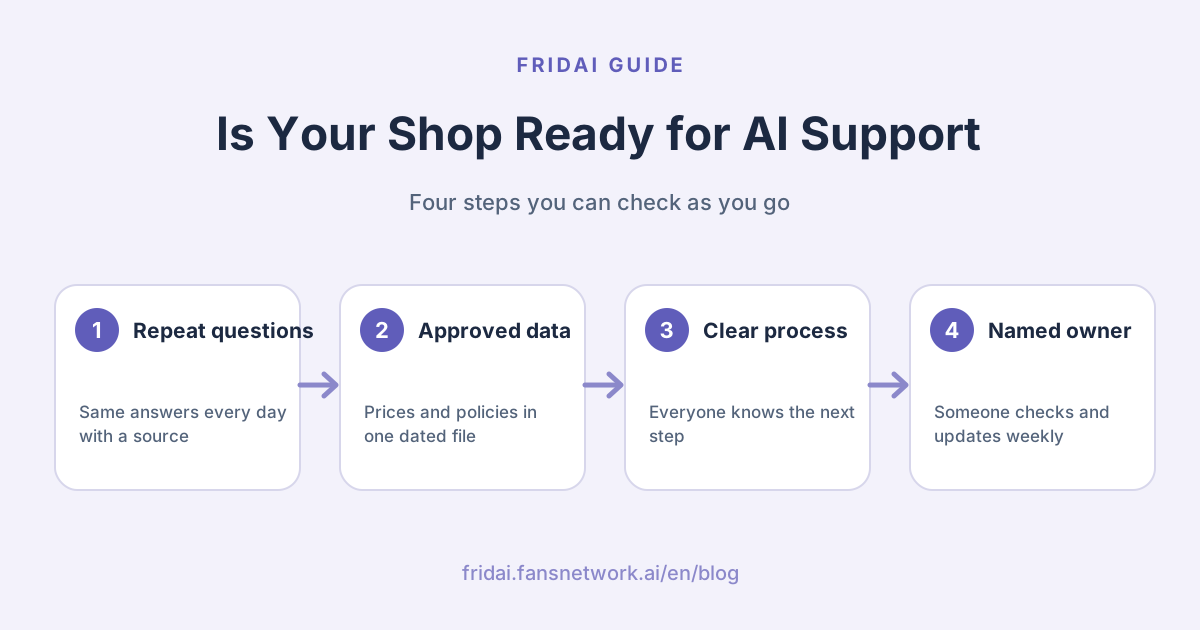
- Run the three-minute self-check: repeat questions, approved data, a clear process, a named owner.
- If prices and policies exist in several versions, consolidate them into one dated brand data file first.
- In month one, pick a single high-frequency question and follow the four-week plan: prepare, test, go live on a small slice, review.
- Track correct-answer rate, handoff share, repeat questions and unresolved conversations; tie revenue to actual payments or bookings.
Pick the question you answer most often every day and turn it into your first rule. Hand it to me for a trial run, and we'll start from there ☺️
FAQ
We only get a dozen or so messages a day. Is AI worth it?
It depends on the kind of messages. If they are highly repetitive and often land outside business hours, AI can answer and collect details after closing. If every message is a complex individual case, let the AI ask what the customer needs and then hand over to a human.
Can we adopt it without an engineer?
Yes. Choose a product that lets you set up knowledge and rules in plain language, and name one person to own account connections, permissions and testing.
How soon will we see results?
Run one process through enough real conversations first, then compare missed replies, repeat questions, human handling time and completed outcomes. Measure success by those outcomes; going live is only the starting point.
How FRIDAI can help
FRIDAI Editorial recommends starting with one high-frequency question on LINE, IG or Facebook, and using FRIDAI to turn your brand knowledge, handling order, exceptions and human handoff into testable rules. Go narrow and get it right, then expand. FRIDAI keeps AI DM replies, comment engagement and content scheduling in one workflow, so once the first process runs smoothly you can bring in more questions and platforms.
- Product: FRIDAI Chat
- Rules guide: How to write AI customer service rules
- Pricing guide: AI customer service pricing guide
- Tool overview: Five AI customer service platforms compared
- Instagram: FRIDAI on Instagram
- Threads: FRIDAI on Threads
- Facebook: FRIDAI on Facebook
Official sources
- FRIDAI Chat: fridai.fansnetwork.ai/
fridai-chat - Google on creating helpful content: developers.google.com/
search/ docs/ fundamentals/ creating-helpful-content