
The usual sticking point when comparing AI customer service is that every vendor bills by a different unit: starting prices all look affordable, yet real bills differ widely. Below: the monthly total cost formula and six billing units, the public pricing structure of five products, then three steps and a worked example to get your own number.
The monthly total cost formula for AI customer service
Monthly total cost = base platform fee
                   + human agent seat fees
                   + active contact or conversation volume fees
                   + AI credits / outcome / resolution fees
                   + channel fees for LINE, WhatsApp, SMS, phone, etc.
                   + labor for integration, knowledge upkeep and rule maintenance
With seat-based pricing, a three-person team pays for three seats; with contact-based or AI-usage pricing, the bill grows in peak season. The first question FRIDAI Editorial wants you to ask is not "what's the minimum?" but "which thing makes the bill grow?"
Six common pricing units
| Pricing unit | What it means | Easy to overlook |
|---|---|---|
| Flat monthly fee | One plan price per month | Often comes with caps, feature tiers or account limits |
| Seat | Billed per human agent who can operate the tool | Whether managers, part-timers and other departments all need a paid seat |
| Monthly active contacts | Number of customers who actually interacted that month | Whether one person across channels is merged, and how overage is charged |
| Messages / conversations | Billed by send volume or conversation count | Official channel fees may apply on top of the platform fee |
| AI credits | Different AI actions consume different amounts of credit | Summaries, generation and agent actions may each burn credits |
| Outcome / resolution | Billed only when the AI achieves a defined result | How "success" is defined, and whether a handoff to a human counts |
Public pricing structures of five products
| Product | Public pricing highlights | How to estimate |
|---|---|---|
| FRIDAI | Chat / Social monthly plans publicly listed from US$70 | Estimate by the product you need, number of platforms and plan allowances |
| SleekFlow | Essential from US$49/ | Count active contacts once for a normal month and once for a campaign month |
| respond.io | Plans based on monthly active contact capacity, AI credits included per plan; some overages billed separately | Split MAC, AI overage and channel fees such as WhatsApp into separate lines |
| Intercom | Essential from US$29/ | Seat fees plus the number of Fin outcomes you might hit each month |
| Zendesk | Support Team from US$19/ | Decide first whether you need Support or Suite, then add AI resolution volume |
Intercom's 2026 outcome definition covers resolutions, specific procedural handoffs and qualification, and the public unit price for qualification differs from a standard outcome. That is why writing "US$0.99 each" alone underestimates certain use cases.
Three steps to your own cost estimate
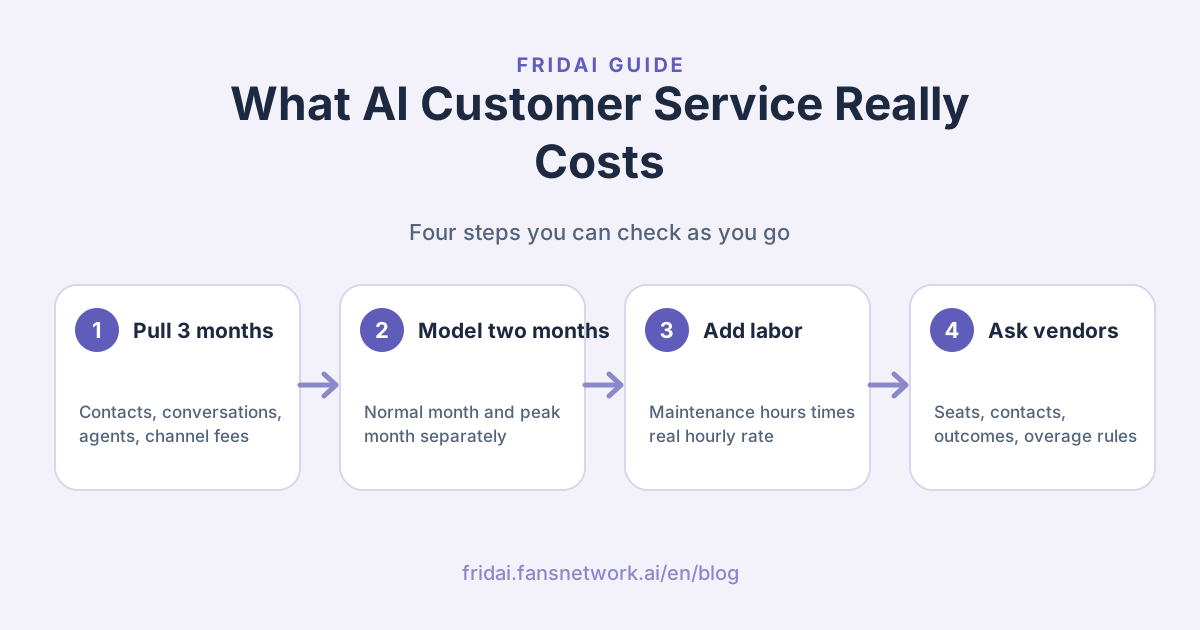
Step one: pull the last three months of usage
Record at least: unique contacts per month, total conversations, total messages, how many people needed a human, number of agents, and channel fees for LINE, WhatsApp and the like. If you have no data, sample two weeks first. Do not go on gut feel.
Step two: separate normal months from peak season
Peak season is not just a normal month times two. A campaign can bring a flood of one-question contacts and can also push more conversations to human agents, and the gap between the two pricing models widens right there.
Step three: convert maintenance labor into cost
If every campaign change needs an engineer, or an agent spends an hour a day fixing the knowledge base, that is part of the total cost. Add "monthly maintenance hours x real hourly labor cost" to your model.
A worked example for a small business
Say a shop has 600 customers interacting per month, 2 human agents and 3,000 conversations, of which 1,200 are handled by AI. When comparing, do not just plug in unit prices. Confirm with each vendor:
- Do all 600 count as monthly active contacts?
- Do both agents need a paid seat?
- Which of the 1,200 conversations count as an outcome or resolution?
- Are official LINE or WhatsApp message fees billed separately?
- After you exceed the cap, does service stop, do you pay per unit, or are you auto-upgraded?
Only once those answers sit in the same spreadsheet are the plans truly comparable. Prices vary by region, annual billing, currency and tax, so fill in unit prices from each vendor's current official pricing page.
Four common underestimates
- Treating the annual-billing discount price as a cancel-anytime monthly fee.
- Forgetting channel fees for WhatsApp, SMS, phone or LINE.
- Estimating only AI-completed conversations and skipping the seats for human handoffs.
- Leaving out the time for knowledge updates, testing and exception handling.
Summary: price it from your own usage

A quick note from FRIDAI
When you read an AI customer service bill, look past the monthly fee on the plan card. Platform fees, human seats, active contacts, AI usage, channel message fees, plus setup and maintenance time make up what you really pay each month.
Before you do the maths, do these five things:
- Ask every vendor: "What makes the bill go up?"
- Pull the last three months of contacts, conversations, messages, handoffs and agent count.
- Model a normal month and a peak month separately, then compare 12-month totals.
- Multiply monthly maintenance hours by the real hourly rate and add it to the spreadsheet.
- Confirm how an outcome is defined and what happens after you exceed the allowance.
Pick one high-frequency support flow and record a month of real usage and billing; the numbers will give you the answer. If you'd like, I'll help you turn that usage into a spreadsheet.
FAQ
Is AI customer service always cheaper than humans?
It depends on what you hand it. Highly repetitive questions with clear rules are where AI cuts marginal cost fastest; sort out the process and keep the data current first, so the time saved is not eaten by maintenance and cleanup.
Is outcome-based pricing fairer?
Look at the outcome definition first. If a customer who simply never replied counts as resolved, spot-check the actual quality yourself rather than relying on the vendor's metric alone.
Can I go live on a free plan?
Use a free plan to learn the interface, then check the channel limits, data capacity, team permissions and support level one by one before a real launch.
How FRIDAI can help
If you want to start from a flat monthly fee, FRIDAI Editorial suggests starting on the entry plan, putting one high-frequency support flow into FRIDAI Chat and tracking a month of AI completions, human handoffs and maintenance time. Once the bill and the results are clear, expand to more platforms and questions.
- Product: FRIDAI Chat
- Five-tool comparison: 5 AI customer service platforms compared
- Instagram: FRIDAI on Instagram
- Threads: FRIDAI on Threads
- Facebook: FRIDAI on Facebook
Official sources
- FRIDAI: fridai.fansnetwork.ai/
fridai-chat - SleekFlow: sleekflow.io/
en-us/ pricing - respond.io: respond.io/
pricing - Intercom: www.intercom.com/
pricing - Intercom outcomes: www.intercom.com/
help/ en/ articles/ 8205718-fin-ai-agent-outcomes - Zendesk: www.zendesk.com/
pricing/