
As messages pile up, the question becomes: a keyword chatbot or AI customer service? By the end of this guide you will know which one each kind of message needs.
The main differences in one table
| Item | Rule-based chatbot | AI customer service |
|---|---|---|
| Input | Menus, keywords, fixed formats | Natural sentences, varied phrasing, longer context |
| Replies | Pre-written content | Answers assembled from knowledge and rules |
| Flow | Clear branches, predictable results | Handles more variation, but needs boundaries |
| Maintenance | Edit menus, keywords and nodes | Update knowledge, rules, test cases and monitoring |
| Risk | Gets stuck when nothing matches | Can say something wrong in a very convincing way |
| Best for | Campaigns, lookups, fixed forms | Consultations, recommendations, follow-up questions, summaries and routing |
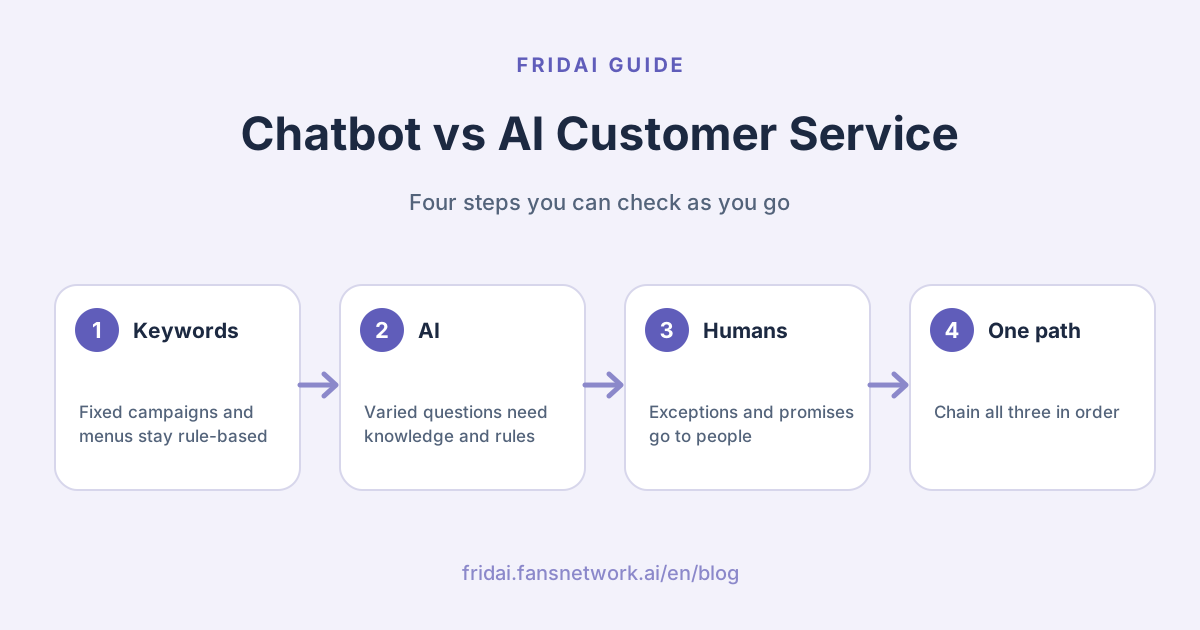
The most practical setup is to chain all three into one path
For example, "comment MENU to get the menu" really does not need an AI to guess. "I don't eat beef, party of four, we'd like a quiet table" is where it pays to let AI understand the conditions. And "can you guarantee this is safe for my allergy?" is the moment to call a human back in. That kind of responsibility should never be handed to a reply that is merely good at chatting.
Which jobs suit a rule-based chatbot?
- Campaign keywords and coupon claims
- Opening hours, address and fixed links
- Format checks on member IDs or order numbers
- Fixed menus and surveys
- Legal or policy text that must be reproduced word for word
These jobs have clear conditions and fixed answers. A rule-based flow is the steadiest and cheapest option here, and it keeps the wording exact.
Which jobs need AI customer service?
- The same question arrives in many natural phrasings
- The reply needs earlier context so you don't ask the customer for their details again
- The next step depends on budget, date, purpose or preference
- The question needs to be sorted first, then routed to different human teams
- There is a lot of knowledge and customers rarely know the right keyword
AI's value is not "sounding human". It is being able to move to the next step, based on your data and your working rules, even when the question comes with more variation.
AI customer service still needs explicit rules
Pointing an AI at your website is not the same as setting it up. At minimum, write down:
- Who the AI represents and which job it is responsible for.
- Which brand data it may use, and which source wins when they conflict.
- Which kinds of questions trigger this flow.
- How known details carry over, and how missing details get asked for.
- Which prices, refunds, treatment outcomes or delivery promises it must not answer on its own.
- Which system result counts as "done".
These six points also work for training a new human colleague. So this is not an extra AI document; it is writing down the judgement that used to live only in the owner's head and the senior agent's head.
How to choose: start with how much the question varies
| Situation | Recommendation |
|---|---|
| Fixed phrasing, fixed answer | Rule-based chatbot |
| Varied phrasing, answer can be derived from approved knowledge | AI customer service |
| Exceptions, promises or high-risk decisions | Human agent |
| Fixed first half, varied second half | Rule-based flow into AI, with a human kept in reserve |
Cost is more than the monthly software fee
A rule-based tool takes time to map out at the start, but every run is stable. AI is quicker to set up, then needs spot checks, knowledge fixes and extra rules over time. When you compare, estimate setup, maintenance, cleanup after mistakes and human takeover together.
Summary: chain keywords, AI and humans into one path

A quick note from FRIDAI
If you remember one thing: rule-based chatbots and AI customer service aren't an either-or. Fixed answers go to keywords, varied questions come to me, and exceptions and high-risk decisions go to you. Chained into one path, the three are the most useful and the easiest to maintain.
Here's how to split it:
- Use a rule-based flow for fixed answers such as campaign keywords, opening hours and fixed links.
- Use AI customer service when one question arrives in many phrasings, when earlier context matters, or when the next step depends on conditions.
- Keep a human for exceptions, important promises and high-risk decisions.
- Before I go live, write down six things for me: who I represent, which data I use, what triggers me, how I ask for missing details, what I must not answer on my own, and what counts as done.
- When comparing cost, count setup, maintenance, cleanup after mistakes and human takeover together.
Pick one job to start with, run real conversations, then decide which part belongs to rules, AI or a person. Once you've picked it, I'll run the trial with you ☺️
FAQ
Is ChatGPT a chatbot or AI customer service?
ChatGPT is a general-purpose AI product. Only once the model is connected to brand knowledge, service channels, permissions, working rules and human handoff does it become an AI customer service system you can actually run.
Do I still need keywords once I have AI?
Yes. Fixed campaigns, compliance text and explicit commands are most reliable on keywords or rules.
Can AI customer service fully replace humans?
The design that works best is a split: the AI handles the large volume of repeat and varied questions, and exceptions, emotions, important promises and missing data go to human judgement.
How FRIDAI can help
FRIDAI can split fixed comment keywords, varied DM questions and the exceptions that need a human into separate flows. FRIDAI Editorial's advice is the same as always: pick one job to start with, and don't force a single AI to run the universe. Once it has handled real conversations, you'll see much faster which part belongs to rules, AI or a human.
- Product: FRIDAI Chat
- Also: FRIDAI Social
- Rules guide: How to write AI customer service rules
- IG tool comparison: Instagram auto-reply tools compared
- Tool overview: Five AI customer service platforms compared
- Instagram: FRIDAI on Instagram
- Threads: FRIDAI on Threads
- Facebook: FRIDAI on Facebook
Official sources
- Intercom Fin overview: www.intercom.com/
help/ en/ articles/ 9515824-what-is-fin - Zendesk AI agents overview: support.zendesk.com/
hc/ en-us/ articles/ 6970583409690-About-AI-agents - respond.io AI Agent getting started: respond.io/
help/ ai-agents/ getting-started-with-ai-agents