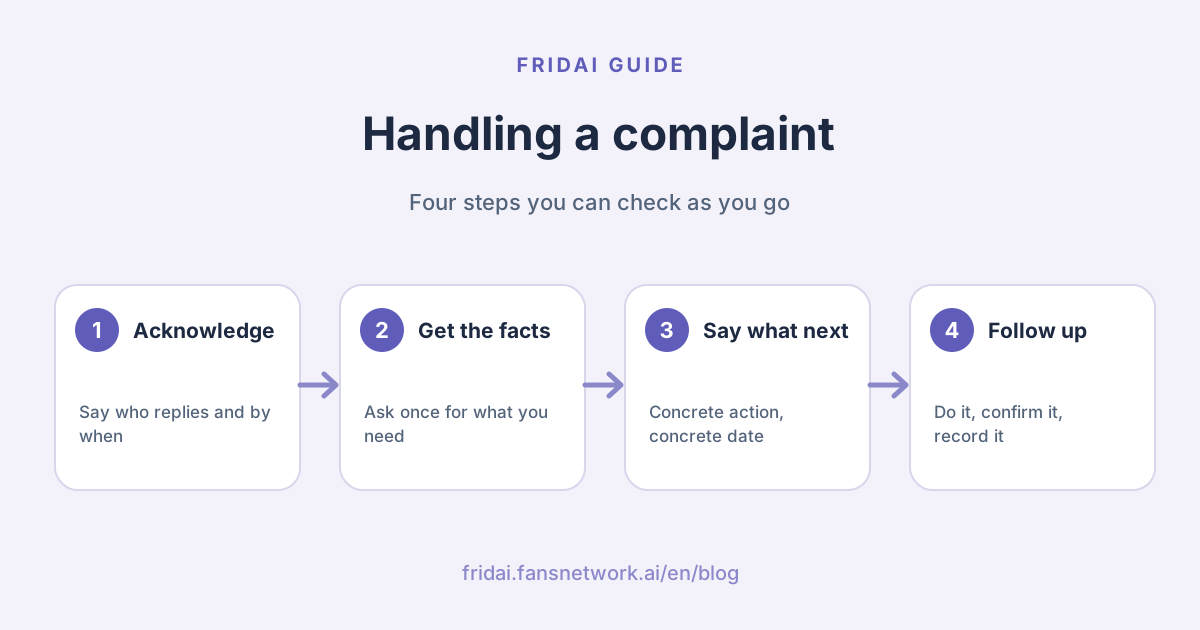
The complaint handling SOP: five steps
A complaint usually grows not because of the original problem, but because nobody answered, the customer was contradicted, or they heard a promise that was not kept. The five steps exist to block those three things.
Step 1: Acknowledge
Let the customer know the message has been seen, who will handle it and when they will hear back. This step does not judge right and wrong. Apologising for the customer's bad experience and admitting responsibility are two different things.
Step 2: Clarify the facts
Ask only for what the case needs: order number, date, photos, the conversation at the time. Ask once. Do not make the customer retell the story three times.
Step 3: State what you can do
If it is your fault, say exactly what happened, what you will do and by when. If it is not your fault, or you are not yet sure, state the policy and the options you can offer. In neither case say "as soon as possible".
Step 4: Follow through
When the promised time arrives, report progress even if there is no result yet. The most expensive sentence in a complaint is "I thought you were going to get back to me".
Step 5: Record
Write down what happened, the cause, how it was handled and which process needs changing. When the same kind of complaint appears a third time, it is no longer a customer problem. It is a process problem.
Public comments, reviews and private messages need different handling
The same complaint lands differently in a private message and under a post, because different people read it.
| Where | Who can see it | What the reply should do | Do not |
|---|---|---|---|
| Private message | Only the customer | Get the details and give a time | Brush it off with a canned message |
| Post comment | All followers | Reply once, briefly, and invite a DM | Argue back and forth in the comments |
| Review | Anyone who searches for you | Write for future customers | Post the customer's personal details |
| Story or tag | The customer's friends | DM to check in and understand | Demand that they delete it |
The principle for public replies is "once, no debate, no leaks". Once, to show you saw it. No debate, because onlookers cannot see the background and only see your tone. No leaks, because order contents, phone numbers and amounts spent do not belong in public.
A reply to a public negative review is really written for the next customer who is deciding whether to come.
Three severity tiers: who handles it and how fast
Not every complaint needs the owner, and not every complaint can be left to the front line. Tier first, then assign. Fill in the time column with your own rule; we are not setting it for you.
| Tier | Typical cases | Who handles it | Reply time |
|---|---|---|---|
| Minor | Long wait, unclear explanation | Front line, on the spot | Your own rule, e.g. same day |
| Needs a remedy | Defect, wrong item, delay | Someone authorised to decide the remedy | Your own rule, told to the customer |
| Safety or legal | Injury, allergy, mention of a formal complaint or lawsuit | Owner or person in charge | Escalate at once, no queueing |
Tiering depends on two questions only: does it involve money or a remedy, and does it involve personal safety or the law? For the third tier the front line should not answer the details. Send the acknowledgement and escalate immediately.
Set your own time limits, but make them achievable and write them down. "As soon as possible" is not a time limit.
12 complaint reply examples to copy
The examples are in Traditional Chinese, as a Taiwan shop would send them; replace everything in 〔〕 with your own content. None of them hard-codes a form of compensation, because that is yours to decide case by case. General service lines are in 36 customer service reply templates and more types are indexed in customer service message templates; this section covers complaints only.
Products and delivery: delay, defect, wrong item
English gloss: (1) late delivery, giving status, reason, new date and an option if they will not wait; (2) defective item, asking for photos and order number with a reply time; (3) wrong or missing item, owning the packing error and promising a handling method by a set time.
【範例 1:出貨延遲】
很抱歉讓你等這麼久。你的訂單〔編號〕目前的狀態是〔狀態〕,原因是〔原因〕,新的預計出貨日是〔日期〕。如果你不想再等,可以選擇〔店家提供的選項〕,請回覆告訴我。

【範例 2:商品瑕疵】
收到商品有問題,真的很抱歉。請幫我拍下〔需要的照片〕並附上訂單編號,我們確認後會在〔時間〕前回覆你處理方式。

【範例 3:出錯貨或少寄】
抱歉,這是我們出貨時沒有核對好。請告訴我你收到的品項和原本訂的品項,我先確認庫存,並在〔時間〕前回覆你〔店家提供的處理方式〕。
Service and price: attitude, price dispute, repeat complaint
English gloss: (4) service attitude, thanking them, asking when it happened and naming who will look into it; (5) price dispute, restating both amounts and promising to check before asking for any extra payment; (6) second contact about the same issue, apologising and passing it directly to a named person.
【範例 4:服務態度】
謝謝你願意告訴我們,這樣的經驗讓你不舒服,很抱歉。方便告訴我是〔日期〕哪個時段、大概的狀況嗎?我會交給〔負責的人〕了解,並在〔時間〕前回覆你。

【範例 5:價格爭議】
了解你的疑問。你當時看到的價格是〔金額或頁面〕,結帳金額是〔金額〕,對嗎?差別可能來自〔可能的原因〕,我確認後在〔時間〕前回覆你,確認前不會請你多付任何費用。

【範例 6:同一件事第二次來】
很抱歉讓你為了同一件事再聯絡我們一次。我看了之前的紀錄,上次是〔上次的處理〕。這次我會直接請〔負責的人〕處理,在〔時間〕前由他回覆你,不會讓你再重講一次。
In public: comments, reviews, abusive language
English gloss: (7) public negative comment under a post, one short reply that moves it to DMs; (8) review reply, acknowledging the specific issue and offering a direct contact; (9) abusive wording, asking them to stop while still offering to deal with the issue.
【範例 7:貼文下的公開負評】
謝謝你告訴我們,很抱歉讓你有這樣的感受。我們想了解細節並好好處理,已經私訊你,也歡迎直接傳訊息給我們。

【範例 8:評論回覆】
謝謝你留下這則評論,很抱歉這次沒有讓你滿意。你提到的〔具體問題〕我們已經在檢討,也希望能直接了解細節,歡迎透過〔聯絡方式〕找〔稱呼〕。

【範例 9:出現辱罵字眼】
我們很想幫你把事情處理好。為了讓對話能繼續,請避免使用辱罵的字眼。你可以告訴我訂單編號和遇到的狀況,我會在〔時間〕前回覆你。
Closing: apology, declining, closing the loop
English gloss: (10) apology after your own mistake, naming what happened, what you will do, by when, and the process you changed; (11) declining a request you cannot meet, with the reason and two real options; (12) closing the loop, confirming completion and asking whether anything is still open.
【範例 10:確認是自己的錯】
這次是我們的疏失:〔具體發生的事〕。很抱歉。我們會〔店家決定的處理方式〕,在〔日期〕前完成,完成後再跟你確認。我們也已經調整〔流程〕,避免再發生。

【範例 11:婉拒做不到的要求】
我了解你的期待,但〔要求的內容〕我們沒辦法做到,原因是〔規定或事實〕。我們可以做的是〔選項一〕或〔選項二〕,你覺得哪一個比較合適?

【範例 12:結案確認】
〔處理內容〕已經在〔日期〕完成。想跟你確認是否都收到、有沒有還沒解決的地方。之後有任何問題,直接回這則訊息就能找到我們。
Abuse, threats, and requests you cannot meet
Many people in Taiwan search for how to handle an 奧客 (a slang term for a "nightmare customer"). We rarely use the word, because once you attach the label it becomes easy to miss the part where the person has a point. A more useful split is between emotion and request: emotion can be acknowledged; requests go back to facts and policy.
- One contact person from start to finish. Switch people and the customer has to retell everything, which only makes things hotter.
- Set one clear boundary. Use example 9 to ask them to stop the abuse; if it continues, tell them that 〔the person in charge〕 will contact them by 〔channel〕 from now on.
- Say a clear no to what you cannot do and offer options, using example 11. Vagueness is read as room to negotiate.
- Keep records. Save screenshots, times, the order and how it was handled.
- Where there are personal threats, public false accusations or sustained harassment, we offer no legal judgment. Keep complete records and consult a lawyer or the relevant authority.
Replying to negative Google reviews: know how the platform works first
Before replying to a Google review, a few points are stated clearly on Google Business Profile's help pages.
- A business must be verified before it can reply to reviews on its Business Profile.
- The reply appears publicly under the review, shown as a reply from the business, not under your personal name.
- Google reviews your reply against its content policies. The help page says review usually takes up to 10 minutes but can take as long as 30 days.
- After you reply, the reviewer is notified, and can still change the review after reading your reply.
- You can report a review, but Google only removes reviews that violate its policies, states that it does not get involved in disputes between businesses and customers, and asks businesses not to report a review merely because they disagree. If the outcome is not what you expected, you can file a one-time appeal.
- If someone uses a negative review to extort you, Google has a dedicated way to report it, linked from the help page on reporting inappropriate reviews.
So the goal of a negative review reply is not to make the review disappear. It is to show readers that this shop deals with things. Screens may change between versions; follow Google's current help page.
What AI should and should not do in a complaint
Complaints are where AI should be least ambitious. It can be the first to acknowledge. It cannot be the one who decides.
| Situation | AI can | AI should not |
|---|---|---|
| Customer is unhappy | Acknowledge and say it has been passed on | Argue about who is right |
| Customer asks for a refund or compensation | State the published policy and hand over | Agree to any remedy on its own |
| Facts need checking | Collect the order number and photos | Guess at causes or blame |
| Abusive language | Stay polite and notify a person | Answer back or repeat a canned line |
| Injury or legal matters mentioned | Notify the person in charge at once | Give medical or legal opinions |
| A person has taken over | Stay silent | Cut in or ask again |
A version you can put straight into your AI rules (an internal instruction, so translate it into whatever language you write your rules in):
[Rule: complaints and dissatisfaction]
Trigger: the customer expresses dissatisfaction, asks for a refund or compensation, mentions injury, a formal complaint, a report or a lawsuit, or uses abusive language.
Order of handling:
1. Apologise in one sentence and restate the customer's problem. Do not judge who is right.
2. Ask for the order number or the date it happened, once only.
3. Say it has been passed to [person in charge] and state [the shop's reply time].
4. Notify a person and attach the customer's original words.
Limits: never promise a refund, compensation, a discount or any outcome; never contradict the customer; never give medical or legal opinions.
Done when: the customer knows who will reply and by when; after a person takes over, send nothing further.
The full six-part format is in how to write AI customer service rules. For how to test the "emotion or complaint" case before launch, see AI customer service implementation: 9 questions to ask first.
What Taiwan's Consumer Protection Act says: within 15 days of the complaint
The following only quotes Taiwan's Consumer Protection Act (消費者
- Article 43: when a consumer dispute arises between a consumer and a business over goods or services, the consumer may file a complaint with the business, a consumer protection group, or a consumer service centre or its branch.
- The same article provides that the business shall properly handle the consumer's complaint within 15 days from the date of the complaint.
- It also provides that if the complaint is not properly handled, the consumer may complain to the consumer ombudsman (消費者
保護官) of the municipal or county (city) government. - Article 44: if a complaint under the preceding article is not properly handled, the consumer may apply for mediation to the consumer dispute mediation committee of the municipality or county (city).
Fifteen days is the period written in the article, not a recommended reply speed. Your own limit should be far shorter. The rule on rescinding an online purchase within seven days, and its exceptions, is covered in the legal section of 36 customer service reply templates and is not repeated here.
A complaint log and common pitfalls
Fill one row per complaint and read the sheet once at the end of the month.
[Complaint log]
No. | Date | Channel (LINE / Instagram / Facebook / review / in store) | Tier | What the customer reported | Facts found | How it was handled | Promised completion date | Actual completion date | Closure confirmed? | Process to change
1 | | | | | | | | | |
2 | | | | | | | | | |
Whether complaints are handled well shows up in resolution time and repeat-contact rate; the formulas are in customer service KPIs for small shops. For how not to miss complaints across several platforms, see the omnichannel customer service guide.
- Explaining the cause in the first sentence. Until the customer feels heard, every explanation sounds like an excuse.
- Posting order or conversation details in public comments to prove you were right. You win that one comment and lose everyone watching.
- Promising compensation before the facts are checked. If it turns out you cannot deliver, that becomes a second complaint.
- Deleting comments or blocking to end it. Content that breaks platform rules can be handled through the platform's own mechanisms, but a plain negative comment that gets deleted usually reappears somewhere else.
- Never closing the loop. Without the line in example 12 you will not know whether the customer is satisfied.
- Apologising several times with no action attached. Apologise once, then state the next step.
FAQ
What should the first reply to a complaint say?
Let the customer know the message has been seen, who will handle it and when they will get a reply, and apologise for the bad experience. This step does not need to judge right and wrong, and should not rush into explaining causes; explain once the facts are clear.
If I apologise first, am I admitting fault?
Apologising for the customer's bad experience and admitting responsibility are two different things. Before responsibility is confirmed you can say you are sorry they had this experience and that you will look into it; once it is confirmed as the shop's fault, state exactly what happened and how you will handle it.
Can I delete a negative review or ask the platform to remove it?
It depends on the platform's rules. For Google reviews, the official help page says only reviews that violate content policies are removed, and that Google does not get involved in disputes between businesses and customers. The more practical route is to reply publicly once and then resolve the matter in private.
Does a complaint always require compensation or a discount?
No. Clarify the facts and responsibility first, then decide based on your policy and the actual situation. Do not promise compensation before things are confirmed; if you cannot deliver it later, it becomes a second complaint. For legal obligations, read the articles or consult a professional.
Is there a legal deadline for handling complaints in Taiwan?
Article 43 of the Consumer Protection Act provides that a business shall properly handle a consumer's complaint within 15 days from the date of the complaint. That is the period in the statute; in practice, set a shorter reply time of your own and tell the customer.
A customer keeps sending abusive messages. Can I stop replying?
You can first ask them to stop the abuse while making clear you are still willing to deal with the issue itself. If it continues, switch to contact by the person in charge through one fixed channel, and keep complete records. Where threats or harassment are involved, consult a lawyer or the relevant authority.
Can I let an AI reply to complaints automatically?
You can let AI do the first step: acknowledge, collect order details, say it has been passed on and notify a person. Do not let it argue, assign blame or promise compensation. Those replies belong to someone with the authority to decide.
How FRIDAI can help
The worst thing in a complaint is that nobody picks it up; the second worst is that whoever picks it up promises too much. FRIDAI Chat connects to your LINE, Instagram and Facebook DMs, acknowledges the customer according to the AI rules you write, notifies a person, and stays out of the way once the person takes over. Public comments are handled by FRIDAI Social: on a negative comment it first soothes publicly, then notifies you to deal with it yourself.
- DM customer service: FRIDAI Chat
- FRIDAI Social: FRIDAI Social
- Reply templates: 36 customer service reply templates
- Measuring it: Customer service KPIs for small shops
- Instagram: FRIDAI on Instagram
- Threads: FRIDAI on Threads
- Facebook: FRIDAI on Facebook
Official sources
- Laws and Regulations Database of the Republic of China (Taiwan): Consumer Protection Act, Article 43: law.moj.gov.tw/
LawClass/ LawSingle.aspx?pcode=J0170001&flno=43 - Laws and Regulations Database of the Republic of China (Taiwan): Consumer Protection Act, Article 44: law.moj.gov.tw/
LawClass/ LawSingle.aspx?pcode=J0170001&flno=44 - Google Business Profile Help: Manage customer reviews: support.google.com/
business/ answer/ 3474050?hl=zh-Hant - Google Business Profile Help: Report inappropriate reviews on your Business Profile: support.google.com/
business/ answer/ 4596773?hl=zh-Hant - FRIDAI Chat: fridai.fansnetwork.ai/
fridai-chat - FRIDAI Social: fridai.fansnetwork.ai/
fridai-social