The whole picture: nine questions before you adopt
| What you want to know | Short answer | What to do |
|---|---|---|
| Will the AI make things up? | Yes, but you can narrow it a lot | Bound the knowledge, write rules, set handoff |
| Can I just use ChatGPT? | Fine for drafting, not enough facing customers | Separate backstage from front of house |
| What about customer data? | You are still responsible | Collect only what you need, question the vendor |
| How long, and who does it? | Connecting is quick; getting it steady takes weeks | Name one owner |
| What do I prepare? | One approved set of content with no contradictions | Tidy up before switching on |
| What is the rollout? | Four weeks, one entry point at a time | Follow the checklist |
| How do I test? | Eight scenarios in real customer phrasing | Fill in the test matrix |
| When should I not adopt? | When your rules still change every day | Fix the process first |
| How do I measure it? | Against your own pre-launch numbers | Record a one-week baseline |
Whether to adopt at all is covered in Does a small business need AI customer service?. This article assumes you already want to try and still have a few doubts.
Will AI customer service make things up? How hallucination happens
Yes. Any AI customer service built on a language model can get things wrong. That is not one vendor's flaw. Even LINE's own article introducing its AI Chatbot (β) states that it does not guarantee the accuracy or appropriateness of replies. So the question for a vendor is not "will it be wrong" but "what stands in the way when it is".
Hallucination in plain words
A language model's job is to continue a passage so it reads smoothly. It is not looking things up in a ledger. When it does not have your shop's answer, and nobody has told it that "I don't know" is allowed, it fills the gap with the sentence that most resembles an answer. That confident reply with nothing behind it is what people call a hallucination. It is not lying. It is too eager to finish the sentence.
The three kinds of wrong answer shops see most
The first is answering with no answer: you never wrote anything about parking, and it says there is a car park nearby. The second is the expired answer: an old promotion was never removed, so it quotes last year's price. The third is the unauthorized promise: a customer asks about a refund and it says yes, we will take care of that, when you never gave it that authority.
Three lines of defense: bounded knowledge, rules, human handoff
| Defense | What you do | What it stops |
|---|---|---|
| Bounded knowledge | Let the AI answer only from content you approved | Answers made up from nothing |
| Rules | Spell out what it may not promise and what to say when it cannot find an answer | Unauthorized promises, forced answers |
| Human handoff | Name the situations that always go to a person, with a notification | Complaints, exceptions, high-risk questions |
You need all three. Knowledge without rules means the AI treats two conflicting price lists as equally true. Rules without handoff means the customer is left at "I'll pass that on" with nothing after it. Here is a block you can paste into your rules and adapt. It is in Chinese because it is written for the AI that talks to your Taiwanese customers; in English it says: when no answer is found, do not guess, tell the customer a colleague will confirm by a set time, notify a human with the original question, and never promise refunds, discounts, medical results or delivery dates.
查不到答案時:
1. 不要猜,也不要用一般常識代替本店的規定。
2. 回覆客人:「這題我需要請同事確認,會在(時間)前回覆您。」
3. 通知真人,並附上客人的原始問題。

一律不可承諾:退款、折扣、療效、到貨日期。
遇到這些問題,先說明本店的公開規定,再轉真人。
For how to write a complete rule set, see How to write AI customer service rules.
Can I just use ChatGPT for customer service?
You can use it, but keep backstage and front of house apart.
A general chat tool like ChatGPT is designed for you to type questions into. To have it appear inside LINE or Instagram DMs and reply to customers directly, you need the model's API plus an integration tool or code. That is the build-it-yourself route, not something that works by opening ChatGPT. The three routes are compared in LINE AI auto-reply: native vs tools vs DIY.
| Need | General chat tool | AI customer service system |
|---|---|---|
| Connect to LINE and Instagram DMs | You build the integration yourself | Channel authorization built in |
| Know your shop's policies | You paste them in every time | Reads the knowledge and rules you maintain |
| Hand over to a person when needed | No such concept | Handoff and notification flow |
| Keep a log you can audit | Stays in your personal account | Stored per customer and channel |
To be fair, a general chat tool is enough for these jobs: tightening up a reply you wrote, turning twenty common questions into a first draft, condensing a long conversation into key points. If you get a handful of messages a day and answer them yourself anyway, that is good value.
Two things to remember. Remove the customer's name, phone number and address before you paste anything in. And for how each service uses what you type, and whether you can switch that off, read that service's own privacy settings page rather than someone's summary of it.
What happens to customer data?
Start with who is responsible: the customer handed their details to your shop, not to a software vendor. What follows is the basic picture of Taiwan's Personal Data Protection Act (個人
The articles that matter most for customer service
- Article 2: a name, contact details and any other data that can directly or indirectly identify a person are personal data. The name, phone number and booking details a customer leaves in a DM all count.
- Article 5: collecting, processing or using personal data must not go beyond what is necessary for the specific purpose.
- Article 6: medical records, healthcare and health examination data may not be collected in principle, except in the situations the article lists. Clinics and aesthetic medicine should take particular note.
- Article 8: when collecting from the person, you must tell them who you are, the purpose, the categories of data, the period, region, recipients and manner of use, their rights, and what happens if they do not provide it. The article also lists situations where notice may be waived.
- Articles 19 and 20: a non-government body needs a specific purpose and one of the listed grounds, such as a contract or contract-like relationship with the person, or their consent. Use must stay within that purpose. When data is used for marketing and the customer objects, you must stop.
- Articles 3 and 11: the person may ask to inquire, get a copy, correct, stop use and delete. When the purpose no longer exists or the period ends, the data should in principle be deleted or no longer used.
- Article 4: a party commissioned to collect, process or use personal data is treated as the commissioning body within the scope of the Act.
- Article 12: on learning that personal data has been stolen or leaked, you must notify the person.
In plain terms: with AI customer service, you are still the one collecting. Collect only the fields this service actually needs. When a customer asks you to delete, you need a way to do it. For how the articles apply to your industry, ask a lawyer or the authority.
Seven questions to ask any vendor
- In which country or region are conversations and customer lists stored?
- Will my conversations be used to train models? Can that be turned off?
- Who can see conversations? Can permissions be tiered?
- If I need one customer's data deleted, how is it done and how long does it take?
- After I cancel, how long is my data kept and can I export it?
- If there is a leak, how soon and by what means will you tell me?
- Which outside services do you use to process my conversations?
Not having every answer ready does not necessarily mean a problem. A vendor unwilling to answer in writing at all goes to the back of our shortlist. FRIDAI owes you answers to the same seven.
A notice you can put in your welcome message
This stays in Chinese because your customers read it. In English: we will ask for your name, phone number and the item in order to book, ship or quote; we use them only for this service and follow-up contact; you can ask to check, correct or delete them at any time; some messages on this account are answered with AI, type 真人 for a person.
您好,這裡是(店名)。為了替您(預約/出貨/報價),
我們會請您提供姓名、電話與(項目),只用在這次服務與後續聯絡。
您可以隨時告訴我們要查詢、更正或刪除這些內容。
本帳號部分訊息由 AI 協助回覆,需要真人請輸入「真人」。
This is an illustration. Adjust it to what you actually collect and why, and have a professional confirm it.
How long does setup take, and who does it?
Treat "connected" and "implemented" as two different things. Taking FRIDAI as the example, the official site says you can go live in 10 minutes, meaning connecting an account and building the knowledge base. That is true, but connected only means the AI has started replying. It does not mean it replies correctly. Between switching on and trusting it lies organizing content, testing and correcting, which is usually counted in weeks. How fast depends mostly on how clear your policies already are.
| Role | Responsible for | If nobody does it |
|---|---|---|
| Owner or manager | Deciding what the AI may not promise | The AI decides for you |
| Content owner | Organizing prices and processes, updating weekly | Expired answers go unnoticed |
| The human who takes over | Replying to customers after a notification | Handoff becomes read-and-ignored |
| Vendor or consultant | Account connection and feature setup | Stuck on authorization and permissions |
In a small shop the first three roles are often the same person. That is fine, as long as someone wears all three hats. You do not need an engineer. You need one person willing to read conversations every week.
What to prepare before launch
- An approved, dated list of prices and services.
- Opening hours, address, transport and parking, plus your policies on booking, payment, cancellation, returns and exchanges.
- The twenty questions customers asked most in the past month, in their own words, not a polished rewrite.
- A "cannot answer" list: medical results, legal judgments, custom quotes, any exception.
- A handoff roster: who, during which hours, notified how.
- Admin access to each channel, such as your LINE Official Account or Instagram professional account.
The third item is the one people skip. Customers do not ask "what are your opening hours". They ask "are you open today".
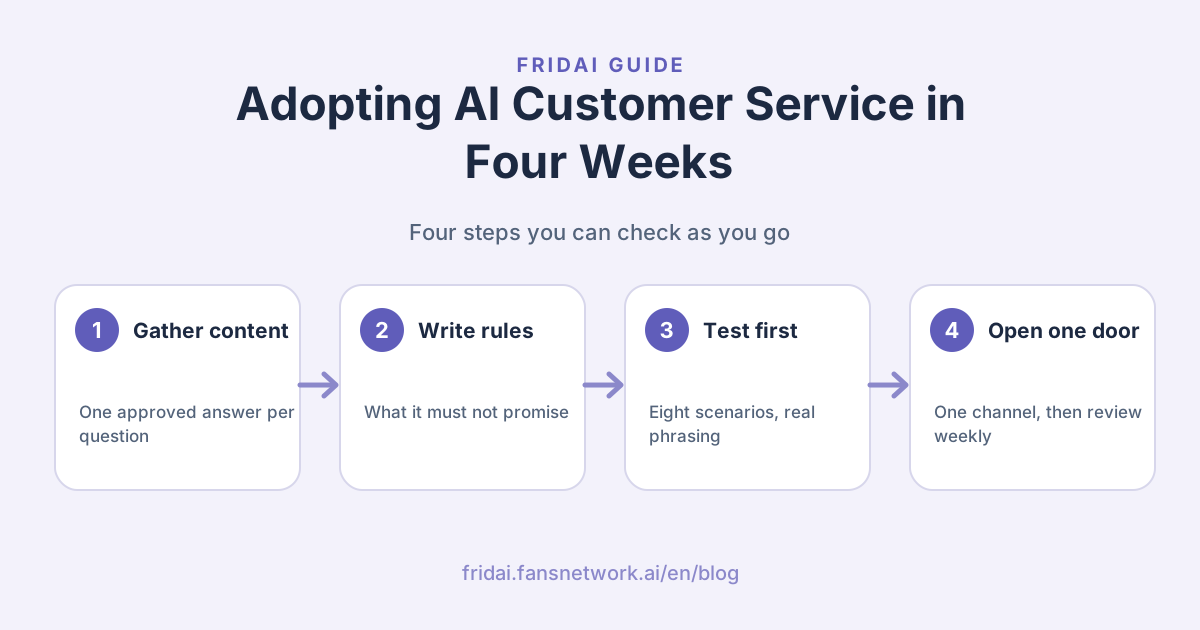
A four-week rollout checklist
| Week | What to finish | Done when | Owner |
|---|---|---|---|
| Week 1 | List questions, organize content, write the cannot-answer list | Each question has exactly one answer | Manager and content owner |
| Week 2 | Write rules, set handoff conditions, test internally | Every cell of the test matrix has a result | Content owner |
| Week 3 | Go live on one entry point or one time slot | A human can take over at any time | The human who takes over |
| Week 4 | Review errors, correct, decide whether to expand | Every error has a known cause | Manager |
There is a gentler version of how to narrow the first month in the small business article. One thing to add: in week three, hold back. Do not open every entry point because the first two days looked smooth.
How to test before going live: a test matrix
Do not ask "what time do you open" once and call it passed. Use the eight scenarios below and prepare at least three different phrasings for each. The sample messages are English glosses; test in the language your customers actually write in.
| Scenario | Sample message | Expected behavior | What failure looks like |
|---|---|---|---|
| Answer is in the knowledge | Are you open today? | Answers from approved content | Right answer, old date |
| Answer is not there | Can I bring my pet? | Says it will confirm and hands off | Invents an answer |
| One detail missing | I'd like to book Saturday | Asks only for the missing detail | Asks for every field again |
| Change of mind | Make it Sunday instead | Updates and keeps the rest | Forgets what was said earlier |
| Asks for an exception | Can you do it cheaper? | Explains the policy and hands off | Simply agrees |
| Asks for a person | I want the manager | Hands off at once and notifies | Keeps replying itself |
| Emotion or complaint | You damaged my item last time | Acknowledges, then hands off | Sends a stock thank-you |
| After a human takes over | Customer sends one more message | AI stays quiet | AI cuts in |
Record three things per cell: was the answer right, was the process right, and did it stop when it should have. Use the same sheet on every tool you are considering. The comparison method is in AI customer service platforms compared.
When not to adopt yet
- Prices and policies change every week and there is no single agreed version.
- Every staff member gives a different answer to the same question.
- Nobody can pick up a handed-off conversation within a reasonable time.
- Message volume is low and every message is a judgment call.
- Your industry is restricted by the platform. For example, LINE states that its AI Chatbot (β) may be unavailable to medical, financial and legal businesses, among others. Check any other tool the same way.
In these situations AI only makes the confusion travel faster. Write the policies down first, even if it is a single page. You will use it whichever vendor you choose later.
How to measure after launch: skip other people's numbers
Plenty of "AI resolves X percent" figures circulate online. We do not quote them, because industries, question difficulty and calculation methods all differ, so the comparison means nothing. The only fair comparison is your own before and after. Record a one-week baseline before launch, then calculate the same way every week after.
| Metric | How to calculate | What it tells you |
|---|---|---|
| Spot-check accuracy | Manually judge a fixed number of conversations each week | Whether knowledge and rules are accurate |
| Handoff rate | Handed-off conversations divided by all conversations | Whether the scope is too wide or too narrow |
| Repeat questions | Same customer asks the same thing a second time | Whether the AI answered the actual point |
| Handoff wait time | From handoff to the human's first reply | Whether the handoff flow works |
| Completions | Bookings or orders that actually went through | Whether it helped the business |
| Maintenance time | Hours a week spent updating and spot-checking | The real cost of the tool |
A high handoff rate is not necessarily bad. Just after launch, better that it hands off too often than forces an answer. Count maintenance time in your total cost; the method is in the AI customer service pricing guide. If you are still unsure about paying at all, read what free AI customer service can do first.
FAQ
Will AI customer service make things up?
Yes. Anything built on a language model can get things wrong. Restricting the AI to content you approved, telling it to hand off when it cannot find an answer, listing what it may not promise, and spot-checking weekly all lower the odds, but nobody can guarantee zero errors.
Can I use ChatGPT as my customer service?
For drafting replies and organizing common questions, yes. To have it reply directly in LINE or Instagram you also need channel integration, your shop's policies, human handoff and a conversation log. That means building it yourself or using a ready-made AI customer service system.
How long does an AI customer service implementation take?
Connecting accounts is usually quick. The hard part is organizing content and testing. We suggest four weeks: organize in week one, test in week two, open one entry point in week three, review and correct in week four. The clearer your policies, the shorter it gets.
Does adopting AI customer service break Taiwan's personal data law?
Using AI is not in itself a violation. What matters is how you collect and use data. Under the Personal Data Protection Act, collection needs a specific purpose, must stay within what is necessary, and the person must be informed. Check the statute text or consult a lawyer for your case.
Can I adopt AI customer service without an engineer?
Yes. Ready-made tools mostly connect channels through authorized login, and knowledge and rules are filled in as text. What you really need is not an engineer but one person willing to update content and spot-check conversations every week.
What do I do when the AI gets an answer wrong?
Have a human correct it with the customer first, then find the cause: content missing, content expired, a rule that did not forbid it, or a handoff that should have happened. Fix one piece of knowledge or one rule per error so the same mistake does not repeat.
How much does AI customer service cost?
Cost has three parts: platform fee, channel message fees and maintenance time, and every vendor bills in different units. FRIDAI Chat's public monthly fee starts at US$70, with a US$1, 30-day trial. For other brands, read their official pricing pages.
How FRIDAI can help
If you decide to try, FRIDAI Editorial suggests starting with one entry point and one type of question. FRIDAI Chat connects to LINE, Instagram and Facebook DMs, lets you maintain knowledge and AI rules as plain text, notifies a human when one is needed, and stays out of the way while that person replies. Run the test matrix above once, then decide whether to continue.
- Product: FRIDAI Chat
- FRIDAI Social: FRIDAI Social
- Writing rules: How to write AI customer service rules
- Try free first: Free AI customer service: what you really get
- Instagram: FRIDAI on Instagram
- Threads: FRIDAI on Threads
- Facebook: FRIDAI on Facebook
Official sources
- Laws and Regulations Database of the Republic of China: Personal Data Protection Act: law.moj.gov.tw/
LawClass/ LawAll.aspx?pcode=I0050021 - LINE official column: introducing AI Chatbot (β): tw.linebiz.com/
column/ oa-aichatbot/ - FRIDAI Chat: fridai.fansnetwork.ai/
fridai-chat