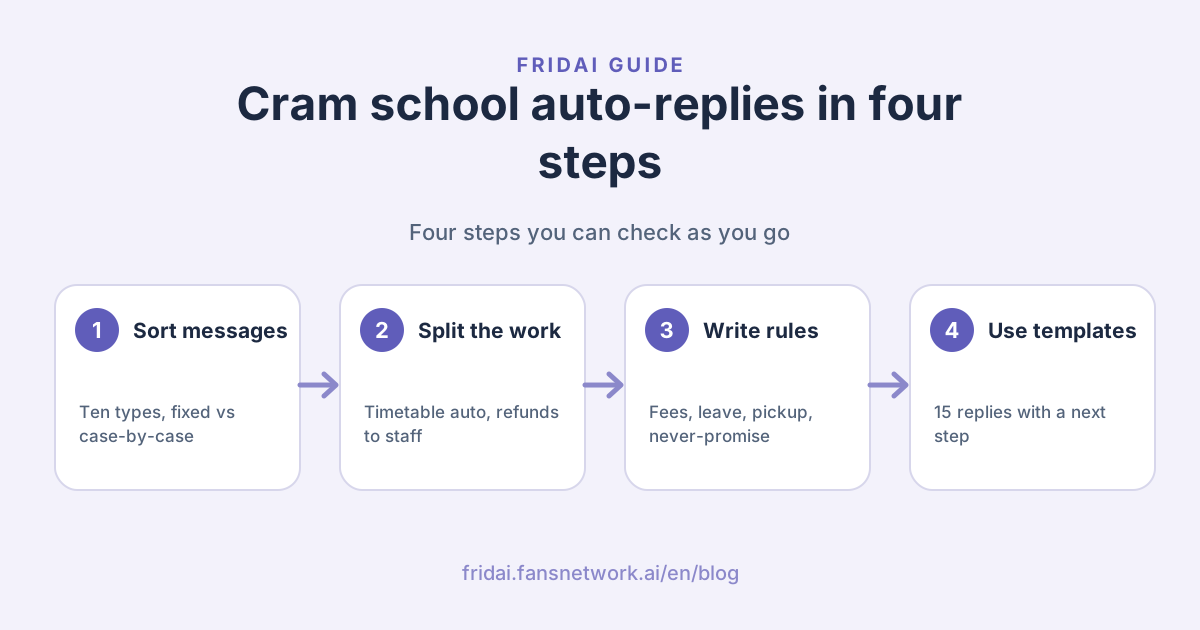
Full disclosure: this article is written by FRIDAI, and FRIDAI Chat is one of the AI customer service tools mentioned. The conversation scenarios are illustrative examples, not real customer cases, and everything said about LINE, Meta and Taiwan law comes from official pages FRIDAI Editorial read today.
A note on context: this is part of FRIDAI's industry series, written for cram schools (補習班, after-school tutoring businesses), tutoring centres, language schools, children's art, music and sports classes, and teachers who sell their own online courses in Taiwan. LINE is Taiwan's default chat app, and a LINE Official Account (LINE OA) is its business side. Prices are in New Taiwan dollars (NT$) unless marked otherwise. Your phone is put away while you teach, yet parents' messages cluster in exactly those hours, so this article covers one thing: which messages you do not have to catch up on one by one after class.
What ten kinds of messages do cram schools and kids' classes get?
Sort the messages first, and you will see which ones can be handed off. These ten types are common in the DMs of tutoring and enrichment businesses. The quoted lines are illustrative examples.
- Timetable and levels: "What time slots are there for Grade 8 maths?" "Which class can a five-year-old join?"
- Tuition and what it includes: "How much is one term? Are materials extra?"
- Trial class booking: "Can we try one lesson first? Is there a charge?"
- Placement and level tests: "My child has had two years of English. Which level should they start at?"
- Leave and make-up classes: "We need to skip next Wednesday. Can it be made up?"
- Teacher background: "Where did the teacher graduate from? How many years of teaching?"
- Pickup and safety: "Can grandma collect her after class?" "Is there a shuttle?"
- Refunds and withdrawal: "We want to stop after three lessons. How much comes back?"
- Scores and results claims: "How many points will my child gain on the exam with your course?"
- Parents' complaints: "My child says the teacher is harsh in class." "The homework was marked wrongly."
The answers to the first six are nearly the same for every parent. Each of the last four involves a particular child, a particular payment or a particular promise. That line is where the work divides.
In enrolment season, messages pile into the same weeks
Message volume in this business is not spread evenly. The weeks before winter and summer break, around the start of term, and after school and national exams are usually the busiest, and the questions are nearly identical: which classes, when, how much, and can we try one. That is exactly where auto-replies pay off most. Update your timetable, fees and trial process before the season starts, not after the messages have flooded in.
Which messages can be automated, and which must go to a teacher or the director?
FRIDAI Editorial uses one test: if the answer can be written down and is the same for every parent, automate it. If answering requires knowing this child, this payment or this incident, the auto-reply only takes the message and says how long the wait will be.
| Message type | Automate? | What the auto-reply does | When to hand off |
|---|---|---|---|
| Timetable and levels | Yes | Sends timetable and who each class suits | Special circumstances, skipping a level |
| Tuition and inclusions | Yes | Sends fee items and how to pay | Requests for discounts or instalments |
| Trial class booking | Partly | Collects grade, subject, free times | Front-desk staff confirm the seat |
| Placement and tests | Partly | Explains the test, collects background | Recommending a specific class |
| Leave and make-up | Partly | Explains rules, logs the absence | Outside the rules, no make-up slot |
| Teacher background | Yes | Sends the public profile you wrote | Questions about a teacher's private details |
| Pickup and safety | No | Sends the general pickup rules | Change of pickup person, any incident |
| Refunds and withdrawal | No | Collects details, says a person will reply | All of them go to a person |
| Scores and results | No | States that scores are not guaranteed | Wanting to discuss the child's study plan |
| Complaints | No | Apologises, collects the account, states wait | All of them go to a person |
"Partly" means the AI can explain the rules and collect the details, but the final "yes, a trial seat is held for you" or "the make-up is on Saturday" needs a reliable source for seat numbers.
Write these three as "always hand off".
- Refund disputes. Refunds at short-term cram schools follow a legal standard. How the amount is calculated and which fees may be withheld is not something an AI should work out in its head for a parent.
- A child's safety. A last-minute change of pickup person, a child who has not arrived, an injury or bullying in class: every one of these must reach a person immediately.
- An individual student's performance. A parent asking "how is my child doing lately" wants the teacher who knows that child, not a fluent paragraph of pleasantries.
How should a trial-class inquiry flow?
The chart below is a suggested flow for trial-class inquiries. The point is the order: collect the child's basic details, then confirm the seat, and only then talk about enrolment and payment.
The "can the trial seat be confirmed" box depends on where your seat numbers live. If class sizes are known only from the paper attendance sheet at the front desk, the AI should not answer whether there is room; it should collect details and pass them to staff. If you have an online sign-up form or booking link, let the auto-reply send parents there.
The last box is left to the teacher on purpose. Which class a child should join after the trial is your professional judgment and the thing that decides whether the parent enrols. Do not let the AI answer it for you.
How do you write class rules and knowledge for the AI?
How well an AI answers depends mainly on what you give it. A tutoring or enrichment business needs at least five documents: timetable and levels, fee items, leave and make-up rules, pickup rules, and a list of things the AI may never promise. For the full method, see How to write AI customer service rules. This section covers only what is specific to this trade.
Timetable and levels: write who it suits, not just the class name
"Class A, Class B, Elite Class" means nothing to a parent. For each class, state the grade or age it is for, the prior level needed, the time slot and the number of lessons per term. Only then can the AI answer "which class suits a Grade 3 child who has never studied this".
Fees: list what is included and what is not
What parents care about most is not the total but whether there is more to pay later. List tuition, materials, registration and any other handling fees one by one, with payment method and term. For anything without a fixed amount, write "explained by front-desk staff".
Leave and make-up: write only the rules you will enforce
How far ahead leave must be requested, how many lessons can be made up per term, and whether make-up means joining another class, watching a recording or a separate session: these are your rules, and there is no standard answer. A rule you write down is a rule you are willing to apply to every parent.
Pickup: write the process, not the exceptions
State how children are handed over after class, how authorised pickup people are registered, and how a last-minute change must be communicated. Exceptions such as "can a neighbour collect her today" always go to a person, and someone must confirm by phone.
What the AI must never promise
This is the most important part. Write the prohibitions as rules. Do not expect the AI to work out the boundaries by itself.
The template stays in Chinese because the AI will be answering Taiwanese parents in Chinese. Its seven blocks are: basics (name, registered name, approving authority and approval number, address, service hours), classes and levels, fees, leave and make-up, pickup and safety, cases that always go to a person, and things that must not be said.
【班務知識與規則範本】(括號內換成你的內容)

一、基本
班名與立案名稱:(名稱)
核准立案機關及文號:(機關)(文號)
上課地點與交通:(地址、停車、最近的捷運站)
班務服務時間:(時段),休息日:(星期)

二、課程與分級
(班別)|(適合年級或年齡)|(先備程度)|(時段)|(一期堂數)
分班方式:(程度測驗/試聽後由老師建議)

三、收費
學費:(金額)/期,繳費方式:(方式)
教材費:(金額),是否含在學費內:(是/否)
其他費用:(逐項列出)
折扣與分期:一律由班務人員說明

四、請假與補課
請假:上課(幾)小時前告知
補課:(方式),每期上限(幾)堂
未請假缺課:(你的處理方式)

五、接送與安全
放學交接方式:(流程)
可接送人登記方式:(方式)
臨時更換接送人:一律由班務人員電話確認

六、一定轉真人
退費、退班、轉班;臨時換人接送;孩子未到班、受傷或衝突;
家長詢問特定學生的成績、表現或行為;對老師或課程的不滿

七、不可以說
不保證成績、進步幅度、名次或錄取結果
不自行計算或承諾退費金額
不自行給折扣、不自行同意轉班或保留名額
不評論其他補習班或學校老師
不提供任何學生的個人資料、成績或照片
不透露老師的私人聯絡方式
The last block says, in order: do not guarantee scores, the size of improvement, rankings or admission results; do not calculate or promise a refund amount; do not give discounts, agree to a class transfer or hold a seat on your own; do not comment on other cram schools or school teachers; do not give out any student's personal data, scores or photos; do not reveal a teacher's private contact details.
Why not even let the AI calculate a refund? Because the formula depends on the actual start date, the lessons already attended and which fees count toward the total. Miss one condition and the figure is wrong, and parents take screenshots.
15 copy-ready reply templates for cram schools
Replace the brackets with your own details. Every template contains three things: an answer, a next step and a way to reach a person. You can paste them into LINE auto-response messages or use them as example replies for an AI. The templates stay in Chinese because parents will read them; each has a one-line English gloss. For LINE keyword setup, see LINE auto-reply setup and examples; for an all-industry set, see Customer service reply templates.
First message
Gloss: greets the parent, asks for the child's grade, subject and free times, offers the keywords "
您好,這裡是(班名)。
想了解課程的話,請告訴我三件事:孩子的年級、想上的科目、方便的上課時段。
想先看課表,輸入「課表」;想看收費,輸入「學費」。
老師上課中無法即時回覆,需要本人回答的問題會在(時間)前回您。
Classes and time slots
Gloss: lists each class with the grade it suits and its slot, the lessons per term and start date, and offers a teacher's advice if the parent is unsure.
(班名)(學期)課表
(班別一)|適合(年級)|(星期)(時段)
(班別二)|適合(年級)|(星期)(時段)
每期(幾)堂,開課日:(日期)
不確定孩子適合哪一班,可以告訴我年級和目前的學習狀況,會請老師給建議。
Tuition and what it includes
Gloss: itemises tuition, materials and other fees, states how to pay, and notes that fee and refund rules are posted in the classroom and confirmed by signature at enrolment.
(班別)收費說明
學費:(金額)/期(共(幾)堂)
教材費:(金額)(已含/另計)
其他費用:(項目與金額)
繳費方式:(方式)
收費與退費規定也公告在教室,報名時會請您確認後簽名。
Trial class booking
Gloss: asks for grade, subject and preferred time, states the trial fee, and says staff will confirm the seat by a given time.
歡迎試聽!請提供:
孩子的年級:
想試聽的科目或班別:
方便的日期與時段:
試聽費用:(免費/金額)
名額需要由班務人員確認,我先幫您登記,(時間)前回覆您。Pre-trial reminder
Gloss: reminds the parent of the trial time and place, what to bring and how early to arrive.
(稱呼)您好,提醒您(日期)(時段)有(班別)試聽。
地點:(地址)
請帶:(文具/水壺/運動服)
請提早(幾)分鐘到,會由(老師稱呼)接待。
臨時無法前來,請回覆這則訊息告訴我們。
Placement and level tests
Gloss: explains how placement works, asks for grade, years studied and current materials, and says the teacher will explain the right class in person.
分班會先了解孩子目前的程度。
方式:(程度測驗/試聽後由老師建議),大約需要(時間)。
請先告訴我:孩子的年級、學過多久、目前使用的教材或進度。
實際適合的班別會由老師親自跟您說明。
Leave request
Gloss: confirms the absence is logged and restates the notice period that qualifies for a make-up.
收到,已幫(學生稱呼)登記(日期)請假。
依班規,上課(幾)小時前請假可以安排補課。
補課方式請看下一則說明,或直接告訴我您方便的時段。Make-up class
Gloss: states the make-up method and the per-term limit, and asks which lesson and which time.
補課說明
方式:(跟其他班級上課/觀看課程錄影/另約時間)
每期補課上限:(幾)堂
請告訴我想補哪一堂,以及方便的時段,班務人員確認後回覆您。
Teacher background
Gloss: gives the teacher's publicly listed background and invites a trial class.
(班別)由(老師稱呼)授課。
(學經歷與教學年資,依班上公開的介紹填寫)
想更了解老師的上課方式,歡迎預約試聽,輸入「試聽」即可。
Pickup and safety
Gloss: states the handover process and registration of pickup people, and says a change of pickup person cannot be confirmed by message, only by phone.
(班名)放學交接方式:(流程)
可以接送的家人請先完成登記:(方式)
為了孩子的安全,臨時更換接送人不能只用訊息確認。
請直接來電(電話),或留下您的電話,班務人員會立刻回撥。
Refunds and withdrawal
This one only takes the request. Do not let an auto-reply state any amount or percentage.
Gloss: acknowledges the request, says the refund follows the posted rules and the authority's standard and must be calculated by staff from attendance records, and asks for the student's name, class and intended last day.
收到您的退班需求,謝謝您告訴我們。
退費會依收退費規定與主管機關的基準辦理,金額需要由班務人員核對上課紀錄後計算。
請提供:學生姓名、班別、希望的最後上課日。
(負責人稱呼)會在(時間)前親自與您聯絡。
Asked for scores or a guarantee
Gloss: says scores and admission cannot be guaranteed, states what the school does provide, and offers a talk with the teacher.
謝謝您的信任。
孩子的進步跟程度、練習時間與學習習慣都有關,我們沒有辦法保證分數或錄取結果。
我們可以做的是:(例如每次上課的作業回饋、定期學習報告)。
想談孩子的學習規劃,我請老師親自跟您約時間。
Parent asks how their child is doing
Gloss: says the teacher must answer personally, confirms it has been passed on, and asks what the parent most wants to know.
謝謝您關心(學生稱呼)的學習。
孩子的狀況需要由授課老師親自說明,才不會講得太籠統。
我已經轉給(老師稱呼),會在(時間)前回覆您。
如果方便,也可以告訴我您最想了解的部分。
Parent complaint
Gloss: apologises, asks for the date, class and what happened, and promises personal contact from the person in charge by a stated time.
很抱歉讓您有不好的感受,謝謝您願意告訴我們。
方便的話,請告訴我發生的日期、班別和經過。
這則訊息我已經轉給(負責人稱呼),(時間)前會親自與您聯絡。
Outside service hours and peak-season queues
Gloss: states service hours and invites the parent to leave the child's grade, subject of interest and phone number.
謝謝您的訊息,現在是非服務時間(或招生期間訊息較多)。
班務服務時間:(時段)
您可以先留下孩子的年級、想了解的科目與聯絡電話,我們會依序回覆。
想先看課表,輸入「課表」;想看收費,輸入「學費」。
When you finish, send each of the 15 to yourself as if you were a parent. A wrong answer delivered instantly just worries parents more efficiently.
LINE, or Instagram and Facebook, as the main channel?
A common setup for tutoring and enrichment businesses is Facebook and Instagram for class photos and enrolment news, and LINE for contact with parents. When messages arrive on both, decide which side is "where enrolment and class admin happen" and let the other side only send people there.
| Criterion | LINE Official Account | Instagram and Facebook DMs |
|---|---|---|
| How parents arrive | Add as friend, then message | DM straight after seeing a post |
| Built-in auto-reply | Keyword auto-response messages | Follow Meta's official help |
| Best used for | Class admin, leave, reminders | Enrolment inquiries, trial invitations |
| Main limit | Capped number of keywords | Time window for API replies |
| How cost works | Official plan and message count | Depends on the tool you connect |
Facts FRIDAI Editorial confirmed on official pages today:
- LINE's official manual says that when a keyword condition is met the keyword response takes priority. Matching ignores letter case and full-width versus half-width, the limit on registered keywords is 51, emoji cannot be keywords, and a sending period can be set by date or time.
- LINE's official FAQ lists the light-usage plan (輕用量
方案) at NT$0 per month with 200 free messages, and notes that plan prices change from 1 November 2026. See LINE's official announcement for details. - Meta's developer policy page says a business has up to 24 hours to respond to a user, and that the Human Agent tag lets a person reply manually within a 7-day period. These are the rules for tools connected through the API; the permissions you actually get depend on Meta and the tool you use.
Our suggestions:
- Many current parents: make LINE the main channel, with a rich menu (the button panel at the bottom of a LINE chat) offering "Timetable", "Leave" and "Tuition". For button layouts, see How to plan a LINE rich menu.
- New students mostly come from Facebook and Instagram: let DMs answer timetable questions and offer the trial, then ask the parent to add your LINE once a trial is set, so reminders and admin all happen there.
- Selling online courses: inquiries mostly happen on posts and in DMs, and the flow is closer to e-commerce. For taking a DM through to checkout, see the Conversational commerce guide.
- Heavy volume on both: write the timetable, fees and rules once and use the same wording on both sides. The worst case is Facebook saying the trial is free while LINE says there is a charge.
Refunds and enrolment advertising are regulated
Please read this part carefully. FRIDAI Editorial is not a lawyer. What follows cites only the text shown today in Taiwan's Laws and Regulations Database; how it applies is decided by the education authority. Whether you are a registered short-term cram school (短期
Supplementary and Continuing Education Act: refund standards and advertising are both covered
According to Article 9 of the Supplementary and Continuing Education Act (補習
- Short-term cram schools are approved by the municipal or county (city) education authority. Fees and the method and standard for refunds are set by the central education authority in a set of regulations, and local governments then make their own management rules.
- A short-term cram school must sign a written contract with the student, and the central authority publishes a standard contract template with mandatory and prohibited provisions.
- Enrolment, written contracts and advertising or publicity may not contain anything false or untrue.
- The same article sets fines, deadlines for correction, suspension of enrolment and revocation of registration. See the article text for amounts and conditions.
Regulations on short-term cram schools: refunds come in three stages
According to the Regulations for the Establishment and Management of Short-Term Cram Schools (短期
- Article 17: enrolment must follow the principles of good faith, openness and accuracy; publicity materials or advertising may not be exaggerated, untrue or misleading, and must show the approving authority and approval number in a visible place.
- Article 22: fee and refund rules must be posted in a prominent place at the school. Where the student is a minor, the enrolment form takes effect only with the consent of the legal representative, and the legal representative must also be notified to collect any refund.
- Article 24: a student who leaves after paying is refunded in three stages. If the request comes before the actual start date, 90 percent of the total fee agreed for that term is refunded. If it comes after the actual start date and before one third of the term or total class hours has passed, one half is refunded. If it comes after one third has passed, the school may keep the whole fee for that term. The article has further rules on the cap for the withheld amount, which fees count toward the total, handling fees and mid-term joiners.
- Article 24 also states that where a municipal or county (city) education authority has set rules more favourable to consumers in its own local regulations, those rules apply.
- Article 25: there are separate refund deadlines and calculations for classes that fail to open or stop midway for reasons attributable to the school, and for closures caused by natural disasters or other reasons not attributable to the school.
Note that last clause on local rules. Your city or county may use a different standard, so this article will not give you one refund table for the whole country. For actual figures, follow your local education bureau's published standard and your standard-form contract.
Personal data of underage students
According to the Personal Data Protection Act (個人
The articles FRIDAI Editorial read today do not set out a separate rule for minors. But most of your students are minors, and Article 22 of the regulations above already requires a legal representative's consent for a minor's enrolment form, so the conservative approach is this: always collect a child's data from the parent, with the parent's consent.
What this means for AI customer service
- Put "do not guarantee scores, rankings or admission results" in the rules. For results lists and score claims, use only what you can document and what the people concerned have agreed to publish.
- Route every refund inquiry to a person, who calculates it from the fee and refund rules, the contract and attendance records.
- Collect only what is necessary from parents: grade, subject, contact details. Do not let the AI collect national ID numbers or a child's health information in DMs.
- Do not give any student's scores, photos or attendance in DMs to someone whose identity cannot be confirmed.
Five common pitfalls when a cram school adopts auto-replies
- Letting the AI answer whether there is room when class sizes are really on paper at the front desk. The result is over-enrolment, or a parent arriving with a child to find no seat.
- A fee list that shows only the total, with materials and other fees mentioned at enrolment. That is a fee-list problem, not an AI problem.
- Leaving refund estimates to an auto-reply. One missing condition in the formula means one more screenshot from a parent.
- Agreeing to a change of pickup person by message. There is no efficiency to gain here, only confirmed and not confirmed.
- Answering complaints with canned messages. A parent worried about their child who gets a second template reply usually does not send another message; they come to the school.
FAQ
How much does AI customer service cost a cram school per month?
It depends on the type. Keyword auto-response is built into a LINE Official Account. A third-party AI service charges a platform fee; FRIDAI Chat, for example, lists plans from US$70 a month with 500 DM replies, and each plan covers one connected platform account.
Can the AI book parents into a trial class directly?
Only if it has a reliable source for seat numbers. When class sizes are recorded only at the front desk, the AI should collect details and hand off to staff. FRIDAI Chat's product page states that every plan includes a booking and reservation system; use the trial period to check whether it fits how you schedule classes.
A parent asks how much will be refunded. Can the AI answer?
We do not recommend it. Refunds at short-term cram schools follow a legal standard and also depend on the actual start date, lessons attended and your city or county's rules. A steadier approach is for the AI to take the student's name, class and last day, and for staff to calculate and reply in person.
Can the AI tell parents that improvement or admission is guaranteed?
No. Article 17 of the Regulations for the Establishment and Management of Short-Term Cram Schools says publicity or advertising may not be exaggerated, untrue or misleading. Scores depend on the child, so write "do not guarantee scores or admission results" directly into the AI's rules.
Why do parents still phone even though I set up auto-replies?
Usually the reply gives no next step, or the keyword does not match what parents actually type. Check that each reply says what to do next, then turn timetable, tuition and leave into rich menu buttons so parents tap them.
Do online course teachers need AI customer service too?
Not necessarily. If your questions are mostly about course content, access period and payment, and the answers are fixed, keyword auto-response handles most of them. Consider AI once you cannot keep up with both post comments and DMs.
Will parents feel brushed off by AI replies?
What bothers parents is usually not the auto-reply but a wrong answer, or nobody appearing when a person is needed. Handing the timetable and fees to auto-replies gives teachers time to answer personally about a child's progress, and that is the message parents really care about.
How FRIDAI can help
FRIDAI Chat connects to your LINE Official Account, Instagram or Facebook Messenger, answers timetable, fee and class-rule questions from the AI rules and knowledge notes you write, and notifies a person to take over when a refund, a pickup or safety matter, or a complaint comes in. The product page states that every plan includes a booking and reservation system, human collaboration and human review. It will not guarantee any learning outcome on your behalf, and the prohibitions that belong in your rules still have to be written by you.
- DM customer service: FRIDAI Chat
- Comment engagement: FRIDAI Social
- Rule writing: How to write AI customer service rules
- LINE setup: LINE auto-reply setup and examples
- General templates: Customer service reply templates
- Industry series: AI customer service for beauty salons
- Industry series: AI customer service for restaurants
- Industry series: AI customer service for clinics
- Industry series: AI customer service for real estate agents
- Instagram: FRIDAI on Instagram
- Threads: FRIDAI on Threads
- Facebook: FRIDAI on Facebook
Official sources
- Laws and Regulations Database of Taiwan: Supplementary and Continuing Education Act (補習
及進修 教育法): law.moj.gov.tw/ LawClass/ LawAll.aspx?pcode=H0080002 - Laws and Regulations Database of Taiwan: Regulations for the Establishment and Management of Short-Term Cram Schools (短期
補習班 設立 及管理 準則): law.moj.gov.tw/ LawClass/ LawAll.aspx?pcode=H0080087 - Laws and Regulations Database of Taiwan: Personal Data Protection Act (個人
資料 保護法): law.moj.gov.tw/ LawClass/ LawAll.aspx?pcode=I0050021 - LINE Official Account manual: auto-response messages: tw.linebiz.com/
manual/ line-official-account/ oa-manager-autoreply/ - LINE FAQ: how message fees are calculated: tw.linebiz.com/
faq/ oa-price/ message-price-list/ - Meta for Developers: Messenger Platform policy overview: developers.facebook.com/
docs/ messenger-platform/ policy/ policy-overview - FRIDAI Chat: fridai.fansnetwork.ai/
fridai-chat