Full disclosure: this article is written by FRIDAI, and FRIDAI Chat is one of the AI customer service tools mentioned. This article is not legal advice and not medical advice. The conversation scenarios are illustrative examples, not real customer cases, and everything said about LINE, Meta and Taiwan law comes from official pages FRIDAI Editorial read today. For whether your setup is compliant, ask your local health bureau or your legal adviser.
A note on context: this is the clinic article in FRIDAI's industry series, written for small clinics in Taiwan, such as dental, dermatology, traditional Chinese medicine, paediatric and physiotherapy practices with one to three reception staff. LINE is Taiwan's default chat app, and a LINE Official Account (LINE OA) is its business side. Prices are in New Taiwan dollars (NT$) unless marked otherwise. This is the most regulated industry in the series, so this article is also the most conservative. The first article is AI customer service for beauty salons; the same batch covers restaurants, cram schools and real estate agents.
What eight kinds of messages does a clinic reception get every day?
Sort the messages first, and you will see which ones can be handed off. These eight types are common in clinic messages. The quoted lines are illustrative examples.
- Clinic hours and doctor schedules: "Are you open Saturday afternoon?" "Which days does Dr Wang see patients?"
- Registration, booking and changes: "I'd like next Tuesday evening." "Can I move tomorrow's appointment?"
- What to bring to a first visit: "What do I need for my first visit?"
- Fees for self-pay items: "Roughly how much are the self-pay items?"
- Directions and parking: "Is it easy to park near the clinic?"
- Post-visit questions: "The wound is still bleeding at home, is that normal?" "The medicine makes me nauseous, can I stop?"
- Test-result inquiries: "Is last week's report out yet?"
- Complaints: "I waited an hour and a half." "The reception staff were rude."
The first five are administrative, and the answers are on the clinic timetable and the notices at reception. The last three each involve one patient's body, records or emotions. That line is where a clinic's work divides, and it is drawn harder than in any other industry.
Which messages can be automated, and which must go to reception or the doctor?
In other industries FRIDAI Editorial's test is "if the answer can be written down, automate it". A clinic needs one more test: if the answer would differ because of this patient's physical condition, it cannot be automated, even if it could be written down.
| Message type | Automate? | What the auto-reply does | When to hand off |
|---|---|---|---|
| Hours and schedules | Yes | Sends timetable and closure notices | Update first for ad-hoc closures |
| Booking and changes | Partly | Explains process, collects preferred slot | Confirming the number and slot |
| First-visit prep | Yes | Sends documents and check-in time | Special status or paperwork |
| Self-pay fees | Partly | Sends published fee items or ranges | What one person needs, total cost |
| Directions, parking | Yes | Sends address and parking | Almost never |
| Post-visit questions | No | Says clinic staff have been notified | All to a person; emergencies call 119 |
| Test results | No | Explains how to obtain them | All handled by clinic staff |
| Symptoms, medication | No | Says it cannot be judged by message | All to a person; emergencies call 119 |
| Complaints | No | Apologises and states the wait | All of them go to a person |
No cell in this table says "the AI answers symptoms". When a patient asks "my tooth has hurt for three days, is it serious", the AI should say neither that it is serious nor that it is not. Both replace the doctor's judgment. It can do one thing only: say that a doctor needs to examine it, and help arrange an appointment or hand off to reception.
Self-pay fees are the other place where things go wrong. The AI may send the clinic's published fee items, but it must not estimate for a patient "you would need about this many sessions, this much in total". That is already a treatment recommendation.
How should an incoming message be triaged?
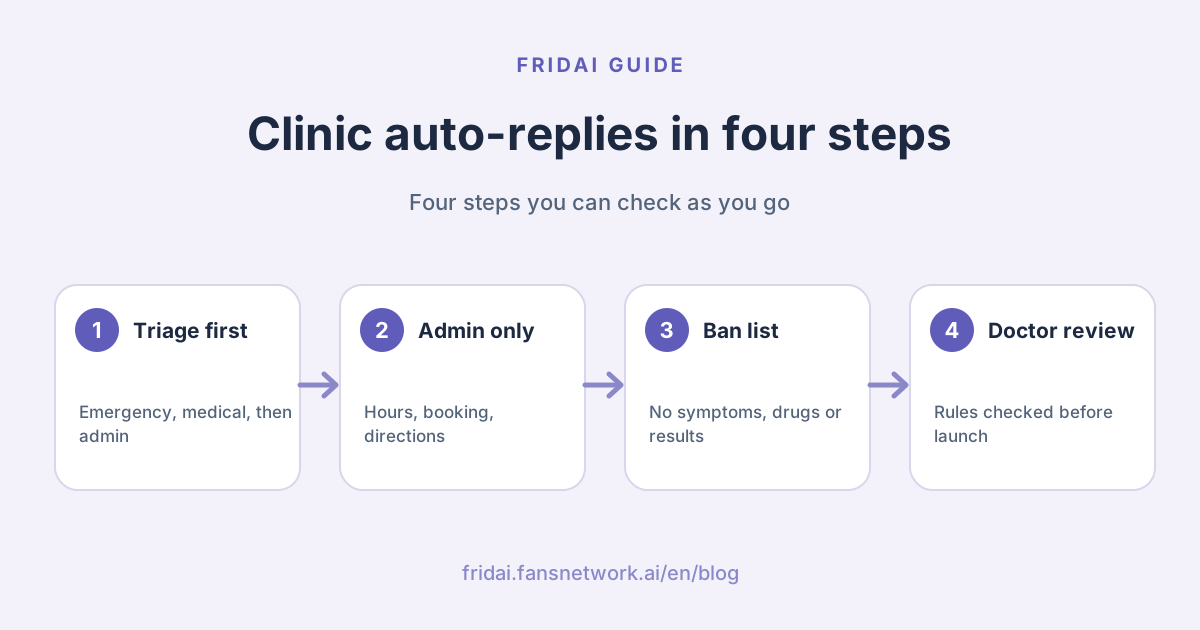
The chart below is a suggested routing for clinic messages. The order matters: first check for an emergency, then for a medical question, and only then deal with administration.
There is a line from C to E: even after telling the person to call 119, the message still has to reach clinic staff. Which descriptions count as a "possible emergency" should be listed by the doctor as key phrases in the rules. Do not let the AI judge severity. One reminder too many is better than one missed.
One more honest point: an auto-reply is not an emergency channel. When a patient messages at midnight, nobody guarantees a person is reading. That sentence belongs in the welcome message and in the after-hours reply.
How do you write clinic rules and knowledge for the AI?
A clinic has less to write than other industries, but its list of prohibitions is much longer. For a full breakdown of the method, see How to write AI customer service rules; questions asked before adopting AI are in AI customer service implementation FAQ. This section covers only what is specific to clinics.
Timetable: who updates ad-hoc closures
The timetable is what a clinic is asked about most, and what goes stale most easily. Write it as text and name one owner: when a doctor takes leave, a typhoon closes the clinic or holiday hours change, who updates it and how long before sessions start. If nobody owns the update, the auto-reply will send patients to a closed clinic.
Registration and booking: administrative details only
The AI can explain how to register, how far ahead bookings are taken and how many minutes late means queueing again. When collecting a booking request, collect only the name, phone, first or return visit, and preferred date and doctor. Do not let the AI ask follow-up questions about symptoms, history or medication in the chat; leave those for the consulting room. The reason is in the personal-data section below.
Self-pay items: published fees only
If your clinic has self-pay items, the AI sends only the names and amounts or ranges you have published, and adds "the items you actually need will be explained by the doctor after the consultation". No offers, no time limits, no comparisons, no description of what happens afterwards.
What the AI must never say
Write the prohibitions as rules. This document should be read by the doctor personally. The template stays in Chinese because it is meant to be pasted into your tool.
【診所知識與規則範本】(括號內換成你的內容)

一、基本
診所名稱:(名稱)
診療科別:(科別)
地址與交通:(地址、停車、最近的捷運或公車站)
電話:(電話)

二、門診時間
(星期)(時段)(醫師)
休診與臨時停診:公告在(位置),由(負責人)更新

三、掛號與預約
掛號方式:(現場/電話/線上連結)
可預約範圍:(幾天內)
改期與取消:請在(時間)前告知
遲到:超過(幾)分鐘(處理方式)
初診請帶:(證件),請提早(幾)分鐘報到

四、費用
掛號費與部分負擔:(依診所公告)
自費項目:(項目)(公告金額或區間)
實際需要的項目與費用,由醫師看診後說明

五、一定轉真人
任何症狀、用藥、療程、術後或治療後狀況的詢問
檢查報告、病歷、診斷證明、收據相關
客訴、退費、醫療爭議、媒體或公部門來訊
代替他人詢問病情

六、疑似急症
出現(由醫師列出的關鍵描述)時,
先回覆「請立即撥打 119 或前往急診」,再通知診所人員

七、不可以說
不判斷症狀、不猜病名、不說嚴重或不嚴重
不建議用藥、停藥、換藥或劑量
不建議或比較療程,不說哪一種比較適合
不談療效、成功率、治療前後差異、保證
不提供優惠、折扣、限時活動
不在訊息中提供檢查結果或病歷內容
不追問病史、用藥史等與行政無關的健康細節
The seven sections are: basics; clinic hours; registration and booking; fees; what always goes to a person (any question about symptoms, medication, treatment or post-treatment condition; test reports, records, certificates and receipts; complaints, refunds, medical disputes, media or authorities; anyone asking about another person's condition); possible emergencies (on the doctor's listed key phrases, first reply "call 119 or go to an emergency department now", then notify staff); and what the AI may not say (no judging symptoms, naming conditions or saying serious or not serious; no advice on taking, stopping, changing or dosing medication; no recommending or comparing treatments; no efficacy, success rates, before-and-after or guarantees; no offers, discounts or limited-time promotions; no test results or record contents by message; no probing for medical or medication history unrelated to administration).
Why "no saying serious or not serious"? Because reassurance is also a judgment. If the AI replies "that sounds fine, don't worry", the patient may not come in.
14 copy-ready administrative reply templates for clinics
Replace the brackets with your own details. All 14 handle administrative matters only. None mentions efficacy, before-and-after, treatment promotions or guarantees, and please do not add them. You can paste these into LINE auto-response messages or use them as example replies for an AI. The templates stay in Chinese because your patients will read them; each has a one-line English gloss. For LINE keyword setup, see LINE auto-reply setup and examples; for an all-industry set, see Customer service reply templates.
First message
Gloss: says the account helps with hours, registration, first-visit preparation and directions; symptoms, medication and results cannot be answered by message; in an emergency call 119 or go to emergency without waiting for a reply.
你好,這裡是(診所名稱)。
這個帳號可以協助:門診時間、掛號方式、初診準備、交通停車。
症狀、用藥與檢查結果無法在訊息中回答,會轉給診所人員或請你回診。
如有緊急狀況,請立即撥打 119 或前往急診,不要等待訊息回覆。
Clinic hours and doctor schedules
Gloss: lists sessions by day and doctor, closed days, and where ad-hoc closures are announced.
(診所名稱)門診時間
(星期)(時段)(醫師)
(星期)(時段)(醫師)
休診日:(星期)
臨時停診會公告在(位置),出門前建議再確認一次。
Collecting a booking request
Gloss: asks for name, phone, first or return visit, and preferred date, time and doctor; asks the patient not to describe their condition in detail by message; states this is not yet a confirmed booking.
好的,協助你登記預約需求。請提供:
姓名:
聯絡電話:
初診或複診:
希望的日期、時段與醫師:
請不要在訊息中描述詳細病情,看診時再直接告訴醫師。
這還不是預約成功,櫃檯確認後會再回覆你。
Booking confirmed
Send this only after reception staff have confirmed the slot.
Gloss: confirms date, time and doctor, what to bring, how early to arrive and the deadline for changes.
已為你完成預約。
時間:(日期)(時段)
醫師:(醫師)
請攜帶(證件),並提早(幾)分鐘報到。
需要改期或取消,請在(時間)前告訴我們。
Rescheduling
Gloss: asks for the original date and the new preferred date and time; reception will confirm.
收到你的改期需求。
請告訴我原本的預約日期,以及你方便的新日期與時段。
櫃檯確認後會回覆你新的時間。
Cancelling
Gloss: acknowledges the cancellation, passes it to reception and invites a new booking later.
收到,已將你的取消需求轉給櫃檯。
原預約:(日期)(時段)
之後想重新預約,直接告訴我日期與時段即可。
What to bring to a first visit
Gloss: lists the documents required by the clinic, how early to arrive for the first-visit form, and who must accompany minors.
第一次來(診所名稱),請攜帶:
(健保卡、身分證件等,依診所規定)
請提早(幾)分鐘到,需要填寫初診表單。
(未成年/需陪同者)請由(家長或陪同者)一起前來。Self-pay fees
Gloss: lists the clinic's published self-pay fees and says what a patient actually needs can only be explained by the doctor after a consultation, not assessed by message.
(診所名稱)公告的自費收費如下:
(項目一)(金額或區間)
(項目二)(金額或區間)
實際需要的項目與費用,要由醫師看診後才能說明,
訊息中無法替你評估。需要的話可以協助你預約門診。
Directions and parking
Gloss: gives the address, public transport, nearest car park and step-free access.
(診所名稱)地址:(地址)
大眾運輸:(捷運或公車站與出口)
停車:(最近的停車場與步行時間)
(有/無)無障礙出入口與電梯。Post-visit questions
Gloss: says the question must be answered by clinic staff or the doctor and cannot be judged by message; it has been passed on, with a reply time and phone number; in an emergency call 119 or go to emergency.
謝謝你的訊息。
看診後的狀況需要由診所人員或醫師回答,訊息中無法替你判斷。
我已經將訊息轉給診所人員,門診時間內會在(時間)內回覆你,
也可以直接來電(電話)。
如果情況緊急,請立即撥打 119 或前往急診。Test-result inquiries
Gloss: says reports and records cannot be given by message, explains how to obtain them (return visit, or phone call by the patient with identity check) and offers to book a return visit.
檢查報告與病歷內容無法在訊息中提供。
查詢方式:(回診由醫師說明/本人來電並核對身分)
需要的話可以協助你預約回診,請告訴我方便的日期與時段。
Questions about symptoms or medication
Gloss: says symptoms and medication need an in-person consultation, asks the patient not to adjust medication based on messages, offers to book, and repeats the 119 instruction.
謝謝你告訴我們。
症狀與用藥需要醫師實際看診才能判斷,訊息中無法回答,
也請不要依訊息自行調整用藥。
需要的話可以協助你預約門診,請告訴我方便的日期與時段。
如果情況緊急,請立即撥打 119 或前往急診。
Complaints
Gloss: apologises, asks for the visit date and what happened, and says a named role will contact the patient personally by a set time.
很抱歉這次就診讓你有不好的感受。
方便的話請告訴我就診日期與發生的情況。
這則訊息我已經轉給(負責人職稱),會在(時間)前親自跟你聯絡。
Outside clinic hours
Gloss: says nobody is reading messages in real time, gives hours, asks for name, phone and preferred slot, and repeats the 119 instruction.
謝謝你的訊息,現在是非門診時間,訊息不會即時有人回覆。
門診時間:(時段),休診:(星期)
掛號需求請先留下姓名、電話與希望時段,開診後會依序回覆。
如有緊急狀況,請立即撥打 119 或前往急診。
Once these are written, have both the doctor and reception read them. The doctor checks whether any sentence strays into medical judgment; reception checks whether the process matches what actually happens.
LINE or Instagram and Facebook as the main channel?
Many clinics use LINE for registration and reminders, while Instagram and Facebook work more like a noticeboard. Before choosing, a clinic should know what LINE itself says about medical businesses.
| Criterion | LINE Official Account | Instagram and Facebook DMs |
|---|---|---|
| How patients arrive | Scan a code, add as friend, message | DM straight from a post |
| Best used for | Timetable, registration, reminders | Closure notices, health education posts |
| Built-in auto-reply | Keyword auto-response messages | Depends on the tool you connect |
| Built-in AI | May be unavailable for medical businesses | Depends on the tool you connect |
| Main limit | Keyword count is capped | API replies are time-limited |
Facts FRIDAI Editorial confirmed on official pages today:
- LINE's help page states that official accounts in medical and social welfare businesses (hospitals, clinics, care facilities) may touch users' sensitive information, so even with the advanced chat plan (聊天
進階方案) purchased as an add-on, LINE may decide the AI chatbot (β) cannot be used. The same passage also lists finance, religion, politics and public administration, and legal businesses. - The LINE manual states that auto-response messages are sent when a user types a specific keyword, up to 51 keywords can be registered, and a sending period can be set by date or time. This is keyword matching, not AI.
- LINE's FAQ notes that plan pricing changes from 1 November 2026. See LINE's official announcement for details.
- Meta's developer policy page states that a business has up to 24 hours to respond after a user messages, and that a Human Agent tag lets a person reply manually within 7 days. Which permissions you actually have depends on Meta and the tool you use.
FRIDAI Editorial's suggestion is blunt: most small clinics should start with LINE's keyword auto-response plus a rich menu with three buttons, "Clinic hours", "How to register" and "Directions", which catches the most repeated administrative questions first. Every sentence in a keyword reply is one you wrote, and it will not improvise. That LINE itself is this cautious about AI for medical businesses is a signal in its own right.
When should a clinic not let AI answer patient messages?
This is the most important section of the article. FRIDAI sells AI customer service, but in the situations below we suggest you do not use it, or use only fixed-text keyword replies.
- Patients habitually ask about their condition by message, for example long-term chronic care, post-procedure care, mental health, or paediatric questions at night. When most messages are medical, all the AI can say is "please come back in", and a person might as well answer.
- Nobody at the clinic can read handed-off messages during clinic hours. If the AI says "this has been passed to clinic staff", someone must really be there. A handoff nobody picks up is worse than no auto-reply.
- You cannot confirm where patient messages are stored or who can see them. What patients send may include their health condition, which the law treats as especially sensitive personal data.
- The doctor has no time to review the rules and templates. Rules a doctor has not read should not go live in front of patients.
- The clinic's main service is self-pay treatment and you hope the AI will help "close" it. That is no longer an administrative reply; the next section explains why.
If any one applies, stay with keyword auto-response for now. Come back when the conditions are in place. No patient misses a consultation because you adopted AI six months later.
Medical advertising and patient data are regulated
Once more: FRIDAI Editorial is neither a lawyer nor a doctor. What follows quotes only statute text from the Laws and Regulations Database of Taiwan, and whether something is a violation is decided by the health authority. The database shows the Medical Care Act (醫療法) as last amended on 23 September 2026; rely on the current text in the database.
Medical Care Act: what advertising may contain and how it may not be done
According to the Medical Care Act in the Laws and Regulations Database:
- Article 9 defines medical advertising as using media or other means to publicise medical services for the purpose of attracting patients.
- Article 84 provides that non-medical institutions and non-physicians may not run medical advertising.
- Article 85 limits the content of medical advertising to items such as the institution's name, practice licence number, address, phone and directions, the physician's name and qualifications, National Health Insurance contracted status, and medical departments and consultation hours. The same article also provides that information a medical institution provides over the internet is not bound by that content list, except in the circumstances in Article 103 paragraph 2, with management rules set by the central competent authority.
- Article 86 lists prohibited promotion methods, including promoting under another's name, publicising secret family remedies or public question-and-answer sessions, excerpting medical publications, promoting through interviews or news reports, and other improper methods.
- Article 87 provides that advertising content that implies or alludes to medical services is deemed medical advertising; the same article states that patient health education and similar content not aimed at attracting patients is not deemed medical advertising.
- Article 103 sets a fine of NT$50,000 to NT$250,000 for violating Articles 85 and 86; where medical advertising is false, exaggerated or distorts the facts, among other circumstances, suspension of practice or revocation of the practice licence may also follow. Article 104 sets the same fine range for violating Article 84.
You will notice that the items in Article 85, namely name, address, phone, directions, departments and consultation hours, are almost exactly the administrative content this article says an AI may answer. That is not a coincidence; we drew the line along it. Whether a sentence in an auto-reply counts as medical advertising is for the authority to decide, and we cannot judge that for you. But efficacy, before-and-after and promotions clearly carry much higher risk, which is why the templates contain none.
Medical Care Act Article 72 and Personal Data Protection Act Article 6: patients' health information
- Article 72 of the Medical Care Act provides that medical institutions and their staff may not, without cause, disclose a patient's condition or health information that they know or hold through their work. Under Article 103, violating Article 72 also carries a fine of NT$50,000 to NT$250,000.
- Article 6 of the Personal Data Protection Act (個人
資料 保護法) provides that personal data concerning medical records, medical treatment, genetics, sex life, health examinations and criminal records may not be collected, processed or used, with exceptions including where a law expressly so provides, where necessary to perform a statutory obligation with appropriate security measures, and where the data subject has consented in writing.
When a patient describes their symptoms on LINE, that message may fall into this category. How any tool you use, whether LINE itself, an AI assistant or a booking system, meets these rules is something to confirm with your legal adviser, and ask the vendor where conversation records are stored, who can see them, how long they are kept and whether they can be deleted. We cannot make that judgment for you in an article.
What this means for an AI assistant
- Say in the welcome message that the account handles administrative matters only and ask patients not to send detailed medical information.
- Forbid the AI in the rules from asking about history or symptom details, and collect only administrative details for bookings.
- Do not provide test results or record contents by message; always a return visit or a phone call by the patient with an identity check.
- Keep efficacy, before-and-after, promotions and guarantees out of the knowledge and on the prohibited list.
- Have the doctor review the rules and templates before launch, and again every time anything other than the timetable changes.
Five common pitfalls when a clinic adopts auto-replies
- An ad-hoc closure is not updated. The auto-reply sends patients to a closed clinic.
- Letting the AI reassure patients. "It should be fine" is a medical judgment.
- Collecting symptoms by message as "pre-consultation". The more you collect, the more you have to protect.
- A handoff nobody picks up. The patient thinks someone will reply, and nobody saw it.
- Pasting self-pay treatment marketing copy into the knowledge. The AI will repeat it, more enthusiastically than you expect.
FAQ
How much does AI customer service cost a clinic per month?
It depends on the type. Keyword auto-response is built into a LINE Official Account. A third-party AI service charges a platform fee; FRIDAI Chat, for example, lists plans from US$70 a month with 500 AI replies, and each plan covers one connected platform account.
Can a clinic use LINE's built-in AI chatbot?
Not necessarily. LINE's help page states that medical and social welfare businesses may touch users' sensitive information, so even with the advanced chat plan add-on, LINE may decide the AI chatbot (β) cannot be used. Keyword auto-response is not covered by that statement.
Can the AI answer a patient's questions about symptoms or medication?
No. Symptoms, diagnosis, medication and treatment choice need an in-person consultation with a doctor. The AI should only say it cannot answer by message, help book an appointment or hand off to clinic staff, and in a possible emergency tell the person to call 119 or go to an emergency department immediately.
Can the AI register patients directly?
Only if it has a reliable source for available slots. When queue numbers exist only in the reception system, the AI should collect the name, phone and preferred slot and hand off to reception. FRIDAI Chat's product page states that every plan includes a booking and reservation system; trial it first and assess the legal requirements yourself before using it for clinic registration.
What should a clinic watch for when patients describe their condition on LINE?
Article 6 of the Personal Data Protection Act lists medical records, medical treatment and health examinations as personal data that in principle may not be collected, processed or used, with exceptions. Ask patients in the welcome message not to send detailed medical information, and confirm with your legal adviser and vendor how conversation records are kept.
Can auto-replies introduce self-pay treatments and promotions?
We do not recommend it. Article 85 of the Medical Care Act limits what medical advertising may contain and Article 86 bans improper promotion methods; whether something is a violation is for the authority to decide. A steadier approach is to send only the published fee items and let the doctor explain the rest during the consultation.
What kind of clinic is not suited to AI replies?
Clinics where patients habitually ask about their condition by message, where nobody can pick up handoffs during clinic hours, where the doctor has no time to review the rules, or where you cannot confirm where conversation records are stored. In those cases fixed-text keyword auto-response is enough for now.
How FRIDAI can help
FRIDAI Chat connects to your LINE Official Account, Instagram or Facebook, answers administrative questions such as clinic hours, how to register and directions from the AI rules and knowledge notes you write, and notifies a person to take over when a message arrives that you have marked as always going to a person. The product page states that every plan includes a booking and reservation system, human collaboration and human review. It does not provide medical judgment and cannot confirm for you that you comply with medical and personal-data law; if your clinic matches any of the "when not to" situations above, we suggest not adopting it yet.
- DM customer service: FRIDAI Chat
- Comment engagement: FRIDAI Social
- Rule writing: How to write AI customer service rules
- LINE setup: LINE auto-reply setup and examples
- General templates: Customer service reply templates
- Adoption questions: AI customer service implementation FAQ
- Beauty salons: AI customer service for beauty salons
- Restaurants: AI customer service for restaurants
- Cram schools: AI customer service for cram schools
- Real estate: AI customer service for real estate agents
- Instagram: FRIDAI on Instagram
- Threads: FRIDAI on Threads
- Facebook: FRIDAI on Facebook
Official sources
- Laws and Regulations Database of Taiwan: Medical Care Act (醫療法): law.moj.gov.tw/
LawClass/ LawAll.aspx?pcode=L0020021 - Laws and Regulations Database of Taiwan: Personal Data Protection Act (個人
資料 保護法): law.moj.gov.tw/ LawClass/ LawAll.aspx?pcode=I0050021 - LINE Official Account help: AI chatbot (β): help2.line.me/
official_account_tw/ web/ categoryId/ 200000670/ 3/ pc?lang=zh-Hant - LINE Official Account manual: auto-response messages: tw.linebiz.com/
manual/ line-official-account/ oa-manager-autoreply/ - LINE FAQ: how message fees are calculated: tw.linebiz.com/
faq/ oa-price/ message-price-list/ - Meta for Developers: Messenger Platform and Instagram messaging policy overview: developers.facebook.com/
docs/ messenger-platform/ policy/ policy-overview - FRIDAI Chat: fridai.fansnetwork.ai/
fridai-chat