Full disclosure: FRIDAI sells DM and comment automation products and is one of the tool types mentioned here. The platform rules in this article come from Meta's and LINE's official pages, and where you can do something without any tool, FRIDAI Editorial says so plainly.
A note on context: this guide is written for shops selling in Taiwan, where LINE is the default chat app and a LINE Official Account (LINE OA) is its business side. Prices, where mentioned, are in New Taiwan dollars (NT$).
How is conversational commerce different from conversational marketing?
The two terms get used interchangeably, but they cover different parts of the conversation.
Conversational marketing is about getting people to speak up: post comments, ads, QR codes and rich menus (the tappable menu pinned to the bottom of a LINE chat) bring a stranger into the DMs, where you learn what they want. Conversational commerce is about finishing the transaction inside the conversation: quoting, confirming specs, taking the order or booking, payment, shipping notices and after-sales.
| Compared on | Conv. marketing | Conv. commerce |
|---|---|---|
| Main purpose | Open a conversation, learn the need | Complete the transaction in chat |
| Typical entry | Comments, ads, QR codes | DMs, Official Account chat |
| What "done" looks like | The customer states a need and leaves contact details | An order or booking exists |
| Main risk | Over-messaging and getting blocked | Wrong promises, lost orders |
| Number to watch | Conversations started | Share of conversations that reach an order |
For a small shop in Taiwan, none of this is new. Customers already ask "is it in stock?" on LINE and write "I'll take one set" in Instagram DMs. Chat shopping is simply that existing habit organised into a flow that does not drop people.
Our view: do the commerce part first, then the marketing. If you cannot properly handle the people who already ask, paying to bring in more only fills a leaking bucket faster.
The four stages of a DM sale
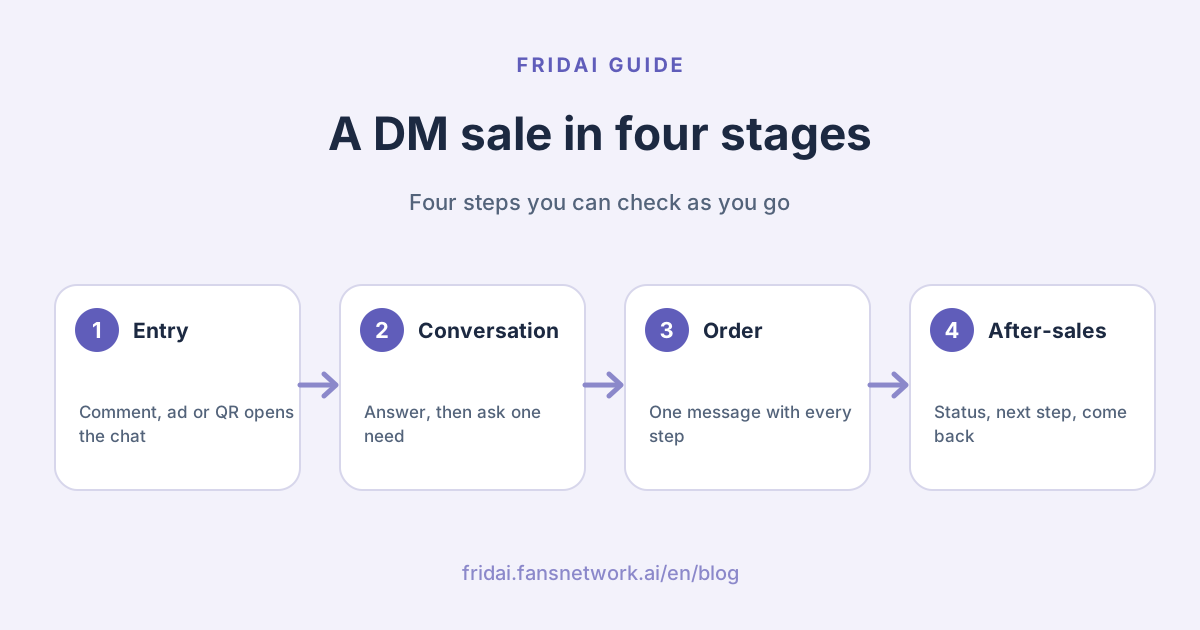
Whether you sell cakes, do nails or run courses, a conversation that ends in a sale passes through roughly four stages.
The last line, from after-sales back to conversation, matters. The benefit of selling in DMs is not a single conversion; it is that the thread is still there the next time the customer wants to buy.
The table below is the core of this guide. At each stage customers ask different things, a good reply looks different, and you measure something different.
| Stage | Customers ask | Good reply pattern | What to measure |
|---|---|---|---|
| Entry | How much? Still available? | Answer in one line, then ask one need | Conversations started |
| Conversation | Which one suits me? | Offer two options and the difference | Share that reach a quote |
| Order | How do I buy and pay? | Put every step in one message | Orders or bookings |
| After-sales | Where is it? Can I exchange? | Give the status and the next step | Repeat orders and complaints |
A few details we care about most:
- At entry, do not open with a wall of price list. Answer the question the customer asked, then ask one question that helps you recommend.
- In conversation, two options are enough. With too many, the customer says "let me think about it", and that is usually the end of it.
- At order, put the item, amount, payment method and pickup or shipping time in a single message and ask the customer to reply to confirm.
- In after-sales, keep "received", "in progress" and "done" apart. If you have only received the message, do not say it has been handled.
Which steps can be automated, and which need a person?
Conversational commerce does not mean fully automatic. Our split is simple: fixed answers with a low cost of error go to the system; anything involving judgment, money or emotion stays with a person.
| Task | Who should do it | Why |
|---|---|---|
| Hours, address, shipping fee | Automated | The answer is fixed |
| Collecting size, date, party size | Automated | Can be asked one at a time |
| Recommending items by need | Automated, with human spot checks | Easy to mis-recommend with many items |
| Booking and pickup reminders | Automated | Should send when the time comes |
| Asking again when a customer goes quiet | Automated, with a cap | Too many nudges gets you blocked |
| Bargaining, custom quotes | Person | Conditions differ every time |
| Complaints, refunds, defects | Person | Needs judgment and ownership |
| Medical, legal, money disputes | Person | A wrong answer costs too much |
For the automated part, the key is writing down when to stop: if the customer mentions a refund, is angry, or asks something that is not in the knowledge base, the system should stop, notify a person, and first tell the customer it has been passed on. For how to write that, see how to write AI customer service rules. Fixed reply wording can be copied straight from the customer service reply templates.
If your enquiry volume is small and the questions are fixed, the keyword auto-response built into a LINE Official Account plus human replies is enough, and you may not need an outside tool. The how-to is in LINE auto-reply setup and examples.
DM sales flows for three kinds of business
The three flowcharts below are illustrations. Adjust them to your own items and staffing.
Retail: from comment to order
For shops selling physical goods whose customers first ask the price under a post.
The second step is the important one. Instagram's official documentation states that a private reply to a comment is limited to one message and must be sent within 7 days of the comment; the conversation can continue only after the customer replies. So that one DM has to make people want to answer, not carry the whole catalogue.
Booking-based services: from enquiry to visit
For hair salons, nail studios, clinic front desks, restaurants, repair shops and anything else that schedules time.
The trap for bookings is "pending". If a person still has to check the calendar, the reply should say "received, pending confirmation", not "booking complete".
Courses and consulting: from enquiry to sign-up
For higher-priced services where the customer first needs to know whether it fits.
For these services, the part most worth automating is the fit check at the start, and the part that should never be automated is promising results. Lines like "you will definitely learn it" or "guaranteed to pay for itself" should not come out of an auto-reply.
How do platform rules limit selling in DMs?
Platforms do not object to doing business in DMs, but they are strict about when you may message someone first. Below is only what we read on the official pages today; for details, read the originals and our dedicated posts.
| Platform | Official rule | Effect on selling |
|---|---|---|
| Meta messaging | A customer message opens a 24-hour standard messaging window | Free replies and promotion only inside it |
| Meta messaging | The Human Agent tag allows manual replies within 7 days | For a real person only, not for bulk sends |
| One private reply per comment, within 7 days | The first message must earn a reply | |
| LINE | Reply messages and one-to-one chats are not billed | Answering customers uses no quota |
| LINE | Push and broadcast messages count toward the quota | Proactive nudges use your allowance |
Meta: finish the deal within 24 hours
Meta's Messenger Platform policy states that it applies to the Messenger Platform and the Instagram Messaging API. When a customer messages you, or clicks an ad that leads to Messenger and starts a conversation, a 24-hour standard messaging window opens, and messages inside it may contain promotional content. To message outside the window you need a message tag for an approved use case; using tags outside approved cases may lead to restrictions on your messaging.
In practice this means the day after a customer asks is the most valuable one. Get the quote, order summary and payment method into the same conversation. If you remember to follow up three days later, the system will most likely not be able to send it.
The same policy says that where the law requires it, automated chats must disclose that the customer is interacting with an automated service, and Meta recommends doing so even where it is not required. For the details and other limits, see Instagram auto-reply: built-in features and tools compared.
LINE: replies are free, proactive pushes are not
LINE's official 2026 price announcement lists greeting messages sent when someone adds you, one-to-one chat messages, auto-response messages and Reply API messages in the Messaging API as not billed. The pricing page on LINE Developers states that push, multicast, broadcast and narrowcast messages are counted, by the number of people who receive them.
So on LINE, the core move of conversational commerce, "the customer asks, you answer", does not use up messages. What costs money is the promotions and reminders you send on your own initiative. We do not recalculate plan fees and add-on prices here; the full numbers are in the LINE Official Account pricing guide for 2026.
How do you tell whether chats lead to orders?
We give no industry averages in this section, because we could not find an official statistic that would hold for your shop. What you need is your own baseline: measure for four weeks, then compare against yourself.
Step 1: define what counts as a sale
For retail it is payment received, for bookings it is the customer showing up, for courses it is a completed sign-up. If the definition is fuzzy, every number after it becomes an argument.
Step 2: make every entry point distinguishable
- Use a different opening keyword or QR code for each entry, for example one set on the shop counter and another on the card inside parcels.
- Use a different discount code for each campaign, so checkout tells you which conversation the customer came from.
- Add a "how did you hear about us" field to the order note or booking form, filled in by the customer or your staff.
- Use contact tags to record the stage, such as quoted, ordered, picked up.
Step 3: work out four numbers a week
Weekly DM sales log
Entry | Conversations started | Reached a quote | Sales | Handed to a person | Notes
IG comment to DM | | | | |
IG direct DM | | | | |
LINE new friend | | | | |
FB Messenger | | | | |
In-store QR code | | | | |The maths is simple: sales divided by conversations started is that entry's conversation-to-sale rate. Here is a made-up example to show how to read it: if one entry opens 50 conversations in a week, 20 reach a quote and 5 become sales, the problem is probably after the quote, so check the payment steps and the order summary rather than the entry copy. These numbers were invented for illustration and are not any shop's results.
Step 4: read the conversations, not just the numbers
Each week pick ten conversations that did not end in a sale and read them through, noting the line where the customer stopped. There are three common stopping points: nobody answered, there was no next step after the quote, or paying was too much trouble. Numbers tell you which stage leaks; conversations tell you why.
Common pitfalls and how to avoid them
- Turning conversational commerce into conversational broadcasting. Pushing when nobody asked gets you blocked on LINE and runs into the messaging window on Meta.
- An auto-reply that promises what the shop cannot deliver. Stock, arrival dates and discounts all change, so never hard-code them in a fixed message.
- Many entry points, all landing in one inbox nobody watches. First settle who looks at which platform during which hours.
- Orders that exist only in the chat history. After a sale, keep a record outside the conversation, or the next person on shift will not find it.
- Sending every question to a human. That is just a more expensive message board; give the fixed questions to the system so people have time for exceptions.
- Watching reply speed only. An instant wrong answer just sends the customer away more efficiently.
FAQ
How is conversational commerce different from an ordinary online store?
On an online store, customers browse, add to cart and check out by themselves. In conversational commerce the customer asks in DMs and the shop or its system walks them through to the order. The two can coexist, and DMs suit products people need to ask about before they dare to buy.
Can I do conversational commerce without a website or shopping cart?
Yes. Many small shops quote in DMs, send bank transfer details or a payment link, and record orders by hand. What matters is keeping a record of the order outside the conversation and sending the customer one confirmation message that states the item, amount and time.
Will the platform restrict me for using AI to reply in DMs?
Automated replies through a platform's official API are allowed in themselves. Trouble comes from pushing messages outside the messaging window, or sending identical content to large numbers of people. Meta also recommends letting customers know they are talking to an automated service.
Why do customers go quiet after asking the price?
Common reasons are a quote with no next step, or too many options at once. Try a quote plus one easy question, such as which time slot or which colour, and put payment and pickup details in the same message.
Does it cost money to follow up on LINE with customers who did not order?
According to LINE, reply messages and one-to-one chats are not counted toward the quota, while push and broadcast messages are, by number of recipients. Which kind a proactive follow-up uses depends on your tool, so confirm with the vendor first.
How many people does conversational commerce take?
There is no fixed answer; it depends on enquiry volume and how repetitive the questions are. Start by counting the ten most-asked questions in one week. If most have fixed answers, automate those first, then see how many people the rest needs.
How FRIDAI can help
The hard part of conversational commerce is not the first reply; it is making sure someone carries every conversation to the end. FRIDAI Chat connects to LINE, Instagram and Facebook DMs, replies based on the AI rules and knowledge notes you write, completes bookings inside the conversation, follows up automatically when a customer goes quiet, and notifies a person to take over when judgment is needed. Bringing people from post comments into DMs is the job of FRIDAI Social.
- DM customer service: FRIDAI Chat
- Comment engagement: FRIDAI Social
- Reply templates: 36 customer service reply templates
- Automation basics: What is social media automation
- Instagram: FRIDAI on Instagram
- Threads: FRIDAI on Threads
- Facebook: FRIDAI on Facebook
Official sources
- Meta: Messenger Platform Policy Overview: developers.facebook.com/
docs/ messenger-platform/ policy/ policy-overview - Meta: Instagram Private Replies: developers.facebook.com/
docs/ instagram-platform/ private-replies - LINE official announcement: 2026 Official Account plan price adjustment: tw.linebiz.com/
column/ LINEOA-2026-Price-Plan/ - LINE Developers: Messaging API pricing: developers.line.biz/
en/ docs/ messaging-api/ pricing/