
When customer service goes to a new teammate, a part-timer or an AI, the question you hear most is "how do I answer this one?". A good SOP makes you hear it far less often.
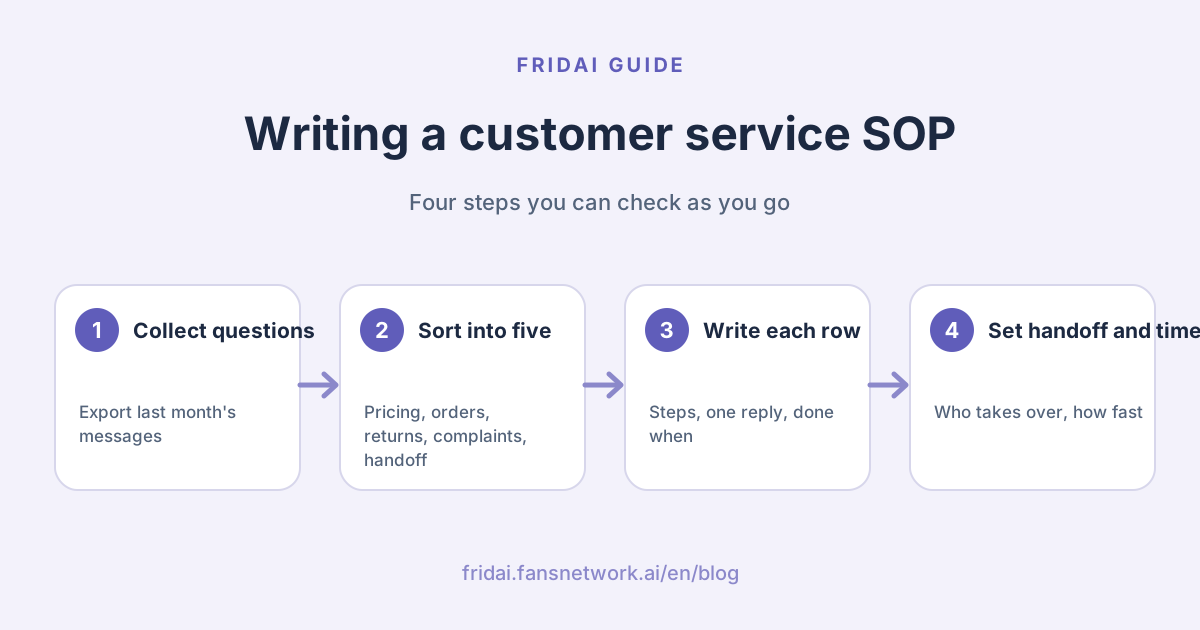
What a customer service SOP is: one table that answers four things
A customer service SOP (standard operating procedure) is not a thick manual. It is a table that lets anyone who picks up the chat reply equally well. Every row answers four things:
| What it answers | How to write it | Example |
|---|---|---|
| The situation | In the customer's own words | "Is this still in stock?" "Has my order shipped?" |
| Who handles it | Front line, manager or AI | Front line replies directly; refunds go to the manager |
| How to reply | Steps plus one standard reply | Look up the order, then reply with status and date |
| When to hand off | To whom, and how fast | Any mention of injury goes to the manager immediately |
Reply templates answer "how do I say this", and the SOP answers "how do I handle this". Use them together: the SOP is the skeleton and the replies are the muscle. For individual lines, use 36 customer service reply templates; this post focuses on building the skeleton.
How to write a customer service SOP: five steps
The fastest way to write an SOP is to start from messages you have already answered, not from a blank page.
Step 1: List the questions you get most
Go through the last month of LINE, Instagram and Facebook messages and copy the questions word for word. Anything that came up three times or more must be in the SOP.
Step 2: Sort them into five scenarios
Most small shops can fit nearly every message into pricing, order status, returns and exchanges, complaints, or human handoff. Put anything that does not fit under "other" and decide next month whether it needs its own row.
Step 3: Write the steps and one standard reply for each scenario
Number the steps 1, 2, 3, and make every step an action: "ask for the order number", "check shipping status", "reply with the status and expected date". Write only the single most common reply; the variations belong in your reply templates.
Step 4: Set handoff rules and reply times
Write down which situations always go to a person, to whom, and how fast. Make the time one you can keep, such as "within 2 hours during business hours", not "as soon as possible".
Step 5: Test it once, then update it monthly
Take five real questions and have a new teammate or the AI answer them using only the SOP. Whichever row cannot produce an answer is the row to fix. After that, review complaints and repeat questions once a month and add the new ones to the table.
Customer service SOP template: five scenarios in one table
Replace the 〔〕 parts with your own details. You can paste this table straight into Google Sheets or Notion; each row is one SOP.
| Scenario | What customers say | Steps | Who handles it | Done when |
|---|---|---|---|---|
| Pricing and products | How much, in stock, what is the difference | Confirm the item → give price and stock → share the purchase link | Front line or AI | The customer has the price and the next step |
| Order status | Has it shipped, when will it arrive | Ask for the order number → check status → reply with status and date | Front line or AI | The customer knows where it is and when it arrives |
| Returns and exchanges | I want to return it, wrong size, it arrived damaged | Ask for the order and reason → explain the policy → give the return steps | Front line takes it, manager approves | The customer knows how to return and how long it takes |
| Complaints | Disappointed, waited too long, wants compensation | Acknowledge → get the facts → say who handles it and when | Manager or owner | The customer knows who replies and when |
| Human handoff | Wants a person, special request, negotiating price | Say it has been passed on → notify a person with the original message | The named person | A person takes over within the set time |
Steps and standard replies for each scenario
Each scenario has the one reply you will use most. The originals are in Traditional Chinese for Taiwan shops; copy them and replace the 〔〕 parts.
Pricing and products: answer first, then give the next step
When a customer asks for a price, the worst reply is "please DM us" or "see our website". Answer, then add the link.
【詢價】
〔品項〕的價格是〔金額〕,目前〔有貨/預計〔日期〕到貨〕。〔一句差異說明,例如:和〔另一款〕差在〔差異〕〕。想直接訂購的話,可以從這裡下單:〔連結〕。
In English: "〔Item〕 is 〔price〕 and is 〔in stock / expected on 〔date〕〕. 〔One line on how it differs from 〔other item〕〕. You can order it here: 〔link〕."
Order status: ask for the number, all at once
【訂單查詢】
幫你查一下!請給我訂單編號或下單時的手機末三碼。
(查到後)你的訂單〔編號〕目前是〔狀態〕,預計〔日期〕送達,物流單號是〔單號〕。
In English: "Let me check! Please send your order number or the last three digits of the phone number you ordered with. (Once found) Order 〔number〕 is 〔status〕, expected on 〔date〕, tracking number 〔number〕."
Returns and exchanges: explain the policy and steps; approval goes to someone with authority
【退換貨】
收到,很抱歉這次讓你需要退換。請告訴我訂單編號和想退換的原因,有瑕疵的話附上照片。我們確認後會在〔時間〕前回覆你退換方式,退回的步驟是〔步驟〕。
In English: "Got it, and sorry you need to return this. Please send the order number and the reason, plus a photo if it is damaged. We will confirm how to return or exchange it by 〔time〕; the return steps are 〔steps〕."
For refund amounts, who pays shipping and exceptions, the front line only explains the published policy; approval always goes to the manager.
Complaints: acknowledge, then say who handles it and when
【客訴】
很抱歉讓你有這樣的經驗,謝謝你告訴我們。請給我訂單編號或發生的日期,我已經轉給〔負責的人〕,他會在〔時間〕前回覆你。
In English: "I'm sorry you had this experience, and thank you for telling us. Please send the order number or the date it happened. I have passed this to 〔person〕, who will reply by 〔time〕."
The full five-step complaint process, severity tiers and 12 examples are in the complaint handling SOP.
Human handoff: say who takes over and how soon
【轉真人】
這個問題我請〔稱呼〕直接回覆你,他會在〔時間〕前回訊息。你不用重講一次,我已經把剛剛的對話轉給他了。
In English: "I've asked 〔name〕 to reply to you directly, and they will message you by 〔time〕. You don't need to repeat anything; I've passed on our conversation."
A quick tip: the handoff line must say how soon. If it only says "please wait", the customer will ask "anyone there?" ten minutes later~
When to hand off: situations that always go to a person
Handing off is not the SOP failing; it is part of the SOP. Use this table as your handoff rules.
| Situation | Why a person handles it | Hand off to |
|---|---|---|
| Asks for a refund, compensation or discount | Money is involved and needs someone with authority | Manager |
| Mentions injury, allergy or feeling unwell | Personal safety is involved | Owner, immediately |
| Mentions a formal complaint, report or legal action | Legal responsibility is involved | Owner, immediately |
| Comes back about the same issue a second time | The first answer did not solve it | Whoever handled it last time |
| Custom work, bulk orders or price negotiation | Needs a quote and judgement | Sales or manager |
| Explicitly asks for a person | Respect the customer's choice | Whoever is on shift |
| The SOP has no answer | Never answer by guessing | Whoever is on shift; add it to the SOP afterwards |
The last row is the one most often skipped: when there is no answer, hand it to a person rather than letting the front line or the AI guess. A wrong guess is the first step toward a complaint.
Reply times and shift handover: replace "as soon as possible" with rules you can write down
Writing reply times into the SOP gives both customers and teammates something to rely on. The times below show how to phrase them; change them to numbers your team can keep.
| Item | Example wording |
|---|---|
| First reply during business hours | 〔e.g. within 30 minutes〕 |
| Messages after hours | 〔e.g. by 11 a.m. the next day〕, with an automatic note giving your hours |
| Questions that need checking | Acknowledge first, reply with the answer 〔e.g. before closing the same day〕 |
| After a handoff | 〔e.g. within 2 hours during business hours〕 |
| Shift handover | Open conversations go on a handover sheet with the time promised to the customer |
Handover goes wrong most often when the previous shift promised a time and the next shift does not know. Three columns are enough: customer, what was promised, and the deadline.
To measure reply speed and resolution time, see customer service KPIs for small shops.
The law behind your returns SOP: seven days and fifteen days
Orders closed through a website, LINE or Instagram DMs are usually distance sales under Taiwan's Consumer Protection Act. Your returns row should at least follow these articles, summarized from the Laws and Regulations Database of the Republic of China (Taiwan):
- Article 19: a consumer in a distance sale may cancel the contract within seven days of receiving the goods or service, by returning the goods or by written notice, without giving a reason or bearing any cost; reasonable exceptions apply and are set by the Executive Yuan.
- Article 19-2: the business must refund what the consumer paid within fifteen days of the day after taking back the goods, receiving the returned goods or receiving notice of cancelling a service contract.
- Article 43: the business must properly handle a consumer complaint within fifteen days of the day it is filed.
So your returns reply should never say "no returns or exchanges" in a way that conflicts with the law. Whether your product falls under a reasonable exception should be checked against the Executive Yuan's published rules or with a professional. Fifteen days is the legal maximum for a refund; write a faster time your team can keep into the SOP.
Handing your SOP to an AI agent: one row becomes one rule
Once the SOP is written, each row can become an AI customer service rule. Each scenario is one rule, the steps become the rule's steps, and the handoff situations become the rule's limits.
【規則:退換貨】
觸發:客人提到退貨、換貨、尺寸不合、收到瑕疵或寄錯。
處理順序:
1. 先表達抱歉,請客人提供訂單編號與原因,有瑕疵請附照片,只問一次。
2. 說明公開的退換貨規定與退回步驟:〔你的規定〕。
3. 告知〔負責的人〕會在〔時間〕前回覆退換方式,並通知真人,附上客人原話。
邊界:不得自行核准退款、補償或例外;客人提到受傷或提告時立刻通知負責人。
完成標準:客人知道下一步與回覆時間;真人接手後 AI 不再回覆。
In English: Trigger: the customer mentions a return, exchange, wrong size, damage or wrong item. Steps: apologize and ask once for the order number, reason and a photo if damaged; explain the published returns policy and steps; say 〔person〕 will reply by 〔time〕 and notify a person with the customer's message. Limits: never approve refunds, compensation or exceptions; notify the owner immediately on any mention of injury or legal action. Done when: the customer knows the next step and the reply time; the AI stays quiet once a person takes over.
The six-part rule format is in how to write AI customer service rules. When a person's reply beats the AI's, the AI can learn from it too; see learning from human replies.
Five common mistakes when writing a customer service SOP
- Starting from a blank page. An SOP written from memory often misses what customers really ask every day. Review the messages first.
- Writing replies without steps. New teammates memorize the lines but don't know whether to check the order or apologize first.
- Leaving out handoff rules. The front line and the AI both push on alone and end up answering refunds and compensation wrongly.
- Writing "as soon as possible" for reply times. If you can't write a number, nobody owns it.
- Never looking at it again. When products, shipping or promotions change, the SOP is out of date. Update it monthly and note what changed at the bottom of the table.
Summary: how to write a customer service SOP

A quick note from FRIDAI
The one thing I want you to remember about a customer service SOP: it isn't a manual, it's a table that lets anyone who picks up the chat reply equally well~
Follow these steps and you can have a first version this week:
- Export the last month of messages; any question that came up three times or more goes in.
- Sort into pricing, order status, returns, complaints and human handoff, and write the steps, one reply and "done when" for each.
- Spell out the handoff rules: money, safety, legal issues, repeat contacts and missing answers always go to a person.
- Write reply times as numbers you can keep, and hand over promised times at every shift change.
- Review the log monthly and add new questions to the table.
Once your SOP is written, hand it to me for a test run; whichever row I can't answer, we'll fill in together☺️
FAQ
What should a customer service SOP include?
Each SOP row covers four things: the situation, who handles it, the order of steps, and when to hand off to a person. Add one standard reply and what "done" looks like, and anyone can follow it.
What is the difference between a customer service SOP and reply scripts?
Scripts answer "how do I say this", and the SOP answers "how do I handle this". The SOP sets the steps, the owner, the handoff rules and the reply times; scripts are the copy-ready lines inside each step.
How many scenarios should a small shop's SOP have?
Most small shops can start with five: pricing and products, order status, returns and exchanges, complaints, and human handoff. Put anything else under "other" and give it its own row once it keeps coming up.
When should a chat always go to a human agent?
Hand off when the customer asks for a refund, compensation or discount; mentions injury, allergy, a formal complaint or legal action; comes back about the same issue; needs custom work or a quote; asks for a person; or when the SOP has no answer.
What laws should a returns SOP follow in Taiwan?
For distance sales, Article 19 of the Consumer Protection Act lets consumers cancel within seven days of receipt without giving a reason, with reasonable exceptions set by the Executive Yuan; Article 19-2 requires the business to refund within fifteen days of the day after receiving the returned goods. Check specific cases with the authorities or a professional.
How often should a customer service SOP be updated?
Review complaints and repeat questions once a month and update the SOP. When products, shipping, promotions or policies change, update it the same day.
Can an AI customer service agent use the SOP directly?
Yes. Rewrite each scenario as an AI rule with a trigger, steps, limits and a "done when". The handoff situations become the rule's limits, so the AI notifies a person on refunds, compensation or safety issues.
How FRIDAI can help
Once the SOP is written, the risk is that nobody follows it when things get busy. FRIDAI Chat connects to your LINE Official Account, Instagram and Facebook Messenger DMs, answers pricing, order and common questions using the rules in your knowledge base, notifies you when a chat hits a situation you set to go to a person, and pauses the AI once a person takes over.
- DM customer service: FRIDAI Chat
- Reply scripts: 36 customer service reply templates
- Complaint process: The complaint handling SOP
- Instagram: FRIDAI on Instagram
- Threads: FRIDAI on Threads
- Facebook: FRIDAI on Facebook
Official sources
- Laws and Regulations Database of the Republic of China (Taiwan): Consumer Protection Act, Article 19: law.moj.gov.tw/
ENG/ LawClass/ LawAll.aspx?pcode=J0170001 - Laws and Regulations Database of the Republic of China (Taiwan): Consumer Protection Act, Article 19-2: law.moj.gov.tw/
LawClass/ LawSingle.aspx?pcode=J0170001&flno=19-2 - Laws and Regulations Database of the Republic of China (Taiwan): Consumer Protection Act, Article 43: law.moj.gov.tw/
LawClass/ LawSingle.aspx?pcode=J0170001&flno=43 - FRIDAI Chat: fridai.fansnetwork.ai/
en/ fridai-chat