One-page website, landing page, sales page: the same thing?
The three terms are used interchangeably, but each looks at the page from a different angle.
A landing page is defined by its use: it is the page a visitor lands on after tapping an ad, a post or a link. It takes one kind of traffic and pushes one action.
A one-page website is defined by its form: the entire site is a single page you scroll through, with no menu to wander around.
A sales page is defined by its purpose: the page exists to sell something or collect leads.
The most common combination is a sales page, built as a one-page site, used as a landing page. A one-page store (一頁
Do you need a one-page website?
Not every brand does. Find the row that matches where you are now.
| Approach | Fits when | Does not fit when |
|---|---|---|
| LINE or IG link only | You are starting out and customers come by referral | You run ads or need a full explanation |
| One-page website | One main product or service, goal is bookings or leads | Many items, or you need memberships |
| One-page store | One or a few products, checkout on the page | Services that need a consultation before a quote |
| Full website | Many items, a blog, several service pages | You only want to test whether one product has demand |
Our rule of thumb: if a customer needs to be persuaded once and your argument can be laid out in a straight line, a one-page site fits. If a customer needs to compare many items, use a full website or a store. There is nothing wrong with only a profile link either, as long as your DMs can handle the conversation. For designing sales that close in chat, see Conversational commerce.
Sales page copy structure: six sections that sell
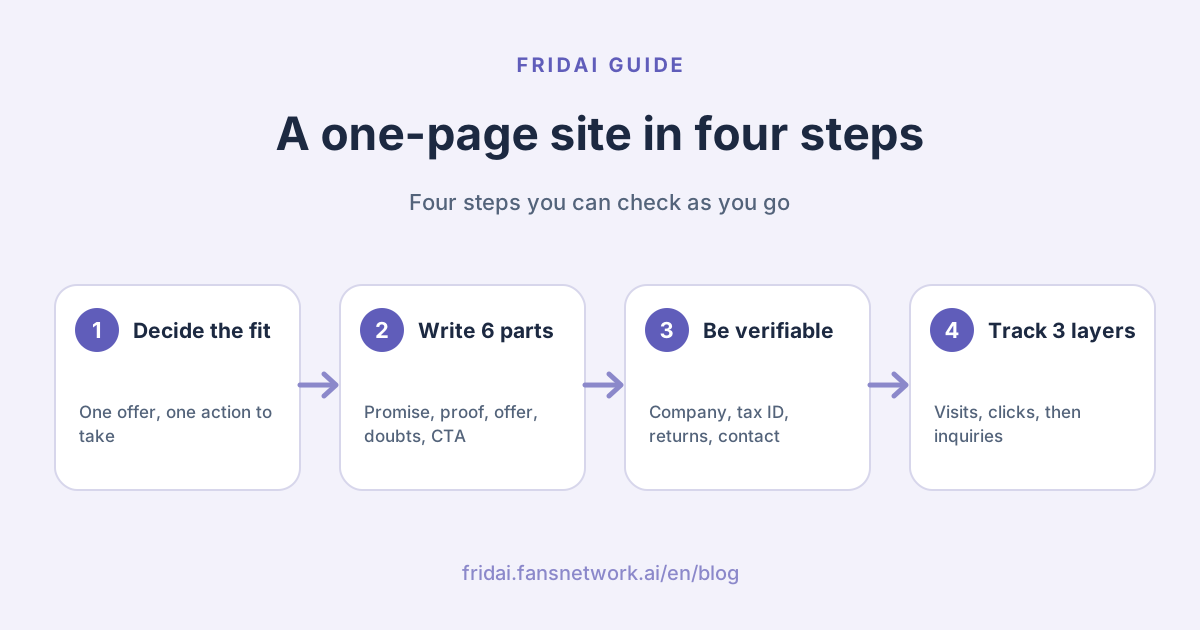
Where people get stuck is rarely design. It is not knowing what each part should say. Put these six sections in order and you have a complete line of persuasion.
| Section | What to write | Common mistake |
|---|---|---|
| Hero promise | One sentence on who you help and with what, plus one button | A brand slogan that never says what is for sale |
| Proof | Real cases, reviews, press coverage, licences | Numbers with no source, or made-up testimonials |
| Offer and price | What is included, price, payment and delivery | Hiding the price at the bottom or behind a DM |
| Objections | What customers fear most and how you handle it | Only benefits, no limits, no "not for you" |
| FAQ | Returns, timing, warranty, how to reach you | Self-praising questions nobody asks |
| Call to action | The button again, and what happens after tapping | Five different buttons at once |
A few principles we hold to.
First, one page pushes one action. If it is bookings, the whole page is bookings. Do not ask for a LINE add at the top, a purchase in the middle and an Instagram follow at the bottom.
Second, show more proof than promise. The promise is what you say; proof is what others can check. If you have no cases yet, show photos of your process and introduce yourself. Do not invent one.
Third, the price has to appear. When a page shows no price, visitors fill in the blank with "expensive" or "something is off". If a quote really is needed, say what the quote depends on.
Fourth, write down who it is not for. It sounds like turning customers away. In practice it saves you refunds and complaints later.
A wireframe outline you can copy
Paste this outline into a document and replace the brackets with your own content. You can reorder the blocks, but keep every one of them.
[1 Hero]
Headline: (who you help) + (what you solve) + (how fast or by what method)
Subheadline: one supporting line on your biggest difference
Button: (Book now / Ask on LINE / Buy now)
Main visual: a real photo of the product, the space or you

[2 Pain points]
Three situations your customer will nod at, in their words

[3 What you offer]
What you provide, how many steps, what the customer does at each step

[4 Proof]
Three cases or reviews (with the source), press coverage, licences

[5 Offer and price]
Items, price, what is and is not included, payment methods, delivery time

[6 Objections]
Who it is not for, common worries and your answer, return or cancellation rules

[7 FAQ]
Five to seven questions: price, timing, returns, warranty, how to reach you

[8 Final call to action]
Repeat the hero button and add one line on what happens next

[9 Footer]
Company or business name, representative, tax ID (統一編號), address,
phone or email, return policy, privacy policy, how complaints are handled
Three ways to build a one-page website
There are roughly three routes. We compare them on the same criteria and state prices only where we could verify them; for the rest, check each vendor's official pricing page.
| Criteria | Website builder, DIY | One-page store tool | Guided AI sales page |
|---|---|---|---|
| Examples | Wix, WordPress, Webflow, Google Sites | The one-page store feature of e-commerce platforms | FRIDAI AI Sales Pages |
| Your work | Pick a template, write copy, lay out, set the domain | List products, set up payment and shipping | Provide your current URL and material, approve the content |
| Cost structure | Varies; may include subscription, hosting, domain or plugins | Usually monthly or yearly, sometimes with transaction fees | One-time setup fee including year one, then yearly |
| Speed to launch | Depends on how much time you have | Sell once products and payment are set | Import the old site, edit, approve, publish |
| Maintenance | Edit it yourself or hire someone | Edit in the admin yourself | Ask the AI in chat, or click text to edit |
| On-page checkout | Usually a separate integration | Built in | No memberships or payments |
Website builder, do it yourself
The upside is maximum flexibility: it can look however you want, and growing into a full site later is smooth. The cost is your time. Copy, images, layout, mobile view, domain and tracking are all your decisions. For a team with hands available and a willingness to learn, this is the best value.
One-page store tool
When what you want is "the customer reads and checks out on the same page", this is the most direct choice, because cart, payment and shipping are built in. It fits less well for services that need a consultation, a booking or a quote first, because the action in that kind of business is a conversation, not a checkout.
Guided AI sales page
Taking FRIDAI AI Sales Pages as the example, the product page states: there is a single yearly plan, a one-time guided setup of NT$50,000 including the first year of service, then NT$18,000 per year from year two, with the checkout page as the final word on charges. The plan includes free import of your existing website, material clean-up and custom images, 6 design templates, your own domain, a 1-hour training session, tracking of call-to-action clicks and bookings, automatic A/
Its limits belong here too: new feature development, memberships or payments, and multi-page applications are out of scope. If you need checkout inside the page, choose a one-page store tool. If budget is tight and you have time to do it yourself, a website builder has a lower entry cost. It suits brands that already have a site or material, want bookings or leads, and do not want to wait on someone every time a word changes.
For the actual workflow, see How to buy and set up an AI Sales Page. For improving the page with data after launch, see How an AI sales page optimises itself.
The shadow of "one-page scams": showing customers you are real
In Taiwan you cannot talk about one-page websites without the phrase 一頁
A Q&A from the Consumer Protection Committee of Taiwan's Executive Yuan lists the usual hooks of one-page ads: emphasis on cash on delivery, prices clearly below market, a touted seven-day trial with refunds, limited-time offers whose countdown never ends, oddly spelled URLs, mainland Chinese wording, and no physical phone number or address. The Committee also notes that these sellers are mostly overseas, which makes cross-border disputes hard to resolve.
Once you know what customers fear, you know what to do in reverse.
| What customers fear | What a legitimate brand does | Where it goes |
|---|---|---|
| No phone or address | Company or business name, tax ID, address and phone, all stated | Footer and contact block |
| Cash on delivery only | Clear payment methods, and what happens if the item is wrong | Offer and FAQ |
| A countdown that never ends | A real end date, and the offer comes down on that date | Hero and offer |
| Unreasonably low price | What the price includes and what it does not | Offer and price |
| A trial period in one slogan | The full return process and how requests are handled | Objections and footer |
| A URL that names nobody | Your own brand domain | Domain settings |
Three more things are worth doing. Link your social accounts, your Google Business Profile and photos of your physical shop so customers can cross-check. Use real reviews and keep the source. And when a customer DMs "are you a scam?", do not get angry; send your company registration details. For wording, see 36 customer service reply templates.
Legal basics for sellers in Taiwan
This section states only what the statutes say. Whether an exception applies to your product is a question for the competent authority or a lawyer.
Consumer Protection Act: what you must tell the customer
The Consumer Protection Act (消費者
- The business's name, representative, office or place of business, and a phone number, email or other means by which consumers can reach it quickly and effectively.
- The content of the goods or service, the price, the payment date and method, and the delivery date and method.
- The deadline and method for the consumer to rescind the contract under Article 19.
- Where the goods or service fall under an exclusion from that right, a statement saying so.
- How consumer complaints are received.
The article adds that for distance sales over the internet, this information must be provided electronically in a form the consumer can view in full and save. That is why the wireframe above ends with a footer.
Rescission within seven days
Article 19 provides that a distance-sale consumer may rescind the contract within seven days of receiving the goods or service, by returning the goods or by written notice, without giving a reason and without bearing any cost. Reasonable exceptions for distance sales are excluded, and those exceptions are set by the Executive Yuan. If the business did not provide the rescission information, the seven days run from the day after it is provided, up to a maximum of four months. Article 19-2 further requires the business to refund what the consumer paid within fifteen days from the day after it collects the goods, receives the returned goods, or receives notice rescinding a service contract.
If the ad says it, you have to do it
Article 22 of the Consumer Protection Act requires a business to ensure its advertising is truthful, and its obligations to consumers may not be less than what the advertising says. Article 21 of the Fair Trade Act (公平
In plain words: every "original price", "limited stock", "last three days" and testimonial on your sales page needs something behind it. If you can write a promise but cannot keep it, delete it from the page.
Pre-launch checklist
Run through this list before you publish. It catches most of the avoidable mistakes.
□ Within three seconds the hero shows what is sold and to whom
□ The whole page has one action, with consistent button text
□ Every button has been tapped once and goes to the right place
□ After a test form submission, you receive the notification
□ On a phone the text reads without zooming and buttons are tappable
□ Price, payment methods and delivery time are stated
□ Cases and reviews are real and their source can be found
□ Offers have a real end date and will come down on that date
□ The footer has company name, tax ID, address, phone or email
□ Return and rescission deadlines and methods are written clearly
□ There is a complaints channel and a privacy policy
□ The URL is your own brand domain
□ Tracking is set up and separates visitors by channel
□ A friend who has never seen it scrolls once and says what it sells
The last item is the cheapest and the most effective. If your friend cannot say it, neither can a customer.
How to tell whether the page works
You do not need a stack of reports at the start. Look at three layers; each answers one question.
| Layer | What to look at | Check first when it is weak |
|---|---|---|
| Visits | How many people saw the page and from which channel | Whether posts and ads carry the link, and the right one |
| Clicks | How many tapped the action button | Hero promise, button position and wording |
| Inquiries or orders | How many left details, sent a message or paid | Form length, reply speed, price explanation |
We are not giving you a "pass mark" percentage. Industries, order values and traffic channels differ too much for anyone else's average to mean anything for you. Compare against yourself: this month against last month, before a change against after, Instagram visitors against Google visitors.
There is one break point people overlook: what happens after the tap. Many pages get decent clicks and still lose because nobody answers once the customer adds LINE. The page brings people into the conversation. Whether the conversation is caught is the other half of the work.
FAQ
How is a one-page website different from a regular website?
A one-page website has a single page and pushes one action, which suits one main product or service. A regular website has several pages and a menu, which suits brands with many items, a blog or memberships. The two can coexist: the full site carries the complete story and the one-page site takes ad traffic.
How much does a one-page website cost?
It depends on the route. Website builders and one-page store tools are mostly subscriptions; check each vendor's official pricing page. FRIDAI AI Sales Pages is a one-time guided setup of NT$50,000 including the first year, then NT$18,000 per year from year two, with the checkout page as the final word.
Will a one-page website be taken for a scam?
It can be, because the features Taiwan's Consumer Protection Committee lists for one-page ads are low prices, endless countdowns and no phone or address. Put your company name, tax ID, address, contact details and full return process on the page and use your own brand domain, so customers can verify you.
Does a one-page website have to include return information?
For distance sales to consumers, Article 18 of the Consumer Protection Act requires the deadline and method for rescinding the contract and how complaints are received. Whether your product falls under an exception to the seven-day right is something to confirm with the competent authority or a lawyer, not to decide on your own.
Is a one-page website good for SEO?
A single page can cover only so many search topics, so it is better at receiving ad and social traffic. For steady visitors from search you usually need several articles answering different questions, or a full website with its own content.
Why do many people view the page but nobody inquires?
Split it into three layers. No visitors is a traffic problem. Visitors but no taps is a hero and button problem. Taps with no follow-through usually means the form is too long, the price is unclear or replies are slow. Change one thing at a time so you know what worked.
Can I skip the website and only use LINE or Instagram?
Yes. When customers mostly come by referral and you do not run ads, a good profile link and DM flow are enough. Build a one-page site later, when you start advertising or need room to explain your offer properly.
How FRIDAI can help
If you already have a website or material and want a one-page sales site that brings bookings and leads and that you can edit yourself at any time, FRIDAI AI Sales Pages start by importing your current site, then track call-to-action clicks and bookings by channel after launch. Once the page has brought customers into LINE or Instagram, FRIDAI Chat can pick up the DMs; it is a separate subscription and is not part of the AI Sales Pages plan.
- AI sales pages: FRIDAI AI Sales Pages
- DM support: FRIDAI Chat
- Getting better after launch: How an AI sales page optimises itself
- Step by step: How to buy and set up an AI Sales Page
- Selling in DMs: Conversational commerce in 2026
- How brands use it: How 8 Taiwan brands use FRIDAI
- Instagram: FRIDAI on Instagram
- Threads: FRIDAI on Threads
- Facebook: FRIDAI on Facebook
Official sources
- Consumer Protection Act (Laws and Regulations Database of the Republic of China, in Chinese): law.moj.gov.tw/
LawClass/ LawAll.aspx?pcode=J0170001 - Fair Trade Act (Laws and Regulations Database, in Chinese): law.moj.gov.tw/
LawClass/ LawAll.aspx?pcode=J0150002 - Consumer Protection Committee, Executive Yuan, on the features of one-page ads (in Chinese): cpc.ey.gov.tw/
Page/ BC16ACF0BBB9CCC2/ 5922d66c-3c30-4418-8ce5-29a2f09b4185 - FRIDAI AI Sales Pages product page: fridai.fansnetwork.ai/
en/ sales-pages