
Most one-page sites are paid for, launched and never touched again, and the owner still cannot say whether the site brings in customers.
Why a one-page sales site needs data
Most one-page sites follow the same story: paid for, launched, never touched again. Not because the owner doesn't care, but because nobody knows what to change. Should the headline be different? Should the price move up? Is the case-study section too far down? Without data, every redesign is a guess.
A one-page sales site has a simple job: get visitors to press "Book", "Buy" or "Add us on LINE". So the useful questions are not about how pretty it is, but:
- Which channel visitors come from (Instagram, Facebook, Google, LINE or direct).
- Where they stop scrolling and which section holds their attention.
- How many of them press the call-to-action button or submit the form.
Answer those three and redesigns get a direction. Changing a page without data is just guessing more efficiently.
What does an AI sales page track?
FRIDAI AI Sales Pages track call-to-action clicks and bookings, not actual sales. Whether a visitor pays after booking happens in your booking or payment flow, which the page cannot see, so the reports show clicks and bookings, and you match sales against your payment records.
| Metric | What it tells you |
|---|---|
| Visitors | How many people saw the page |
| CTA clicks | How often CTA links and booking buttons were pressed |
| Form submissions | How many people left their details or a booking request |
| Traffic sources | Visitors and clicks from Instagram, Facebook, Google, LINE and direct visits |
| Section engagement | Scroll depth, dwell time, sections seen, FAQ opens and video plays |
| Actual sales | Not tracked; use your payment or booking records |
Your sales page also loads none of FansNetwork's own Google Analytics or Meta Pixel, so the data belongs to your page alone.
How auto-optimisation works: three mechanisms
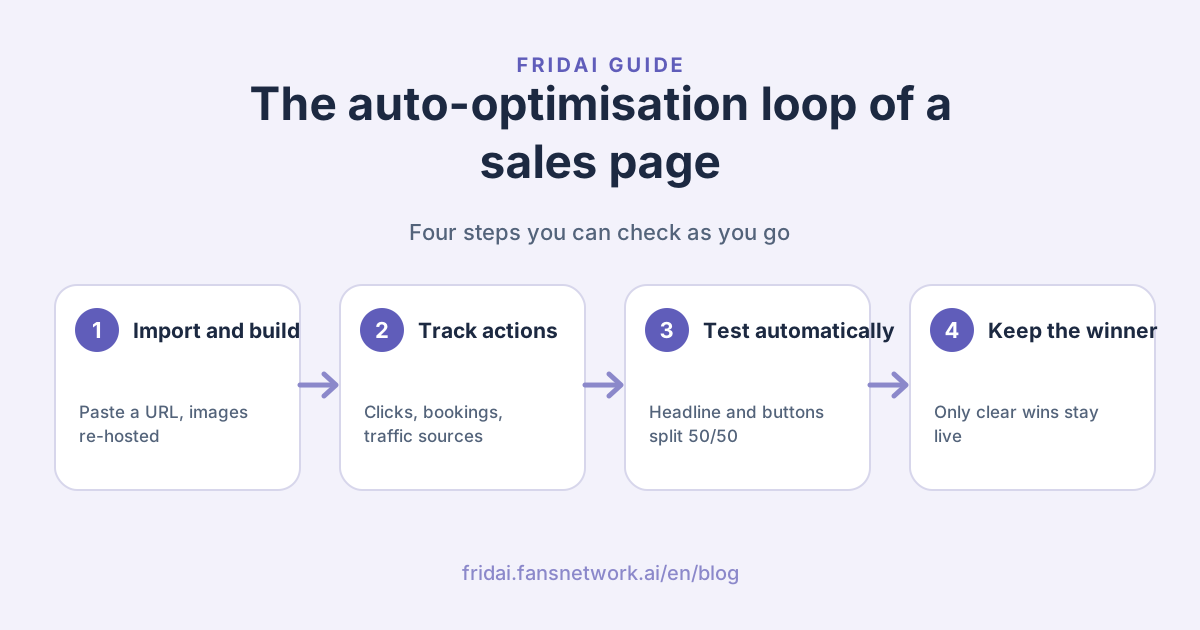
"Auto-optimisation" sounds mysterious, but it is three mechanisms with explicit rules. They share one principle: every change starts as a hypothesis, is checked against real visitors and is only kept when the difference is clear.
Mechanism 1: headline, sub-headline and button A/B tests
The AI writes a challenger for your page and states the hypothesis behind it, for example "putting the result customers care about most in the headline will earn more clicks". Then:
- Visitors are split evenly between the two versions, and the same visitor always sees the same one.
- Results are judged once a day on CTA clicks.
- A winner needs at least 150 visitors per side, at least 12 clicks in total and a 95% or higher probability of being better.
- The winner goes live automatically and the next round starts, with the AI drawing on past rounds for its next hypothesis.
- If there is no winner after 45 days or 3,000 visitors per side, the test is recorded as "no difference" and the next hypothesis starts.
Why so strict? Because a gap between a dozen visitors is usually luck. Stricter rules mean every change that goes live is easier to trust.
Mechanism 2: moving buried sections up
Some sections persuade visitors well, such as case studies or the FAQ, but sit so far down that most people never reach them. The system looks for exactly that:
- visitors who see a section click at least 1.3× more than others;
- yet fewer than 60% of visitors reach that section.
When both hold, the system proposes moving the section up, at most two sections at a time, and verifies the move with an A/
Mechanism 3: traffic-source insights
Visitors are reported separately for Instagram, Facebook, Google, LINE and direct visits, and each channel's click-through is compared. The AI turns the numbers into plain advice such as: "Instagram converts at twice the average. Consider investing more in Instagram." It is not telling you to pour money into ads; it is telling you where the same hour of effort pays off best.
More traffic, faster optimisation
A/
Editing by chat: how the AI editor works
The slowest part of a traditional website is waiting for someone to change a single word. AI Sales Pages let you edit by chatting:
- In Edit (編輯), tell the AI chat on the right what to change, for example "change the service price to NT$2,800 and move Press below the case studies". To change one area only, click that section in the preview first and use the floating Shorter, Friendlier or Move up buttons, or just type.
- The edit is saved to a draft. Switch between Original and Edited (原本
/ 修改後) under the preview to compare, or click Preview link (預覽連結) in the top bar for a private preview you can open on a phone or share. - When it looks right, click Publish (發布) at the top right. The new version is live instantly, with no redeploy.
The AI handles text, images, prices, FAQ, section order, template, colours and button links. New features, memberships or payments, multi-page apps and code changes are out of scope.
Counting is simple: each plan year includes 1,200 AI edits, and only edits that actually change the page count; questions and failed edits are free. For a typo, double-click the text in the preview and fix it directly, free and unlimited. If you need more AI edits, 50 extra cost NT$300.
Outsourced website vs FRIDAI AI Sales Pages
The two approaches suit different needs: for memberships, payments or a multi-page application, hire an engineering team; for one-page sales, bookings and lead capture, AI Sales Pages let you change the page by chatting and keep improving it with data after launch. This comparison covers the one-page sales site scenario:
| Aspect | Outsourced site | FRIDAI AI Sales Pages |
|---|---|---|
| Changes | Write a brief, wait for the developer's schedule | Tell the AI, preview, publish with one click |
| Data | Depends on the contract; analytics often set up and read by you | CTA clicks, bookings, traffic sources and section engagement built in |
| Optimising | Human judgement, then another redesign | Automatic A/ |
| Cost | Quoted per project; changes and upkeep per contract | NT$50,000 setup incl. year one, then NT$18,000/ |
| Best for | Memberships, payments, multi-page features | One-page sales, bookings and lead capture |
Pricing and what the plans include
AI Sales Pages has two plans. The website is identical in both; the only difference is how many SEO blog articles you get:
| Item | Personal Website | Full plan |
|---|---|---|
| Setup | NT$50,000 incl. year one | NT$50,000 incl. year one |
| Renewal | NT$18,000 / year | NT$18,000 / year |
| SEO articles | 3 a year | 3 a year + 8 a month |
| Blog fee | Included | US$70 / month |
The website plan is priced in New Taiwan dollars; the SEO blog is billed monthly in US dollars. Both plans include:
- Free import of your current site: paste a URL and your home page plus sub-pages such as stories, press and news are rebuilt as pages on the new site, with images re-hosted so nothing links back to the old site.
- Material and custom images: AI-generated scene and service images; portraits are always real photos you upload, never generated people.
- Six designer templates: the default is modelled on a high-converting clinic one-pager, and sections without material are hidden automatically.
- Your own domain connected and a one-hour training session.
- Tracking and auto-optimisation: CTA clicks, bookings, traffic sources, section engagement, automatic A/
B tests and section re-ordering. - 1,200 AI edits a year, plus unlimited double-click text edits.
- SEO health score, Search Console connection and 3 SEO articles a year; the Full plan adds 8 articles a month.
If your customers search and compare online before choosing, go for the Full plan; start with the Personal Website plan and you can add the blog from the dashboard any time after launch. We compare the two in How to choose an AI website plan.
Add-ons: domain purchase at the domain's actual cost plus NT$300 per year; 50 extra AI edits for NT$300; Fridai Website Chat is not included in the plan: paid add-on, priced per the Website Chat plan.
Available page sections: hero, about you, cases and testimonials, pain points, services, press, news, video, process, FAQ, a final call to action and a booking or lead form.
Summary: launch day is where a sales page starts

A quick note from FRIDAI
By now you know a one-page sales site doesn't have to be perfect on launch day. What matters is seeing where visitors come from, what they read and whether they press the booking button. FRIDAI AI Sales Pages verify every change with data, and when you want to change content, just tell me.
After launch, keep an eye on these:
- Watch three things: traffic sources, how far visitors scroll, and how many press the call-to-action button.
- Let A/
B tests decide headlines, sub-headlines and buttons; a winner goes live only after it clears the thresholds. - Move up sections that earn more clicks but that few visitors reach, once a test confirms the move.
- Compare click-through by channel and put your time into the channel that pays off best.
- To change text, prices or section order, tell me, compare Original and Edited, then click Publish.
The site you already have is the best place to start. Hand me the URL and we'll turn it into a sales page that keeps getting better.
FAQ
How much does an AI sales page cost?
There are two plans. The Personal Website plan is a one-time guided setup of NT$50,000 that includes the first year of service, then NT$18,000 per year from year two; the Full plan adds the SEO blog at US$70 a month for 8 extra articles a month.
Does the AI sales page track actual sales?
It tracks visitors, CTA clicks, bookings and form submissions, broken down by traffic source and page section. For actual sales, use your payment or booking records.
How long until an A/B test has a result?
It depends on traffic. A winner needs at least 150 visitors per side, 12 clicks in total and a 95% or higher probability of being better. Send your Instagram, Facebook and LINE audience to the page: the more traffic, the sooner the result.
How does auto-optimisation make sure a change works?
Every change is verified against real visitors' CTA clicks and only clear winners are kept; the size of the improvement varies with your traffic, offer and content.
I already have a website. Can it be moved over?
Yes, and the import is free. Paste the URL and your home page and sub-pages are rebuilt as pages on the new site, with images re-hosted so nothing links back to the old site.
When does an AI edit count against my allowance?
Only edits that actually change the page count, with 1,200 included per plan year. Questions and failed edits are free, and double-click text edits in the preview are free and unlimited.
Is Fridai Website Chat included in the plan?
No. Fridai Website Chat is not included in the AI Sales Pages plan: it is a paid add-on, priced per the Website Chat plan. Once added, it sits in the bottom-right corner and answers visitors' questions.
How FRIDAI can help
If you already have a website but can't tell whether it brings you bookings, FRIDAI AI Sales Pages start from the site you have: we handle setup, material and training, and after launch the data shows which headline and which section order get visitors to act. To try it yourself first, open the website tour and let the AI edit a sample site for real; to talk through where your site should start, book a consultation on LINE; when you're ready, buy it online in the dashboard.
- One-page AI sales site: FRIDAI AI Sales Pages
- Buy online: Get AI Sales Pages in the dashboard
- Consultation: Book a consultation on LINE
- Try the dashboard: Website tour (AI Sales Pages)
- Compare the two plans: How to choose an AI website plan
- AI chat in the bottom-right corner (paid add-on): FRIDAI Chat
- Instagram: FRIDAI on Instagram
- Threads: FRIDAI on Threads
- Facebook: FRIDAI on Facebook
Official sources
- FRIDAI AI Sales Pages product page (plans, pricing and optimisation rules): fridai.fansnetwork.ai/
en/ sales-pages