Full disclosure: this article is written by FRIDAI and mentions our own FRIDAI Post near the end. Everything said about Facebook comes from official Meta pages FRIDAI Editorial read today. Where Meta says nothing, we write "Meta does not say", and we cite no unofficial reach figures. No tool can guarantee reach, including ours.
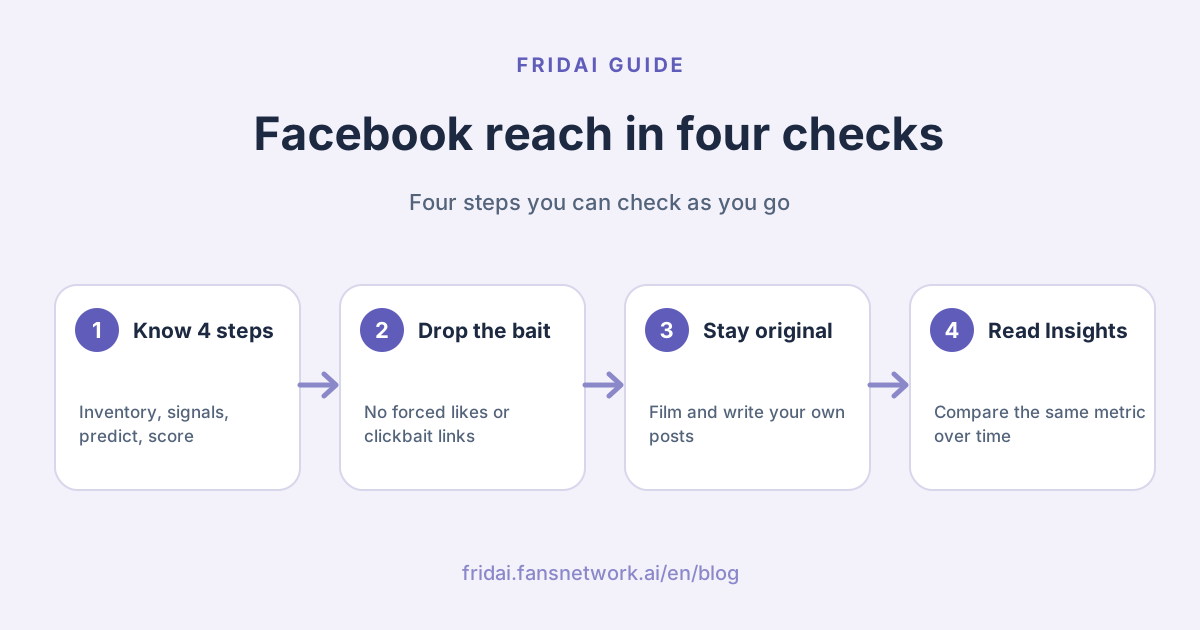
How does the Facebook algorithm rank posts? The four official steps
Meta's Transparency Center has a page explaining how Facebook Feed is ranked, and the Meta Business Help Center has a page called "How Facebook distributes content". Both describe the same four steps.
Step one: inventory
The system first gathers the posts that could be shown to this person, from friends, Pages they follow and Groups they have joined. Content flagged as violating the Community Standards is excluded at this step.
Step two: signals
Meta says thousands of signals are considered for each post and gives several kinds of example: which types of content the person usually interacts with and for how long; whether the post is a photo, video, link or Live; the past views, shares and comments of the Page or Group that posted it; and the relationship between the person and the poster.
Step three: predictions
The signals feed more than 100 prediction models. Meta groups the predictions into four categories: the actions you will take on the post, how long you will spend viewing it, your interest in the post or its poster, and how others will interact if you act. Meta also mentions surveys asking people whether a post was "worth your time".
Step four: relevance score
Each post gets a relevance score and posts are ordered by it. Meta notes that ranking also aims for variety, so people are less likely to see several posts in a row from the same Group or Page. Recommended content is interspersed afterwards, and ads are added last.
Meta also publishes an AI system card for Facebook Feed, marked as updated on 6 October 2026. The card says a lightweight model first selects about 500 relevant posts, which are then scored one by one, and it states plainly that these models and their input signals change frequently.
So the first fact to accept: your post is not measured against one fixed rule. It competes with the few hundred other posts each follower could see at that moment.
Which signals does Meta name, and what can a small Page do?
The table lists only signals or predictions that appear on Meta's official pages. The right-hand column is FRIDAI Editorial's suggestion, not Meta's statement.
| Signal or prediction | What Meta says | What a small Page can do |
|---|---|---|
| Interaction with the poster | Past interaction with the poster counts | Answer every comment and DM |
| Likelihood to comment or share | Predicts whether you will comment or share | Write posts worth forwarding |
| Time spent | Predicts how long you will view the post | Lead with the point; match text and image |
| Back-and-forth discussion | Predicts whether it sparks discussion | End on a real question, not bait |
| Post format | Photo, video, link, Live are signals | Check Insights for formats followers view |
| Clicking an outside link | Predicts clicks and time on the site | Honest headline, fast landing page |
| Originality | Original content is prioritised | Film and write your own; repost less |
| User controls | Favorites, Snooze, Unfollow | Ask regulars to add you to Favorites |
Some additions:
- The predictions listed on the AI system card include the likelihood that a person scrolls past a post without engaging, the likelihood of clicking an outside link and spending time on that site, and intent to interact with friends or groups.
- Meta's official guide for creators splits reach into two kinds. Being seen by people who already follow you is called connected distribution; being seen by people who do not follow you, through shares or "Suggested for You", is unconnected distribution. The guide recommends three things: post mainly original content, make content others want to share, and stay eligible for recommendation. It also says "When in doubt, start with Reels."
- People can add a Page to Favorites, and Meta says this makes that Page's posts appear higher. It is one of the few things you can simply ask your regulars to do.
What content gets reduced distribution?
The Transparency Center has a page titled "Types of content we demote", marked as updated on 2 July 2025. The current list is short. FRIDAI Editorial goes through it and adds behaviours named on other official pages.
Engagement bait
The official definition: posts that explicitly request engagement, such as votes, shares, comments, tags, likes or other reactions, for purposes other than a specific call to action. The exceptions Meta lists include seeking help to find missing people or property, raising money, sharing a petition, asking people to show whether they support an issue, and sharing time-sensitive information about natural disasters. Meta's stated reason is that feedback shows people dislike posts that push them to interact.
So "comment +1 to enter the draw" or "like if you agree, angry-react if you don't" falls into the type Meta demotes. Asking a question you actually want answered does not.
Clickbait links
The official definition: posts that lure people into clicking a link by creating misleading expectations, through withholding information, sensationalist phrasing, all capital letters or excessive exclamation marks. Meta's stated reason is that people prefer headlines that accurately reflect the article.
Unoriginal content
Meta's "Original content guidelines on Facebook" open with this: Facebook prioritises original content in Feed and Reels recommendations. Third-party content posted without substantial changes is considered unoriginal, receives reduced distribution, and may lead to limited or lost recommendations and monetisation.
The guideline's examples of "minor editorialization" are useful for anyone running a Page: superimposing borders, inserting logos or watermarks, adding only an on-screen caption or title, adding background music, changing a video's speed, adding subtitle transcripts, or simply describing what happens in the photo or video. None of these counts as a meaningful enhancement.
Spammy posting habits
In an official announcement in April 2025, Meta said that accounts posting long, distracting captions, often with an inordinate amount of hashtags, or captions completely unrelated to the content, will have their content shown only to followers and will not be eligible for monetisation. The same post says comments detected as coordinated fake engagement will be seen less.
Other types Meta mentions
Meta's "Reducing the distribution of problematic content" page (marked as updated on 25 April 2025) also mentions links to sites covered with ads, slow to load or broken; low-quality comments that are repeatedly copied and pasted; fact-checked misinformation; and content by creators who repeatedly violate policies.
Do links reduce reach?
This is the most common question, so here is the official position in three layers.
- What Meta names is clickbait links and low-quality webpages, not links as such. In its example of how the relevance score is built, the Business Help Center lists "Likelihood that this is clickbait" and "Likelihood that this links to a low-quality webpage".
- The AI system card lists "likelihood of clicking an outside link and time spent on that site" as one of the predictions. In other words, link posts have their own prediction, and Meta does not say whether it adds or subtracts.
- The change log of the Content Distribution Guidelines records that from December 2023, link posts shared at high frequency are no longer demoted.
Not one official page FRIDAI Editorial read says that a post containing a link gets reduced distribution. Whether your link posts actually do worse is a question for the numbers in your own Insights; do not trust a percentage with no source.
Myths versus official statements
| Common claim | Does Meta say so? | Our suggestion |
|---|---|---|
| Scheduled posts get less reach | No page we read says this | Schedule freely; content matters more |
| Links always cut reach | Only clickbait and low-quality pages named | Honest headline; check your own numbers |
| "Comment +1" boosts reach | Meta lists it as engagement bait | Ask a real question |
| More hashtags is better | Excessive hashtags can limit reach | Keep only the relevant few |
| Adding subtitles makes it original | Listed as a minor edit; not original | Add your own view or footage |
| There is a universal best time | No universal time published | Use the suggested active times |
| You must post N times a day | No frequency advice on pages we read | Post at a pace you can sustain |
One more word on scheduling. Meta's own Business Suite offers scheduling, and its help page says "Active times" recommends publishing times based on when followers were most active on Facebook and Instagram over the past 7 days. FRIDAI Editorial found no official statement that the platform penalises a feature it provides and recommends. Whether scheduling through a third-party tool makes any difference is also not mentioned on the official pages, and we will not answer for Meta.
On frequency, Meta says only that ranking aims for variety, so people are less likely to see several posts in a row from the same Page. It is reasonable to infer that many posts on one day will not all be seen, but that is our inference, not a Meta rule.
What changed in 2026
Only changes with a date that FRIDAI Editorial read on an official page today are listed.
- In March 2026, Meta published "Rewarding Original Creators on Facebook": Facebook prioritises original content in Feed and Reels and reduces the reach of unoriginal content, and the original content guidelines were updated. The post says that simply watching along, reacting with facial expressions, stitching clips together or narrating what is on screen, without adding anything meaningful, is treated as unoriginal; accounts that keep posting mostly unoriginal content may be deemed non-recommendable and demonetised. It also says creators can appeal originality decisions.
- The same post says Meta is testing enhancements to its content protection tool to detect potential impersonation.
- The Facebook Feed AI system card was updated on 6 October 2026. Meta states that models and signals change frequently, so check any "three algorithm priorities this year" claim against that card.
Two changes that are not from 2026 but that many tutorials have not caught up with:
- In July 2025, Meta removed 14 guidelines from its Content Distribution Guidelines in one update, including "Low Quality Comments", "Pages Predicted to be Spam" and "Sensationalist Health Content and Commercial Health Posts". Many algorithm explainers online still cite these removed items.
- In November 2024, Meta announced Views as the primary content distribution metric on Facebook, explained in the Insights section below.
Weekly posting checklist
Keep this checklist next to your scheduling tool and run through it before you plan each week. Every item maps to an official statement above. It is in Chinese because it is meant for a Taiwan-based team; in English it covers: before posting (is it our own work, does the first line state the point, do caption and media match, only relevant hashtags, no forced-engagement lines, honest link headline and fast page), when posting (use suggested active times, do not bunch posts), after posting (answer comments and DMs within 24 hours), and a weekly review of Views, content interactions, format and the follower versus non-follower split.
【每週 Facebook 發文檢查清單】

發文前
□ 這則是我們自己拍、自己寫的嗎?引用別人的素材,有加入自己的觀點嗎?
□ 第一行有直接講重點嗎?
□ 說明文字和圖片、影片內容對得上嗎?
□ 主題標籤只留相關的幾個了嗎?
□ 有沒有「留言 +1」「分享才能抽」這類催促互動的句子?有就改成真問題。
□ 有放連結的話:標題有沒有如實描述?連過去的頁面載入快嗎?

發文時
□ 用後台建議的活躍時段,或你自己觀察到的粉絲在線時間。
□ 同一天不要把所有內容擠在一起發。

發文後
□ 24 小時內回完留言與私訊。
□ 有人問問題就認真答,來回討論是官方點名的預測之一。

每週回顧
□ 看洞察報告:哪一則的瀏覽次數與內容互動最高?是什麼格式?
□ 粉絲與非粉絲的比例有沒有變化?
□ 下週多做一則表現好的類型,少做一則沒人看的類型。
How to read reach in Meta Business Suite Insights
Many people who say "reach dropped" are looking at different numbers. Align the definitions first.
Four metrics that get mixed up
| Metric | Meta's definition | What to watch |
|---|---|---|
| Reach | People who saw any content from or about your Page | Meta marks it as an estimate |
| Views | Times your content was played or displayed | Repeat views by one person count again |
| Impressions | Times content entered a person's screen | Replaced by Views for photo and text posts |
| Content interactions | Listed as a results metric in Insights | Read it alongside Views |
In its November 2024 announcement, Meta explained that "Plays" on reels and videos was renamed "Views" with no change in calculation, while for Stories, photos and text posts "Views" replaces "Impressions": one person viewing the same photo three times in a day counts as three Views. Reach, 3-second views, 1-minute views, reactions, comments and shares remain unchanged.
So if you compare today's Views with an older Reach figure, the numbers will never line up. The algorithm did not change; you are comparing two different things.
Which tabs Insights has
According to the Meta Business Help Center, Insights in Meta Business Suite on desktop may include the tabs below. The names are from the English help page; other language versions and your own screen may differ.
- Overview: focuses on the past 28 days and includes metrics such as Views and Follows.
- Results: includes Views, Content interactions and Link clicks.
- Audience: followers' age, gender, interests and location, and when followers are more active.
- Overview (below Content): results for all formats or a single format, with breakdowns by organic versus ads and followers versus non-followers, plus top content and top formats.
- Content: a table of results for each piece of content.
- Benchmarking: a comparison with other businesses in the same category that have a similar organic 28-day reach.
We suggest two fixed checks each week: the follower versus non-follower split in the content overview, and the formats of the top three posts in the content table. The first shows whether your content is leaving its own circle; the second shows what to make more of next week.
Page reach is falling: what to check first
The usual reaction to falling reach is to change posting times or suspect a penalty. We suggest checking in this order, starting with what is easiest to confirm.
Most people end up in the last box. There is no shortcut there: look at which posts drew comments and shares, and make more in that direction. Meta's ranking predicts for each person individually, so when followers do not engage, the system predicts they will not engage next time either.
One thing to say up front: the official Meta pages FRIDAI Editorial read do not publish an average Page reach rate or a "normal" percentage. Your only reliable comparisons are your own past numbers and the Benchmarking tab in Insights.
FAQ
Does scheduling Facebook posts reduce reach?
No official Meta page FRIDAI Editorial read says so. Meta Business Suite itself offers scheduling and suggests publishing times based on when followers were active over the past 7 days. What Meta explicitly demotes is engagement bait, clickbait links and unoriginal content.
My Page reach suddenly dropped. Have I been penalised?
Not necessarily. First confirm you are comparing the same metric and period; Meta has replaced Impressions with Views for photo and text posts. Then check whether you recently used forced-engagement lines, reposted content or excessive hashtags, which are the behaviours Meta actually names.
Does putting a link in a post reduce Facebook reach?
Meta names clickbait links and low-quality webpages, not links as such. The system card lists the likelihood of clicking an outside link as one of the predictions. Write an honest headline and compare your own link posts with other formats in Insights.
Will asking followers to "comment +1" get me penalised?
Meta defines posts that explicitly request likes, comments, shares or tags, other than for a specific call to action, as engagement bait and reduces their distribution. Finding missing people, fundraising and petitions are listed exceptions. If you want comments, ask a question your followers genuinely have an answer to.
How many times a day should a Facebook Page post?
The official pages we read recommend no number. Meta says only that ranking aims for variety, so people are less likely to see several posts in a row from the same Page. The practical approach is a steady pace whose quality you can sustain, adjusted using Insights.
Does paying for ads improve organic reach?
Meta's explanation says ads are added to Feed after ranking is done, and the system card notes that ads are outside the scope of this ranking description. We read no official statement that advertising raises the ranking of organic posts, so assess the two separately.
Can an auto-posting tool increase reach?
A tool helps you post consistently and saves time. It cannot guarantee reach. Meta's ranking looks at each person's predicted response to the content, so whether the content is original and whether followers engage are still yours to look after.
How FRIDAI can help
If your problem is "I know I should post steadily, but every week I have nothing ready", FRIDAI Post lets you set up recurring post series; the AI then writes the copy, makes the images and publishes on time to Facebook, Instagram, Threads and four other platforms. If you only need scheduling and write the copy yourself, there is FRIDAI Post Lite. Both solve consistent output and on-time publishing, not reach: no tool can guarantee reach, and what goes out still needs a person to check regularly that it is original and fits your followers.
- Content scheduling: FRIDAI Post
- Comment engagement: FRIDAI Social
- Automation basics: What is social media automation?
- Comment and Messenger replies: Facebook comment and Messenger auto-reply
- Tool comparison: Social media scheduling tools 2026 (in Chinese)
- Sync posting: IG, FB and Threads sync posting guide (in Chinese)
- Threads scheduling: Threads scheduling guide 2026 (in Chinese)
- Instagram: FRIDAI on Instagram
- Threads: FRIDAI on Threads
- Facebook: FRIDAI on Facebook
Official sources
- Meta Transparency Center: Our approach to Facebook Feed ranking: transparency.meta.com/
features/ ranking-and-content/ - Meta Transparency Center: Facebook Feed AI system card: transparency.meta.com/
features/ explaining-ranking/ fb-feed/ - Meta Transparency Center: Types of content we demote: transparency.meta.com/
features/ approach-to-ranking/ types-of-content-we-demote/ - Meta Transparency Center: Engagement Bait: transparency.meta.com/
features/ approach-to-ranking/ content-distribution-guidelines/ engagement-bait/ - Meta Transparency Center: Clickbait Links: transparency.meta.com/
features/ approach-to-ranking/ content-distribution-guidelines/ clickbait-links/ - Meta Transparency Center: Content Distribution Guidelines change log: transparency.meta.com/
features/ approach-to-ranking/ cdgs-changes-corrections - Meta Transparency Center: Reducing the distribution of problematic content: transparency.meta.com/
enforcement/ taking-action/ lowering-distribution-of-problematic-content/ - Meta Business Help Center: How Facebook distributes content: www.facebook.com/
business/ help/ 718033381901819 - Meta Business Help Center: Original content guidelines on Facebook: www.facebook.com/
business/ help/ 262834734651607 - Meta Business Help Center: Create and manage posts in Meta Business Suite: www.facebook.com/
business/ help/ 942827662903020 - Meta Business Help Center: About Insights in Meta Business Suite: www.facebook.com/
business/ help/ 917147395728365 - Facebook Help Center: differences between Page views, reach and impressions: www.facebook.com/
help/ 274400362581037 - Meta for Creators: Introducing Views to simplify content distribution metrics: creators.facebook.com/
introducing-views-to-simplify-content - Meta for Creators: How to get your content seen on Facebook: creators.facebook.com/
how-to-get-your-content-seen-on-facebook/ - Meta Newsroom: Rewarding Original Creators on Facebook (March 2026): about.fb.com/
news/ 2026/ 03/ rewarding-original-creators-on-facebook/ - Meta Newsroom: Cracking Down on Spammy Content on Facebook (April 2025): about.fb.com/
news/ 2025/ 04/ cracking-down-spammy-content-facebook/ - FRIDAI Post: fridai.fansnetwork.ai/
fridai-post