
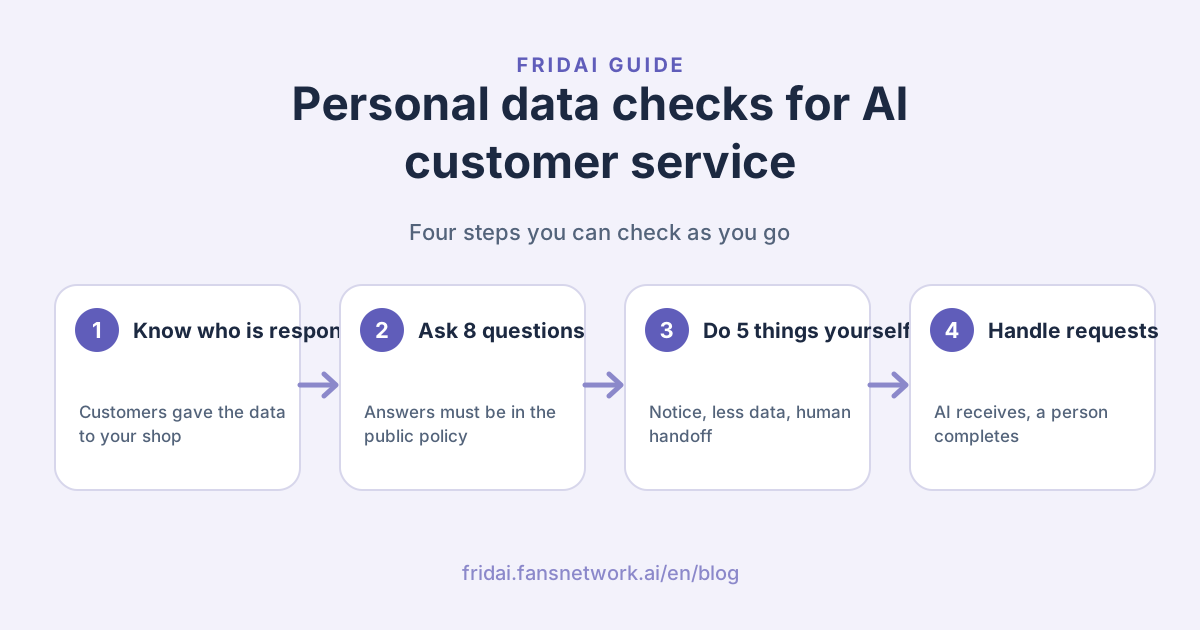
Customers leave more in a DM than you might expect: name, phone number, address, order number, sometimes a health condition or a family matter. Before an AI handles that, a shop owner needs to settle two things: how the vendor treats the data, and what the shop itself has to do. Below we cover who is responsible, what data AI customer service touches, the eight questions, FRIDAI's answers, and five things to do on your side.
Why shop owners ask about personal data first: the responsibility is yours
Customers hand their data to your shop, not to a software company. Under Article 4 of Taiwan's Personal Data Protection Act (PDPA), anyone commissioned to collect, process or use personal data is treated as the commissioning party within the scope of the Act. In plain words: when a vendor processes customer data for you, you are still the one answerable to the customer.
So choosing AI customer service is like choosing a payment or shipping provider: look first at how they keep what customers gave you. Four PDPA articles matter most to a shop:
| PDPA article | In plain words | What the shop does |
|---|---|---|
| Article 3 | Customers have five rights: to inquire or review, to get a copy, to supplement or correct, to ask you to stop collecting, processing or using, and to ask for deletion. These cannot be waived in advance | Have a contact point customers can find |
| Article 8 | When collecting data you must clearly tell the customer who you are, the purpose, the categories of data, the period, region, recipients and method of use, their rights, and what happens if they do not provide it | Put a notice on your site or in your welcome message |
| Article 11 | Keep data accurate; delete it or stop using it when the purpose ends or the period expires | Clear out old data on a schedule |
| Article 12 | When you learn data was stolen, altered, damaged, lost or leaked, notify the people affected | Ask the vendor in advance how they will notify you |
Turn those four articles into buying questions and you get the eight below.
What customer data does AI customer service touch?
List the data first and the questions follow. A typical shop's AI customer service handles these every day:
| Type | Common examples | Handling rule |
|---|---|---|
| Contact data | Name, phone, email, LINE or Instagram account | Keep only the fields needed to reply and serve |
| Conversation content | DMs, comments, images and voice messages | Use only to reply and to improve your own service |
| Transaction data | Order number, items, delivery address, booking time | Look it up, then do not paste it elsewhere |
| Payment data | Card number, verification code, online banking login | Never collected in chat; always completed on the payment page |
| Sensitive data | Medical records, health checks, national ID number | Do not ask for it in DMs; a person handles it through a formal channel |
A quick tip: read through your last 30 DMs and circle every phone number, address and order number a customer volunteered. Everything you circled is personal data your AI customer service handles daily.
8 questions to ask an AI customer service vendor
Each question comes with what a good answer looks like. Ask the vendor to point to the matching section of its privacy policy or terms.
1. What data do you collect?
A good answer lists categories: account and contact data, conversation and social data, transaction data, device and usage logs. The clearer the categories, the easier your own customer notice is to write.
2. Which regions is data stored in? Does it leave the country?
Almost every cloud service crosses borders. What matters is whether the vendor publicly lists the main regions where data is processed and updates the policy when they change. You quote this section when your notice states the "region of use".
3. Is customer data sold or given to unrelated third parties?
A good answer states in writing that personal data is not sold, lists the situations where it goes to a commissioned service provider, and says what protection that provider must apply.
4. Who can see customer conversations?
Ask about both sides: which vendor staff can reach the data and when; and whether each of your colleagues can sign in with their own account that you can withdraw when they leave.
5. How long is data kept? What happens after I cancel?
A good answer states the retention principle and whether data is deleted, no longer used, or de-identified when the period ends. This maps to PDPA Article 11.
6. Who handles a customer's request to inquire or delete?
The five rights in PDPA Article 3 cannot be waived in advance, so the vendor needs a clear contact and process. That is how you meet a customer's request.
7. How are we notified of a security incident?
Ask about the method and who is told. You need to know first so you can notify your own customers under PDPA Article 12.
8. When the AI connects to my shop or order system, can it change my data?
AI customer service often connects to an online shop to look up products and orders. The sound approach is to read only what it needs to answer and not modify the shop.
| Question | PDPA | What good looks like |
|---|---|---|
| What is collected | Article 8 | Listed by category in the privacy policy |
| Which regions | Article 8 | Main processing regions published |
| Is data sold | Article 4 | Stated in writing that it is not sold; providers apply protection |
| Who sees conversations | Article 4 | Access is controlled by permission |
| Retention | Article 11 | Deleted, no longer used or de-identified at the end |
| Inquiry and deletion | Article 3 | A contact and a process |
| Incidents | Article 12 | Handled and notified as the law requires |
| Shop integration | Article 4 | Reads data, does not modify |
How FRIDAI answers the 8 questions
FRIDAI's answers are in its public privacy policy and product pages, so you can check them without signing in:
| Question | What FRIDAI publishes |
|---|---|
| What is collected | Section 1 lists five categories: account and contact data, service and social data, transaction data, device and usage data, support and marketing interactions |
| Which regions | Section 5 lists the main processing regions: Taiwan, Singapore and the United States; the policy is updated when the main regions change |
| Is data sold | Section 4 states that personal data is not sold and that commissioned providers must apply appropriate protection |
| Who sees conversations | Sections 5 and 6 state access control, encryption and permission management |
| Retention | Section 3: the term of the account or contract, plus the period needed for legal duties, disputes and security; then deleted, no longer used or de-identified as the law requires |
| Inquiry and deletion | Section 8: you can ask to inquire or review, get a copy, supplement or correct, stop collection, processing or use, and delete, by emailing fridai@fansnetwork.ai |
| Incidents | Section 6: logging, backup and incident handling; incidents that must be notified by law are handled and notified accordingly |
| Shop integration | FRIDAI Chat product page: product and order lookups read data only and do not modify your shop |
The data collector is 智賦學習
Every FRIDAI Chat plan includes human collaboration and human review, and FRIDAI's official LINE account notifies you when a person is needed. When a customer sends something sensitive, one rule makes the AI stop and hand over; the wording is in the template below.
Five things to do on your side
The vendor covers half; the other half is yours. None of these five needs an engineer, and you can finish them today.
Step 1: Put your notice where customers can see it
In your website footer, LINE welcome message or an Instagram highlight, add a short notice: who you are, why you collect data, where it is used, and how to contact you.
Step 2: Collect only what the service needs
An order lookup needs the order number. A booking needs a name and phone. Write in your rules which fields the AI may ask for in each situation, and nothing else.
Step 3: Send sensitive matters to a person
Payment data, national ID numbers, health conditions, complaints and refunds: write them as rules. The AI does not ask for details and notifies a person. For handoff wording, see how to write AI customer service rules.
Step 4: Look after your own accounts
Turn on two-step verification for your dashboard, LINE Official Account and Meta business account. Each colleague uses their own login, and access is withdrawn the day they leave.
Step 5: Clear old data regularly
Review your customer list every quarter. Data whose purpose has ended (event sign-ups, completed orders past warranty) is deleted or no longer used, as PDPA Article 11 requires.
A reminder from the editor: however fast the AI replies, it should not collect a card number for you. Write "payment always happens on the payment page" into your rules and both you and your customers can relax.
Notice text and AI rules you can paste
Replace the square brackets with your shop's details.
Personal data notice (website footer or welcome message):
[Shop name] collects the name, contact details and conversation content
you provide in order to answer enquiries and handle orders and bookings,
and uses them during the service period in Taiwan and the regions where
our cloud providers operate. You can email [Email] at any time to
inquire about, correct or delete your data. Without the necessary data
we may be unable to complete your order or booking.
AI customer service rules (paste into brand knowledge or rules):
1. For order lookups ask only for the order number. Never ask for a national ID number, card number or verification code.
2. If a customer sends a card number, ID or medical record photo, ask them not to send more and notify a person.
3. Payment, refunds and complaints always go to a person. The AI does not promise an outcome.
4. When a customer asks to inquire about, correct or delete personal data, reply "Received. A team member will handle this within [days] days" and notify a person.
5. Never reply with order or personal details in public comments. Ask the customer to move to DM.When you write brand knowledge, prices, processes and opening hours are all fine to include. Customer lists and individual orders stay out of the knowledge base. For how to organise it, see how to write an AI customer service knowledge base.
How to handle a request to inquire or delete
When a customer makes a request, follow four steps:
| Step | What to do | Done when |
|---|---|---|
| 1. Receive | AI confirms receipt and notifies a person | The customer knows someone is on it |
| 2. Verify identity | A person confirms it is the customer through the original contact channel | Data does not go to the wrong person |
| 3. Act | Inquire, correct or delete in your own lists and systems; email the vendor when you need their help | Every place the data lives is covered |
| 4. Reply | Tell the customer the result and the date | A record of the handling exists |
Keep "received" and "completed" as separate replies: the AI does step 1, a person does the other three. For more questions that come up during setup, see the AI customer service implementation FAQ.
Summary: ask first, then hand customers to the AI

A quick note from FRIDAI
We went from the law to paste-ready templates today. Four things to take away:
- Customers gave their data to your shop. When a vendor processes it for you, the responsibility stays with you.
- Ask the eight questions before choosing a vendor, and find the answers in a public privacy policy.
- Do five things yourself: notice, collect less, send sensitive matters to a person, look after accounts, clear old data.
- When a customer asks to inquire or delete, the AI receives and a person completes, with separate replies for each.
Write your notice and your handoff rules, then give them to me for a test run and see how I handle your customers' data questions ☺️
Frequently asked questions
Can AI customer service leak customer data?
AI customer service handles the data customers provide in conversation, and how safe it is depends on the vendor's protection and the shop's own rules. Check that the privacy policy states access control, encryption and incident handling, and write a rule that sends sensitive matters to a person.
With AI customer service, is customer data stored abroad?
Cloud services usually process data in several regions. Section 5 of FRIDAI's privacy policy publicly lists the main processing regions as Taiwan, Singapore and the United States, which you can quote in your own notice.
Does a shop need to tell customers it uses AI customer service?
Yes. Under PDPA Article 8, when collecting personal data you must clearly state the collector's name, the purpose, the categories of data, the period, region, recipients and method of use, the person's rights, and the effect of not providing the data. A notice in your site footer or welcome message does this.
What if a customer asks to delete their conversation history?
Under PDPA Article 3 a customer can ask for personal data to be deleted. The shop verifies identity, acts in its own systems, and emails the vendor when it needs help; FRIDAI's contact is fridai@fansnetwork.ai.
Does FRIDAI sell customer data?
Section 4 of FRIDAI's privacy policy states that personal data is not sold. It is disclosed to commissioned providers only where needed to provide the service, follow instructions or meet legal requirements, and those providers must apply appropriate protection.
What if a customer sends a card number or ID in a DM?
Write it into your rules: the AI asks the customer not to send more and notifies a person. Payment always happens on the payment page, and full card data is handled directly by the payment provider.
If AI customer service connects to my online shop, can it change my orders?
When FRIDAI Chat connects to SHOPLINE, CYBERBIZ, WooCommerce, Ruten or Shopify to look up products and orders, it reads data only and does not modify your shop.
How FRIDAI can help
To let an AI take the repetitive enquiries while keeping personal data safe, start by connecting one DM channel to FRIDAI Chat, paste in the five rules above, and test with three real customer messages with the personal details removed. Confirm sensitive matters reach a person, then switch it on everywhere.
- AI customer service for DMs: FRIDAI Chat
- Privacy policy: FRIDAI privacy policy
- Plans and pricing: FRIDAI pricing
- Instagram: FRIDAI Instagram
- Threads: FRIDAI Threads
- Facebook: FRIDAI Facebook
Official sources
- Personal Data Protection Act (Laws & Regulations Database of the Republic of China): law.moj.gov.tw/
ENG/ LawClass/ LawAll.aspx?pcode=I0050021 - Preparatory Office of the Personal Data Protection Commission: www.pdpc.gov.tw/
- FRIDAI privacy policy: fridai.fansnetwork.ai/
en/ privacy-policy - FRIDAI Chat: fridai.fansnetwork.ai/
en/ fridai-chat